

The affiliate marketing industry is booming, with the global market projected to reach over $20 billion in 2026. This lucrative opportunity presents a tantalizing prospect for beginners seeking to generate passive income streams. Whether you’re a blogger, content creator, or simply looking to diversify your income, this comprehensive guide will equip you with the essential knowledge and strategies to start your affiliate marketing journey in 2026.
What Is Affiliate Marketing?
Affiliate marketing is a performance-based business model where individuals or companies (known as “affiliates”) earn commissions by promoting and selling other businesses’ products or services. As an affiliate, you earn a percentage of the sale or a fixed fee for every customer you refer to the merchant’s website. This makes it a powerful way to leverage other companies’ products and earn a slice of the profits without the hassle of creating your own products.

Affiliate marketing offers an attractive return on investment, with an average ROI of $12-$15 for every $1 spent, a staggering 1,200-1,500% ROAS (Return on Ad Spend). However, the industry is not without its challenges – a sobering 95% of beginners quit within the first year. To avoid becoming one of the statistics, it’s crucial to have a solid understanding of the process and a well-defined strategy.
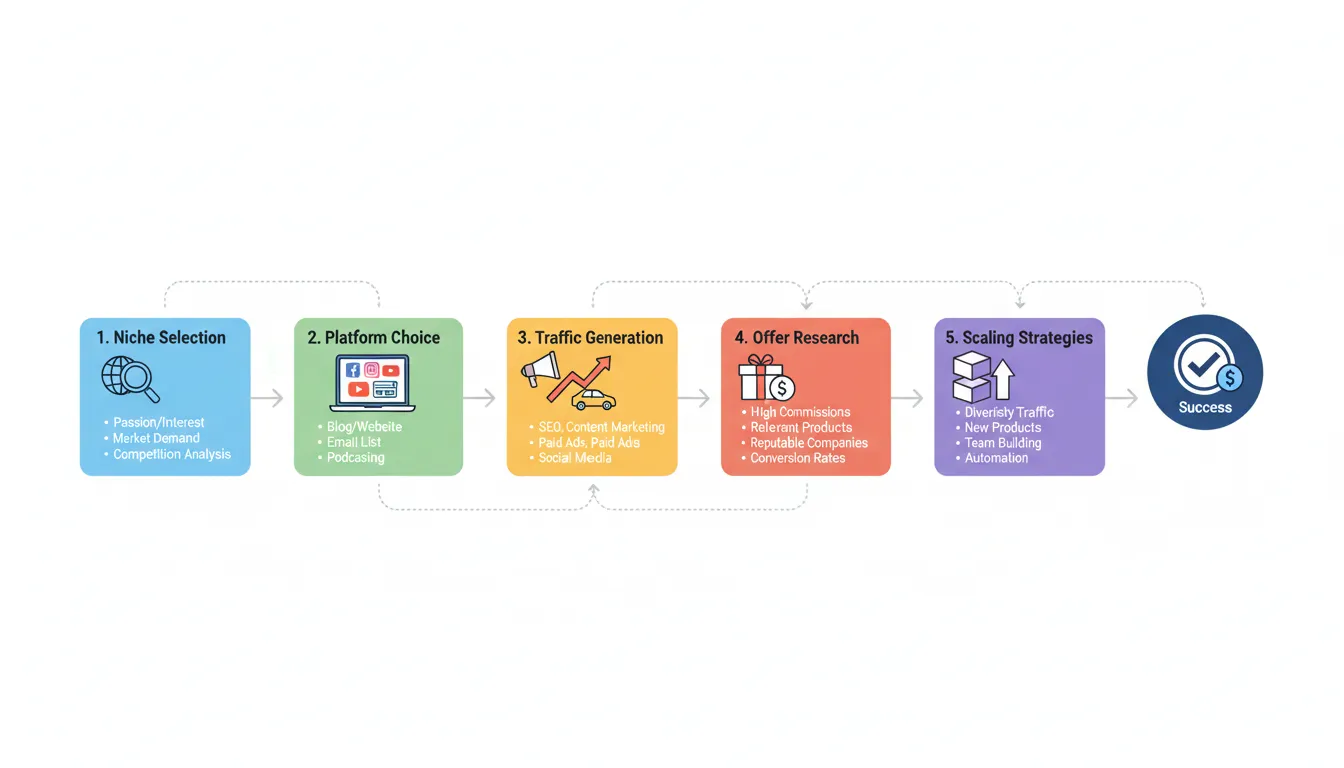
The 5-Step Beginner’s Roadmap to Affiliate Marketing Success
Embarking on your affiliate marketing journey can seem daunting, but with the right approach, you can build a thriving passive income stream. Here’s a step-by-step roadmap to guide you:
1. Choose Your Niche
The first and arguably most critical step is to select a profitable niche that aligns with your interests and expertise. This will not only make the content creation process more enjoyable but also increase your chances of success. Consider factors such as market demand, competition, and your ability to provide value to potential customers.
2. Pick Your Platform
Once you’ve identified your niche, it’s time to choose the right platform to host your affiliate marketing efforts. Popular options include blogs, YouTube channels, social media accounts, and even e-commerce websites. Each platform has its own unique advantages, so carefully evaluate which one best suits your goals and target audience.
3. Drive Targeted Traffic
Attracting the right audience to your affiliate marketing platform is crucial for generating sales. Leverage a variety of tactics, such as search engine optimization (SEO), content marketing, social media promotion, and paid advertising, to drive highly targeted traffic to your affiliate offers.

4. Research and Select Profitable Offers
Scouring the vast array of affiliate programs can be overwhelming, but it’s essential to identify the right offers that align with your niche and audience. Consider factors such as commission rates, product quality, market demand, and the reputation of the merchant. Building relationships with merchants can also open up exclusive opportunities.
5. Scale and Optimize
Once you’ve established a solid foundation, it’s time to scale your affiliate marketing efforts. Continuously test and optimize your strategies, explore new traffic sources, and diversify your affiliate offers to maximize your earning potential. Automation and outsourcing can also help you streamline your operations and free up more time for growth.

Top Affiliate Marketing Platforms and Programs
To jumpstart your affiliate marketing journey in 2026, consider these top-performing platforms and programs:
Platforms
– Awin: A leading global affiliate network with a vast range of merchants, particularly popular in the UK.
– CJ Affiliate: Formerly known as Commission Junction, this platform offers a comprehensive selection of affiliate programs across various industries.
– Skimlinks: A popular choice for content creators and publishers, offering automated affiliate link integration and monetization.
Programs
– E-learning: With an average monthly income of $15,551 for top earners, e-learning affiliates can tap into the rapidly growing online education market.
– Travel: Travel affiliates can earn an average of $13,847 per month, capitalizing on the post-pandemic resurgence of the tourism industry.
– Finance: The finance niche boasts some of the highest commissions, ranging from 20% to 70%, making it an attractive option for savvy affiliates.
Key Takeaways
Pros and Cons of Affiliate Marketing
Like any business model, affiliate marketing has its advantages and disadvantages. Let’s explore them in detail:
Pros:
– Passive income potential: With the right strategies, you can generate a steady stream of passive income from your affiliate marketing efforts.
– Low startup costs: Compared to launching your own product or service, affiliate marketing has minimal upfront costs, making it an accessible option for beginners.
– Flexible and scalable: Affiliate marketing allows you to work on your own schedule and scale your operations as your expertise and resources grow.
– Diverse income streams: By promoting multiple affiliate programs, you can diversify your income sources and reduce financial risk.
Cons:
– Saturated market: The affiliate marketing industry is highly competitive, with the top 10% of affiliates driving 90% of all revenue.
– Dependence on merchants: As an affiliate, you’re reliant on the merchant’s products, policies, and performance, which can be outside your control.
– Potential for low commissions: Certain affiliate programs may offer relatively low commission rates, requiring you to drive a high volume of sales to earn a decent income.
– Learning curve: Mastering the technical and marketing aspects of affiliate marketing can take time and effort, especially for beginners.

Real-World Examples and Case Studies
To provide a better understanding of the affiliate marketing landscape, let’s examine some real-world examples and case studies:
Niche Blogger Earns $10,000+ per Month
Jane, a travel blogger, has built a thriving affiliate marketing business by focusing on her niche. By promoting high-commission travel-related products and services, she has been able to earn over $10,000 per month in passive income, allowing her to quit her full-time job and pursue her passion for travel.
YouTube Influencer Earns $15,000 per Month
John, a popular YouTuber in the fitness niche, has leveraged his large following to drive significant affiliate sales. By strategically placing affiliate links in his video descriptions and mentioning products within his content, he has been able to earn an average of $15,000 per month from his affiliate marketing efforts.
E-commerce Store Boosts Revenue by 30% with Affiliates
Sarah, the owner of an online home decor store, decided to launch an affiliate program to expand her customer base. By recruiting a network of influential bloggers and social media influencers to promote her products, she was able to increase her store’s revenue by 30% within the first six months.
Frequently Asked Questions
1. How much can I earn as an affiliate marketer?
The earning potential in affiliate marketing varies widely, but the top earners can make impressive incomes. The average monthly earnings for top affiliates are: e-learning ($15,551), travel ($13,847), and finance ($9,296). However, it’s important to remember that success in affiliate marketing requires dedication, strategy, and a willingness to learn and adapt.
2. What are the best affiliate marketing niches?
Some of the most lucrative affiliate marketing niches include e-learning, travel, finance, SaaS (Software as a Service), and health/wellness. These industries typically offer high commission rates (20-70%) and have strong demand from consumers.
3. How do I choose the right affiliate programs to promote?
When selecting affiliate programs, consider factors such as commission rates, product quality, market demand, and the reputation of the merchant. It’s also important to choose programs that align with your niche and target audience to maximize your chances of success.
4. How much traffic do I need to start earning from affiliate marketing?
The amount of traffic required to start earning from affiliate marketing can vary greatly depending on your niche, the quality of your content, and the competitiveness of your offers. As a general rule, aim for at least 1,000 monthly unique visitors to your platform before expecting to generate significant affiliate revenue.
5. How can I drive more traffic to my affiliate marketing efforts?
Effective traffic-driving strategies for affiliate marketing include search engine optimization (SEO), content marketing, social media promotion, email marketing, and paid advertising. Continuously testing and optimizing your tactics is key to driving high-quality, targeted traffic to your affiliate offers.
Conclusion: Start Your Affiliate Marketing Journey in 2026
The affiliate marketing industry is poised for continued growth, with the global market projected to exceed $20 billion in 2026. By following the step-by-step roadmap outlined in this guide, you can position yourself for success and start generating passive income through affiliate marketing.
Remember, the key to long-term affiliate marketing success lies in choosing the right niche, selecting the most profitable offers, driving targeted traffic, and continuously optimizing your strategies. With dedication, persistence, and a willingness to learn, you can unlock the power of affiliate marketing and create a thriving passive income stream in 2026 and beyond.
Ready to embark on your affiliate marketing journey? [Start now](https://mykitchenincome.com/best-affiliate-programs-to-join-in-2024/) and take the first step towards your financial freedom.
Advertisement
