

The gig economy isn’t waiting for your diploma. While your classmates debate internship offers, thousands of students worldwide are earning $2,000-$5,000 monthly from freelance work. Here’s the reality: the digital landscape has shifted dramatically. Traditional entry-level positions now compete with remote freelance opportunities that offer better pay, flexible schedules, and genuine skill-building. According to recent data, the India digital ad market alone continues to grow into 2027, with specialized freelancers commanding premium rates. This isn’t just about pocket money—it’s about building a sustainable income stream while still in school.
The secret? High-RPM niches outperform entertainment-based work by a significant margin. A student who masters technical writing or UI/UX design earns 3-4 times more than someone doing generic content writing. The skills gap is real. Employers desperately need specialists in niche areas, and they’ll pay substantially more for proven expertise. The question isn’t whether you *can* earn money as a student freelancer—it’s which skill will give you the highest return on your learning investment.
This guide breaks down 10 legitimate high-paying freelance skills you can master part-time, exactly how much each pays, and the realistic timeline to start earning.
What High-Paying Freelance Skills Are (And Why They Matter for Students)
Freelance skills aren’t just hobbies you monetize—they’re valuable services that solve specific problems for businesses and entrepreneurs. A “high-paying” skill typically earns $50+ per hour or $100+ per project, and the demand consistently outpaces supply.
The distinction matters. Generic freelance work (basic writing, data entry, virtual assistance) pays $15-25/hour because thousands of people can do it. High-paying work requires specialized knowledge—often built over 3-6 months of focused learning—but opens doors to recurring clients, retainers, and premium rates.
For students specifically, this timing advantage is crucial. You have something professionals lack: time to learn without the pressure of replacing your primary income. A developer with a full-time job can’t invest 200 hours learning a new framework. You can. This creates your competitive edge.
The freelance economy has also matured. Platforms like Upwork, Fiverr, and specialized marketplaces now have transparent rating systems that protect clients. This means building a portfolio and reputation is genuinely possible—and profitable—within 6-12 months.
The India digital ad market growth specifically benefits freelancers in SEO, content marketing, and digital advertising niches. These sectors are hiring aggressively and willing to pay premium rates to specialists who understand the Indian market specifically.
The Top 5 Highest-Paying Freelance Skills Ranked by Rate
Before diving into the full list, here’s what the data shows:
1. UI/UX Design: $80-150/hour
– Demand: Extremely high
– Learning curve: Moderate (3-4 months to proficiency)
– Why it pays well: Every startup needs apps and websites; good designers are rare
– Tool cost: $20-50/month
2. Technical Writing: $60-120/hour
– Demand: High and growing
– Learning curve: Low (1-2 months if you can write clearly)
– Why it pays well: SaaS companies desperately need documentation specialists
– Tool cost: Minimal ($0-10/month)
3. Full-Stack Web Development: $75-200/hour
– Demand: Extremely high
– Learning curve: High (6-12 months of intensive study)
– Why it pays well: Every business needs websites; good developers are expensive
– Tool cost: Free to $50/month
4. Video Editing & Motion Graphics: $70-150/hour
– Demand: High (content creators everywhere)
– Learning curve: Moderate (2-4 months)
– Why it pays well: Video content is booming; quality editors are scarce
– Tool cost: $20-55/month
5. SEO Specialist: $75-175/hour
– Demand: High (growing with India’s digital ad market expansion)
– Learning curve: Moderate (2-3 months)
– Why it pays well: Results are measurable; clients see ROI directly
– Tool cost: $10-100/month depending on tools

High-Paying Freelance Skill #1: UI/UX Design
User Interface and User Experience design is arguably the most accessible high-paying skill for students without a technical background. Companies invest heavily in how their products look and function—and good design directly impacts revenue.
Why this skill pays so well: Every company—from startups to Fortune 500s—needs digital products. Designers who understand both aesthetics and user psychology command premium rates. The skill set is also relatively rare because it requires both art sensibility *and* strategic thinking.
What you actually do:
– Create wireframes (blueprints of how apps/websites work)
– Design user interfaces (buttons, navigation, forms)
– Conduct user research to understand how people interact with products
– Test designs and iterate based on feedback
– Create design systems that companies use long-term
How to get started:
1. Learn Figma (most in-demand tool; free version available)
2. Complete a 4-week online course (Interaction Design Foundation, Nielsen Norman Group)
3. Redesign 5 existing apps or websites as portfolio pieces
4. Build a professional portfolio on Dribbble or Behance
5. Apply for design projects on platforms like Toptal or Dribbble Jobs
Realistic timeline: 3-4 months to get your first paid client; 6 months to command $80+ per hour.
Real project example: A student redesigned a local e-commerce site’s checkout flow, reducing cart abandonment by 12%. The business paid $1,200 for the project. Time investment: 40 hours. Hourly rate: $30/hour initially, but this led to a $1,500/month retainer redesigning their product quarterly.
Tools you need:
– Figma ($0-12/month)
– Adobe XD or Sketch (alternative options)
– Prototyping tool (InVision or Figma)
– Portfolio site (Webflow or custom domain)
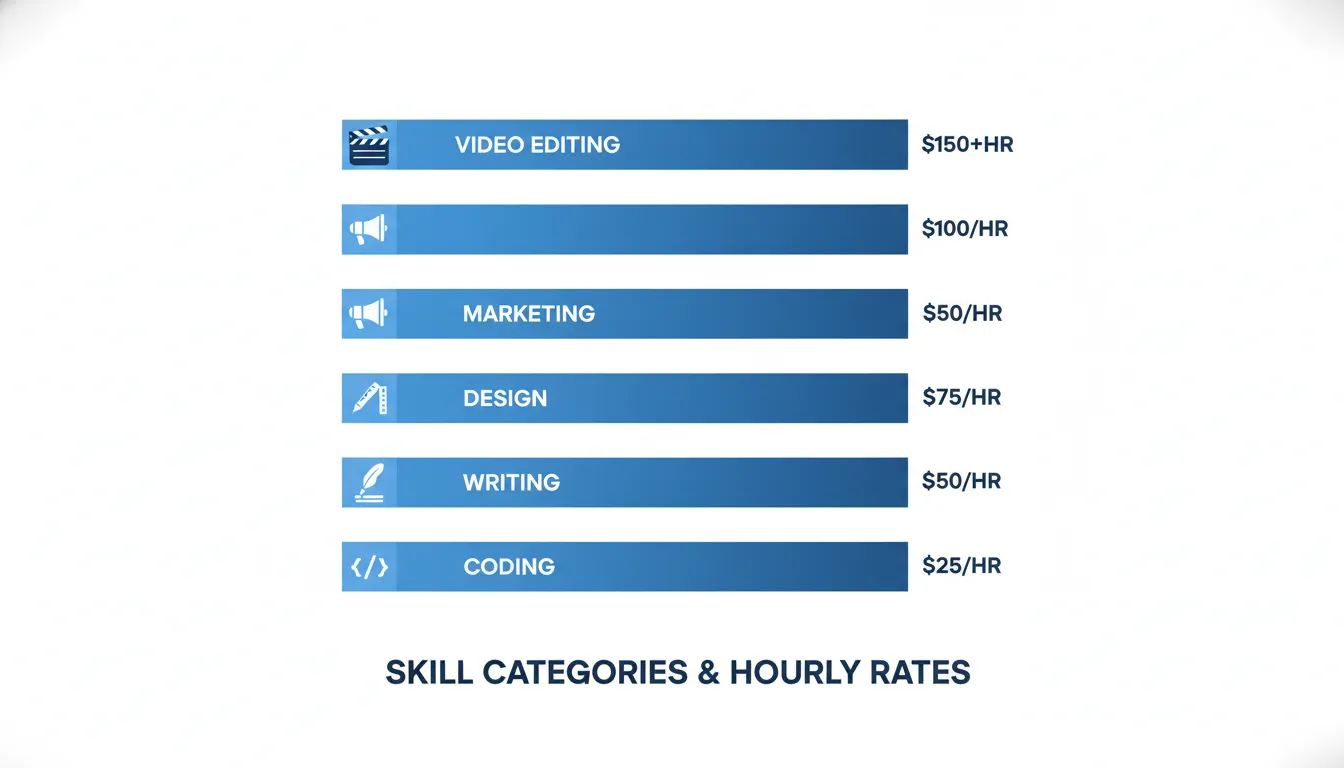
Key Takeaways
High-Paying Freelance Skill #2: Technical Writing
This is the most underrated high-paying skill. Most people assume “writing” means journalism or creative work. Technical writing is completely different—and much more profitable.
Technical writers create documentation, guides, and educational content for software products, APIs, and complex tools. Think: user manuals that actually make sense, API documentation that developers trust, onboarding guides that reduce support tickets.
Why companies pay so much: Poor documentation costs money. When users can’t figure out how to use a product, support teams waste time answering basic questions. A technical writer who can explain complex topics clearly saves companies thousands in support costs.
What you actually do:
– Read technical specifications and understand them deeply
– Write clear, concise documentation for non-technical users
– Create step-by-step guides with screenshots
– Maintain wikis and knowledge bases
– Edit and improve existing documentation
– Sometimes record video walkthroughs
How to get started:
1. Master one tool deeply (Confluence, GitHub, or WordPress)
2. Write 3 detailed guides about technical topics you know
3. Create a portfolio on Medium or personal website
4. Take a short technical writing course (Google’s Technical Writing Course is free)
5. Apply to roles on Write the Docs job board or Upwork
Realistic timeline: 6-8 weeks to your first client; 3-4 months to reach $60+ per hour.
Real project example: A student with marketing knowledge became the technical writer for a SaaS tool. She documented API endpoints and created user guides. First project: $800 for 20 hours of work. Within 6 months, she negotiated a $1,800/month retainer working 10 hours weekly.
Why it’s perfect for students: You don’t need a technical background—you need the ability to learn and explain clearly. This skill transfers anywhere.

High-Paying Freelance Skill #3: Full-Stack Web Development
This is the heavyweight champion of freelance income. A skilled full-stack developer can charge $100-200+ per hour because they can build entire products independently.
Full-stack development means you can build both the frontend (what users see) and backend (servers, databases, logic). This makes you incredibly valuable—you’re essentially a complete development team.
Why the demand is insane: Every business needs a website. Every app needs a backend. The supply of competent developers is nowhere near demand, especially for freelancers who understand business needs.
What you actually do:
– Build responsive websites that work on all devices
– Create web applications with real functionality
– Set up databases to store and retrieve data
– Integrate payment systems, authentication, APIs
– Deploy projects to production
– Maintain and update code
How to get started:
1. Choose a learning path: React/Node.js or Python/Django (both pay equally well)
2. Complete a comprehensive bootcamp or course (100-150 hours minimum)
3. Build 3-5 portfolio projects: a blog, e-commerce site, SaaS tool
4. Practice on coding challenges (LeetCode, HackerRank)
5. Apply for small projects on Upwork or specialized platforms like Gun.io
Realistic timeline: 6-12 months to competency; 9-15 months to command $75+ per hour consistently.
Real project example: A computer science student learned React and Node.js in summer break. By fall, he built a task management app portfolio project. His first Upwork gig: $1,500 to build a landing page with a contact form and email integration (15 hours). After 8 more projects, he was getting $3,000-4,000 per project and turning down work.
Cost reality: Development tools are mostly free. The cost is time. You’ll spend 150-200 hours learning before earning.
Why students have an advantage: You likely have Computer Science classes that teach programming concepts. This accelerates the learning curve significantly.
High-Paying Freelance Skill #4: SEO Specialization
The India digital ad market continues to grow in 2027, and SEO remains one of the most profitable marketing skills. Here’s why: results are measurable. A company can see exactly what they got for their money.
SEO specialists help websites rank higher on Google. When done right, organic traffic brings customers at a fraction of paid advertising cost. Businesses pay premium rates for proven results.
Why this specifically pays well: SEO is undervalued by most freelancers. Generic “SEO services” from random people hurt more than help. Companies are desperate for specialists who understand their niche and can deliver results.
What you actually do:
– Research keywords companies should target
– Audit websites for technical SEO problems
– Create content strategies
– Optimize on-page elements (titles, meta descriptions, headers)
– Build quality backlinks
– Track rankings and ROI
– Provide monthly reports
How to get started:
1. Learn SEO fundamentals (free on Moz, HubSpot, Ahrefs)
2. Choose a niche (e-commerce SEO, local SEO, B2B SaaS SEO)
3. Document a case study: take a website from rank 50 to rank 10 for a keyword
4. Master one tool: SEMrush, Ahrefs, or Moz
5. Pitch local businesses or small SaaS companies directly
Realistic timeline: 2-3 months to understand SEO; 4-6 months to secure first client; 6-9 months to reach $75+ per hour.
Real project example: A business student took on a small local electrician’s website. The site ranked for nothing. She:
– Researched 30 local keywords
– Created 12 location-specific pages
– Got 2 quality backlinks from local directories
– In 6 months: ranked on first page for “emergency electrician [city]” and similar keywords
The electrician went from 2 calls/week to 12 calls/week from organic search. He paid her $2,500 initially and then $1,000/month ongoing. That’s $12,000+ annual income from one local business.
Why this works in 2024-2025: India’s digital ad market growth means more businesses competing for attention. SEO becomes increasingly valuable.
High-Paying Freelance Skill #5: Video Editing & Motion Graphics
Video content dominates. YouTube, TikTok, Instagram Reels, LinkedIn—every platform prioritizes video. Content creators everywhere need editors who can turn raw footage into polished final products.
Video editing pays well because: (1) it requires expensive software and hardware, (2) it takes genuine skill to make content engaging, (3) supply of quality editors can’t keep up with demand.
What you actually do:
– Cut and arrange footage into coherent sequences
– Add transitions, effects, and color grading
– Sync audio and add background music
– Create titles and lower thirds
– Animate graphics and text
– Export in multiple formats for different platforms
– Provide quick turnaround (24-48 hours typical)
How to get started:
1. Learn Adobe Premiere Pro or DaVinci Resolve (free version available for Resolve)
2. Complete a 4-week video editing course
3. Edit 10 short videos (YouTube, TikTok, testimonials)
4. Build portfolio reel showing your best edits
5. Target YouTubers, course creators, and agencies with pitch
Realistic timeline: 4-6 weeks to competency; 2-3 months to first paid client; 4-6 months to $70+ per hour.
Real project example: A student editor found a course creator on YouTube with 50K subscribers who needed video editing. She offered to edit 3 videos at a discount ($150 each) to build the relationship. The creator loved her work and hired her for $400/video (8-hour turnaround). At 2-3 videos weekly, that’s $3,200-4,800 monthly income.
Tools: Adobe Premiere Pro ($20.99/month) or DaVinci Resolve (free). Honestly, start with free versions.
Additional High-Paying Skills Worth Considering
Beyond the top 5, here are 5 more valuable skills trending upward:
#6: Content Strategy & Copywriting
– Rate: $50-100/hour
– Why: Content drives everything in digital marketing
– Learning time: 2-3 months
– Best for: People with strong writing skills
#7: Data Analysis & Visualization
– Rate: $60-130/hour
– Why: Businesses have massive data but can’t interpret it
– Learning time: 3-4 months (Excel, SQL, Tableau)
– Best for: Math-oriented students
#8: Email Marketing Automation
– Rate: $55-110/hour
– Why: Email generates $36+ ROI per $1 spent
– Learning time: 2-3 months
– Best for: Detail-oriented, strategic thinkers
#9: Graphic Design (Specialized)
– Rate: $45-100/hour
– Why: Every brand needs visual assets
– Learning time: 3-5 months
– Best for: Creative students with Figma/Adobe knowledge
#10: Social Media Management (Specialized)
– Rate: $40-90/hour for niche expertise
– Why: High-RPM niches (B2B, SaaS, finance) pay significantly more
– Learning time: 1-2 months
– Best for: Students with existing social media influence
Tools, Resources, and Cost Breakdown
Here’s what you need to invest to start each skill:
| Skill | Software Costs | Learning Resources | Total Initial Investment | Time to First $ |
Advertisement
