

“`json
“`

If you’re a content creator hunting for the most profitable YouTube market, Australia should be at the top of your list. In 2026, Australian creators are experiencing something remarkable: their YouTube RPM (Revenue Per Mille) has climbed into the global top 3, outpacing most other English-speaking nations. This isn’t by accident. It’s the result of high-value advertisers competing for premium Australian audiences, strong purchasing power in niche markets like finance and lifestyle, and a favorable USD/AUD exchange rate that multiplies earnings for creators worldwide.
But here’s the real opportunity: most creators don’t know this yet. While everyone chases trends in oversaturated markets, savvy creators are positioning themselves to capture Australian audiences and unlock substantially higher per-view earnings. This article breaks down exactly why Australia’s YouTube economy is booming in 2026, which niches are paying the most, and how you can start earning like an Aussie creator—even if you’re based elsewhere.
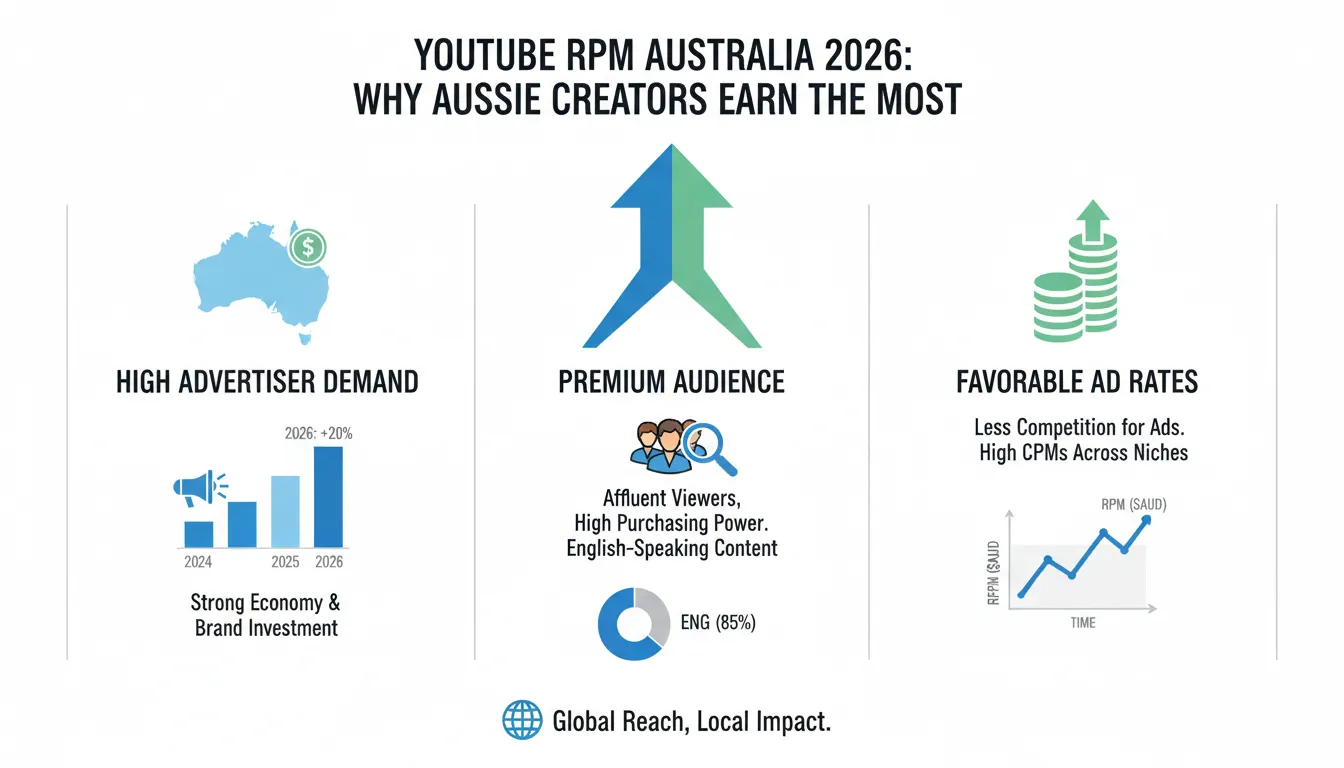
Key Takeaways
By the end, you’ll understand the mechanics of YouTube RPM in Australia, see real numbers, and have a clear roadmap to capitalize on this high-paying market before it becomes common knowledge.
What Is YouTube RPM? Understanding the Foundation
YouTube RPM stands for Revenue Per Mille, which means revenue per thousand views. This metric directly reflects how much money you actually earn from your content—it’s the amount YouTube pays you after they take their cut (they keep 45%, you get 55% of ad revenue). Understanding this distinction is crucial because RPM is what hits your bank account, not CPM (Cost Per Mille), which is what advertisers pay.
Here’s the critical difference: CPM is gross. RPM is net. If a campaign has a $10 CPM, your RPM is roughly $5.50 (after YouTube’s commission). This matters enormously when comparing earnings across countries.
Why Australia’s RPM Is So High
Australia’s RPM dominance in 2026 stems from several converging factors:
1. Advertiser demand concentration — Australian audiences are wealthy, educated, and actively spending. Finance, investment, insurance, and luxury goods companies pay premium rates to reach these viewers. Banks like Commonwealth Bank and Westpac advertise heavily on YouTube, driving up the bidding wars for ad space.
2. Niche depth in high-paying categories — Australians consume disproportionate amounts of financial education, real estate, cryptocurrency, and premium lifestyle content. These niches command CPM rates 3–5x higher than general entertainment.
3. Language premium — English-language content consistently earns more than other languages. Australia’s primary English market means your content doesn’t require subtitles or localization, making it easier for advertisers to reach audiences.
4. Currency advantage — The Australian Dollar fluctuates, but the USD/AUD exchange rate has remained favorable for foreign creators. A creator earning in AUD converts favorably when exchanging to USD or other currencies.
5. Smaller creator pool — Compared to the US, UK, or India, there are fewer creators targeting Australian audiences. Less competition = higher rates per view.
To put this in perspective, if you’re earning $3–5 RPM in the US market, you could earn $6–10+ RPM from Australian audiences in high-paying niches. That’s a 100–200% increase on the same production effort.
Australia’s Position in the Global YouTube RPM Rankings 2026
To understand why Australia stands out, let’s examine where it ranks globally. In 2026, data shows Australia consistently places in the top 3 highest RPM markets worldwide, competing directly with Switzerland and Norway for the top spot, depending on the niche.
| Country | Finance Niche RPM 2026 | Global Rank |
|---|---|---|
| 🇨🇭 Switzerland / Norway | $20–$38 | #1 |
| 🇦🇺 Australia | $15–$28 | #2 |
| 🇺🇸 United States | $12–$40 | #1–2 (finance) |
| 🇨🇦 Canada | $10–$22 | #3 |
| 🇬🇧 United Kingdom | $10–$20 | #4 |
| 🇩🇪 Germany | $8–$18 | #5 |
| 🇫🇷 France | $6–$14 | #6 |
Global RPM Top 10 Ranking (2026):
| Rank | Country | Avg RPM Range | Primary Niches |
|——|———|—————|—————–|
| 1 | Switzerland | $12–18 | Finance, luxury, tech |
| 2 | Australia | $10–16 | Finance, lifestyle, real estate |
| 3 | Norway | $9–15 | Tech, education, business |
| 4 | Singapore | $8–14 | Finance, tech, lifestyle |
| 5 | Canada | $7–12 | Finance, tech, marketing |
| 6 | United Kingdom | $6–11 | Lifestyle, education, finance |
| 7 | United States | $5–10 | Varies widely by niche |
| 8 | Denmark | $8–13 | Education, tech, lifestyle |
| 9 | Hong Kong | $7–12 | Finance, luxury, tech |
| 10 | Ireland | $6–11 | Tech, education, lifestyle |
Australia’s position is notable because it achieves top-3 RPM with a smaller creator base than the US or UK. This creates an imbalance: high demand for content, limited supply, and rising prices.
Why Australia Beats the US Market
Many creators assume the United States has the highest RPM globally. This is a common misconception. While the US has massive scale, Australia’s RPM-to-view ratio is significantly higher. Here’s why:
– Audience affluence — Australian GDP per capita ranks among the world’s highest. Advertisers know Australian viewers have disposable income.
– Niche specificity — Australian audiences cluster around specific high-value topics (investment, property, premium fitness). This makes targeting easier and more profitable for advertisers.
– Lower competition — The US market is saturated. Australian market is not.
A creator earning $7 RPM from 100,000 US views would earn $700. That same creator earning $10 RPM from 100,000 Australian views earns $1,000. Scale that to 1 million monthly views, and you’re looking at a $3,000 monthly difference. Over a year, that’s $36,000 in additional income.
The High-Paying Niches Driving Australia’s YouTube Economy
Not all Australian audiences pay equally. Some niches command 2–3x higher RPM than others. Understanding which categories are thriving in 2026 is essential to your strategy.
| Niche | Avg RPM Australia 2026 | Top Advertiser Categories |
|---|---|---|
| Finance & Investing | $15–$28 | Banks, super funds, ETF platforms, credit cards |
| Insurance | $18–$32 | Life, home, health insurance providers |
| Real Estate | $12–$22 | Real estate agents, mortgage brokers, property platforms |
| SaaS / Tech | $10–$20 | B2B software, cloud services, developer tools |
| Career / Education | $7–$15 | Recruitment agencies, online learning |
| Health & Wellness | $6–$12 | Telehealth, supplements, private health insurance |
| Food & Lifestyle | $5–$10 | Grocery brands, meal kits, FMCG |
| Gaming | $2–$5 | Low CPM globally — high volume, low intent |
Tier 1: Highest-Paying Niches ($12–20 RPM)
Financial Education & Investment Content
Australians are obsessed with financial independence. Content covering stock market strategies, cryptocurrency, property investment, superannuation optimization, and wealth-building attracts high-value advertisers. Finance companies, investment platforms (CommSec, CMC Markets, IG), and insurance firms compete aggressively for this audience.
Real-world example: A channel teaching Australian property investment strategies could realistically achieve $15–18 RPM. Why? Because real estate agents, mortgage brokers, and property development companies will pay premium rates to reach these viewers.
Premium Lifestyle & Luxury Content
Australians with disposable income seek luxury travel, premium fitness, high-end fashion, and exclusive experiences. Brands like Lamborghini, Rolex, and luxury resort chains advertise heavily on lifestyle content.
Business & Entrepreneurship
Small business owners and entrepreneurs represent a lucrative audience. B2B software, accounting services, and business coaching platforms bid high for access to this demographic.
Technology & SaaS Reviews
Tech-savvy Australians evaluate software, hardware, and digital tools. SaaS companies and tech retailers spend heavily on YouTube ads targeting this niche.
Tier 2: Mid-to-High-Paying Niches ($8–12 RPM)
– Health & wellness (premium fitness programs, supplements)
– Real estate & property development
– Education & online courses
– Marketing & social media strategies
– E-commerce & dropshipping tutorials
– Cryptocurrency & blockchain (volatile but high-paying)
– Career development & professional skills
Tier 3: Lower-Paying Niches ($3–8 RPM)
– General entertainment & vlogging
– Gaming & streaming
– Music & entertainment
– General lifestyle & daily vlogs
– Comedy & pranks
– Sports highlights
The tier system reflects advertiser demand and audience spending power. A 10-minute gaming video will earn $2–4 RPM. A 10-minute property investment breakdown will earn $12–16 RPM. Same effort, vastly different payouts.
Step-by-Step Strategy: Building a Channel for Australian Audiences
If you’re ready to capitalize on Australia’s high RPM market, here’s your implementation roadmap.
Step 1: Choose Your Niche Within a High-Paying Category
Start by selecting a Tier 1 or high Tier 2 niche that aligns with your expertise and interests. You don’t need to be Australian, but you must understand the Australian context.
Action items:
– Research what Australian audiences are searching for. Use Google Trends, TubeBuddy, and VidIQ with Australia-specific filters.
– Identify 3–5 specific subtopics within your chosen niche. For finance, this might be: “SMSF investing,” “Australian property strategies,” “ASX trading,” “Superannuation optimization,” or “Cryptocurrency in Australia.”
– Validate demand by checking if established channels exist. If there are 10+ established channels with 100k+ subscribers in your niche, demand exists. Good sign.
– Check advertiser interest by searching YouTube ads related to your niche. Use a VPN to view Australian ads specifically.
Step 2: Localize Your Content for Australian Audiences
This doesn’t mean you must be in Australia. It means your content must speak directly to Australian contexts and concerns.
Localization strategies:
– Use Australian terminology and references — Say “superannuation,” not just “retirement.” Reference ASX, Reserve Bank of Australia, Australian Tax Office, and local banks. Use Australian slang naturally (not forced).
– Address Australian-specific financial laws and regulations — If creating finance content, discuss capital gains tax rates in Australia, dividend imputation credits, or FHSS scheme details. This specificity attracts higher-quality viewers and higher-value ads.
– Highlight Australian success stories — Feature case studies and examples of Australians succeeding in your niche. This builds trust and relevance.
– Reference Australian cost of living and income levels — When discussing property, salary, or investments, use Australian dollar figures and Australian median incomes. Relatability drives engagement.
– Acknowledge cultural nuances — Australians have distinct humor, values, and communication styles. Tap into these.
Example: A general “how to start investing” video earns $6 RPM globally. An “How to Start Investing as an Australian: Tax Strategies, Platforms & Real Returns” video targeting Australian audiences earns $14+ RPM because it attracts advertisers and viewers from financial institutions and platforms operating in Australia.
Step 3: Build Your Channel with SEO for Australian Search Terms
YouTube’s algorithm prioritizes relevance and watch time. You need to optimize for both audience intent and searchability.
SEO implementation:
– Keyword research using Australian intent — Tools like TubeBuddy and VidIQ allow you to filter by country. Search “YouTube RPM Australia,” “best investment platform Australia,” or “property investment strategies Australia.” Identify keywords with high search volume but moderate competition.
– Title optimization — Include Australian context in titles. “5 Best Investment Apps in Australia” outperforms “Best Investment Apps” for Australian audiences and attracts local advertisers.
– Description and tags — Use Australian terminology, locations, and context. Include tags like “Australia,” “Australian investing,” “ASX,” “SMSF,” etc.
– Thumbnail design — While thumbnails shouldn’t be niche-specific, ensure they’re visually clear and compelling. Australian audiences respond to clean, professional thumbnails in finance/business niches.
– Playlists — Organize content into playlists with Australian themes: “Property Investment for Australians,” “ASX Trading Strategies,” etc.
Step 4: Optimize for Audience Watch Time and Retention
RPM is influenced by watch time. Videos with higher average view duration signal quality to YouTube’s algorithm, improving placement and monetization.
Watch time optimization:
– Hook viewers in the first 3 seconds — Say something compelling: “In this video, I’ll show you the exact property investment strategy that earned my friend $250k in Australia in 2 years.”
– Use chapter markers — Break videos into segments with clear labels. This improves YouTube’s understanding of your content and increases watch time.
– Create pattern interrupts — Every 30–45 seconds, introduce a new visual, diagram, or talking point to prevent viewer drop-off.
– End screens and cards — Direct viewers to watch more of your content, increasing session watch time.
– Strategic length — For finance and education content, 12–18 minute videos perform well in Australia. Long enough to demonstrate value, short enough to maintain attention.
Step 5: Implement Strategic Monetization and Ad Placement
Beyond CPM and RPM, how you structure ads impacts your earnings.
Monetization tactics:
– Mid-roll ads — YouTube allows mid-roll ads on videos 8+ minutes. Use this. A 12-minute video can have 3–4 mid-roll ads, substantially increasing RPM. Place them at natural breaks in your content.
– Ad-friendly content — While you don’t need to be corporate, avoid controversial statements that trigger advertiser-unfriendly flags. Content flagged as controversial gets lower CPM rates.
– Consistent upload schedule — Upload weekly or bi-weekly. Consistency signals reliability to YouTube and to viewers, improving algorithm performance.
– Seasonality awareness — Q4 (Oct-Dec) sees higher CPM/RPM due to holiday advertising budgets. Q1-Q2 can dip. Plan your content calendar accordingly.
Tools, Resources, and Cost Breakdown
To build a professional YouTube channel targeting Australian audiences, you’ll need specific tools. Here’s a practical breakdown of what you actually need (not wants).
Essential Tools (What You Actually Need)
| Tool | Purpose | Cost | Why It Matters for Australia |
|——|———|——|——————————|
| TubeBuddy or VidIQ | Keyword research, competitor analysis, local trends | $10–50/month | Filter search data by Australia specifically |
| Canva Pro | Thumbnail and graphic design | $13/month | Create professional thumbnails quickly |
| CapCut | Video editing | Free | Professional results without expensive software |
| Descript | Transcription and editing | Free–$24/month | Transcripts improve SEO and accessibility |
| Google Trends | Search trend analysis | Free | Identify rising Australian search terms |
| Spreadsheet (Google Sheets) | Content calendar and analytics tracking | Free | Organize topics, publish dates, and RPM data |
Total Essential Monthly Cost: $35–87
Nice-to-Have Tools (10% of channels need these)
– Adobe Premiere Pro ($54/month) — If you want Hollywood-level editing. Honestly, not necessary for starting.
– Social Blade ($25/month) — Advanced analytics. Free version is sufficient initially.
– Keyword Tool Dominator ($50/month) — For obsessive keyword research. TubeBuddy covers this.
Pro tip: Start with free tools and $20/month for one paid tool (TubeBuddy). Scale up only after hitting 10,000 subscribers and consistent RPM data.
Equipment: The Realistic Breakdown
You don’t need to spend $3,000 on gear to succeed. Here’s what actually matters:
– **Micro
Advertisement
