
The average YouTube creator dreams of passive income. But the numbers tell a different story.
Most aspiring YouTubers in Canada are publishing content into a void. They’re not failing because they lack talent. They’re failing because they don’t understand where the money actually is.
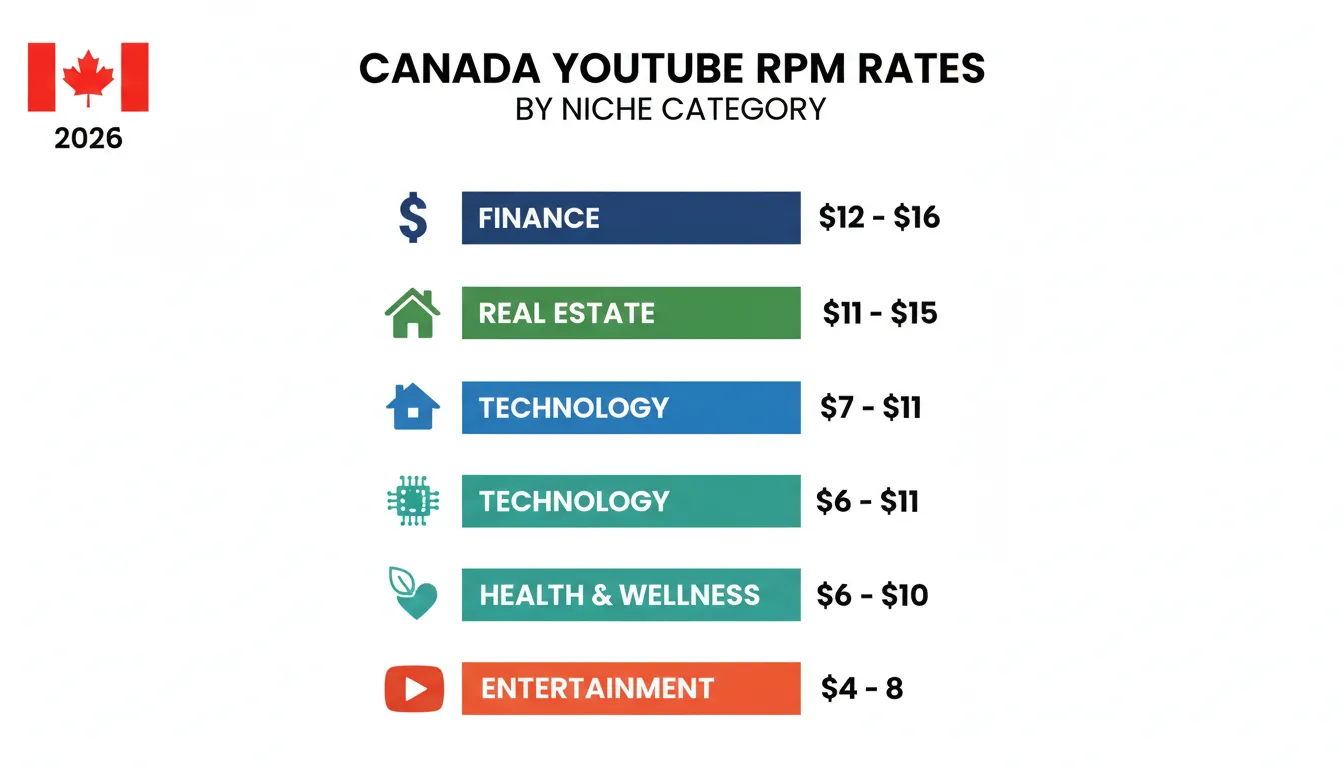
Here’s the uncomfortable truth: A Canadian creator making lifestyle videos might earn $4-$8 RPM, while a finance creator in the same country could earn $12-$16 RPM for identical view counts. That’s a 300% difference. Not from better editing. Not from luck. From niche selection.
Canada’s YouTube landscape in 2026 presents a unique opportunity. Your country has high advertiser demand. Bilingual content (English and French) commands premium rates. And certain niches are deliberately underserved by quality creators.
This complete breakdown reveals exactly how much Canadian creators earn across different categories. You’ll discover why finance and real estate dominate. You’ll learn the hidden metrics that determine your actual income. And you’ll understand how to position yourself for maximum earnings in the next 12 months.
The data comes from aggregated creator reports, YouTube partner statistics, and industry benchmarks specific to Canada’s advertising market. By the end, you’ll know precisely which niche gives you the best chance at sustainable YouTube income.
What Is YouTube RPM and How Does It Work in Canada?
YouTube RPM (Revenue Per Mille) is the amount you earn for every 1,000 views on your channel. It’s different from CPM (Cost Per Mille), which is what advertisers pay YouTube.
Here’s the critical distinction: CPM is what advertisers pay. RPM is what you actually receive.
YouTube takes a 45% cut. Payment processors take their cut. Currency conversion happens if you’re earning in USD. By the time money hits your Canadian bank account, RPM is significantly lower than the CPM advertisers paid.
If an advertiser pays $10 CPM, you might earn $5.50 RPM after all deductions.
Canadian RPM ranges from $4-$16 depending on multiple factors:
– Content niche
– Audience location
– Audience demographics
– Seasonality
– Content quality and watch time
– Advertiser-friendly guidelines compliance
Canada ranks in the top 10 globally for YouTube RPM rates. This isn’t random. Canadian advertisers spend aggressively on digital platforms. Your audience has purchasing power. Payment fraud is lower than in developing nations, so YouTube’s risk is minimal.
Why does Canada outperform most countries?
1. High GDP per capita — Advertisers targeting wealthy audiences pay more.
2. English-speaking market — English content attracts premium advertisers globally.
3. Proximity to US advertisers — Many US-based advertisers target Canadian audiences as extensions of North American campaigns.
4. Regulatory trust — PIPEDA compliance and payment reliability increase advertiser confidence.
The practical difference? A creator with 100,000 monthly views in Canada earning $8 RPM makes $800/month. That same 100,000 views in a lower-paying country might generate $150-$300. Geography and niche compound to create vastly different creator incomes.
YouTube RPM by Niche in Canada: The Complete Breakdown
Not all content is created equal in Canada’s advertising market. Your niche determines your baseline earning potential before any other factors.
| Niche | Avg RPM Canada 2026 | Top Advertiser Categories |
|---|---|---|
| Finance & Investing | $10–$22 | Banks, robo-advisors, ETF platforms, credit cards |
| Insurance | $12–$24 | Life, home, and auto insurance providers |
| Real Estate / Mortgage | $9–$20 | Mortgage brokers, realtors, property management |
| SaaS / Tech | $8–$16 | B2B software, cloud services, PM tools |
| Career / Remote Work | $6–$14 | Recruitment agencies, online learning platforms |
| Education / E-learning | $5–$12 | Online courses, tutoring, certifications |
| Health & Wellness | $4–$9 | Telehealth, supplements, insurance |
| Food & Lifestyle | $4–$9 | Grocery brands, food delivery, FMCG |
| Gaming | $2–$5 | Low CPM globally — high volume, low intent |
Finance and Investment (Highest Earners)
Finance creators in Canada operate in the sweet spot. Banks, investment platforms, insurance companies, and fintech startups compete aggressively for audience attention. The average RPM ranges from $12-$16.
Why so high? These advertisers have high customer lifetime value. A single conversion (opening an investment account, buying insurance, switching banks) is worth hundreds or thousands of dollars. They’ll spend $10-$15 per click knowing they’ll convert maybe 1 in 100 clicks into a customer worth $500+.
Canadian creators discussing RRSP strategies, TFSA optimization, investment fundamentals, or mortgage brokers pull premium ad rates. The content quality matters. Vague financial advice earns $8-$10 RPM. Expert-level content citing studies and offering actionable strategies earns $14-$16.
Real creator example: A Canadian finance channel with 250,000 views monthly at $14 RPM generates $3,500/month purely from AdSense, before sponsorships or affiliate income.
Real Estate and Property Investment
Real estate follows finance closely at $11-$15 RPM in Canada. This makes sense. Your audience watching real estate content has assets or the desire to acquire them. Real estate agents, mortgage brokers, property investment platforms, and construction companies advertise heavily.
Geographic specificity matters here. A Toronto real estate creator attracts different advertisers than a Calgary creator. Urban markets with higher property values attract more premium advertising. But all Canadian regions see strong real estate RPM because property investment is culturally significant.
Technology and Software
Tech content in Canada earns $7-$11 RPM. SaaS companies, cloud platforms, productivity tools, and hardware manufacturers advertise to technical audiences. The conversion values are solid but lower than finance. A software subscription might be $20-$100/month. An investment account opening is worth $500+ lifetime value.
Sub-niches matter significantly:
– Cybersecurity and data privacy: $9-$11 RPM (high-value B2B focus)
– AI and machine learning tutorials: $8-$10 RPM (enterprise audience)
– Gaming tech and peripherals: $6-$8 RPM (consumer-focused, lower margin products)
– General software reviews: $7-$9 RPM (mid-range)
Health, Wellness, and Fitness
Health and wellness content generates $6-$10 RPM in Canada. Supplement companies, fitness apps, medical device manufacturers, and health insurance providers advertise here.
The split is notable:
– Medical/clinical content: $8-$10 RPM (advertisers target serious health seekers)
– General fitness and weight loss: $6-$8 RPM (more consumer-focused, lower margins)
– Mental health and therapy: $7-$9 RPM (growing advertiser demand)
– Nutrition and dietetics: $6-$9 RPM (supplements drive ads)
Health creators must navigate advertiser guidelines carefully. Medical claims restrict which ads run. A channel claiming to “cure” conditions attracts fewer advertisers than one offering educational fitness content.
Education and Learning
Online education content earns $6-$9 RPM in Canada. This includes language learning, professional development, academic subjects, and skill-building.
Universities, online course platforms, professional certification programs, and language apps advertise. Conversion values are moderate. A student enrolling in a course might be worth $500-$2000 for the platform.
Entertainment, Gaming, and Lifestyle
Entertainment represents the largest creator category but offers the lowest RPM: $4-$8.
This includes:
– Gaming and esports: $4-$7 RPM
– Comedy and sketches: $4-$6 RPM
– Vlogging and lifestyle: $4-$8 RPM
– Music and entertainment: $4-$7 RPM
– Food and cooking: $5-$8 RPM
Why so low? Advertiser value is minimal. Gaming peripherals sell for $30-$100 with thin margins. Snack companies pay based on brand awareness, not conversions. Entertainment audiences are younger with less purchasing power. The CPM advertisers pay is simply lower, so RPM bottoms out.
A critical insight: Entertainment channels succeed through volume and diversification. They rarely sustain income from AdSense alone. Sponsorships, merchandise, Patreon, and affiliate income become essential. A 1-million-view entertainment channel at $6 RPM earns $6,000/month from ads. A 100,000-view finance channel at $14 RPM earns $1,400/month from ads—10x fewer views but similar income.

How to Calculate Your Potential Monthly Earnings in Canada
Understanding the math helps you set realistic income goals.
| Channel Type | Monthly Views | Avg RPM | Monthly AdSense |
|---|---|---|---|
| Finance channel | 30,000 | $16 | ~$480/mo |
| Real Estate channel | 75,000 | $14 | ~$1,050/mo |
| Lifestyle channel | 200,000 | $6 | ~$1,200/mo |
| Gaming channel | 500,000 | $3 | ~$1,500/mo |
The basic formula:
(Monthly Views × RPM) ÷ 1,000 = Monthly AdSense Revenue
Example 1: Finance Creator
– Monthly views: 200,000
– RPM: $14
– Calculation: (200,000 × $14) ÷ 1,000 = $2,800/month
Example 2: Entertainment Creator
– Monthly views: 200,000
– RPM: $6
– Calculation: (200,000 × $6) ÷ 1,000 = $1,200/month
Same views. Same effort potentially. 233% more income from choosing the right niche.
Accounting for seasonal variation:
Canadian RPM fluctuates throughout the year:
– Q4 (October-December): Highest rates (+15-20%). Holiday shopping and year-end financial planning drive advertiser budgets.
– Q1 (January-March): Strong rates (+10%). New Year resolutions (fitness, learning, finance) attract premium advertisers.
– Q2-Q3 (April-September): Lower rates (-5-10%). Summer slowdown and lower advertiser spend.
A finance creator earning $14 average RPM might see $16-$17 RPM in December, then drop to $12-$13 in July.
Factoring in YouTube’s cut and taxes:
Remember, RPM is after YouTube’s 45% cut. But you still owe Canadian income tax.
If you earn $2,800/month in AdSense revenue:
– Gross AdSense: $2,800
– Canadian income tax (varies by province, estimate 30-40%): -$840 to -$1,120
– Net income: $1,680-$1,960
This assumes no business expenses (equipment, software, courses). If you deduct business expenses, your taxable income decreases. Consulting an accountant familiar with creator income is essential.
Projecting annual income:
Channels rarely maintain flat monthly views. Most grow exponentially early, then plateau.
A realistic year-one Canadian YouTube channel:
– Months 1-3: 5,000 views/month
– Months 4-6: 15,000 views/month
– Months 7-9: 40,000 views/month
– Months 10-12: 80,000 views/month
– Average monthly views: ~35,000
– Niche: Tech ($8 RPM)
– Calculation: (35,000 × $8) ÷ 1,000 = $280/month average
– Annual income: ~$3,360 before taxes
That’s not enough to quit your job. But it’s proof of concept. Year two, if you achieve 2x growth, you’re at $6,720+. Year three at 3-4x growth, you’re approaching part-time income.
The math works only if you choose a defensible niche and execute with consistency.
Key Takeaways
The Bilingual Advantage: English + French Content Strategy
Canada presents a unique opportunity: bilingual audiences.
English speakers comprise 75% of Canada’s population. French speakers are 23%. But here’s where it gets interesting: French-language YouTube content is severely underproduced relative to the French-speaking population.
Quebec and French-speaking audiences in other provinces consume content primarily in French. Competition is fragmented. Quality French content creators are rare compared to English creators. This creates a supply-and-demand imbalance.
French content RPM in Canada:
French-language finance content earns $10-$14 RPM (vs. $12-$16 for English). The gap exists because fewer Quebec advertisers spend on YouTube advertising compared to English Canada. But the rates are still premium.
French tech content earns $6-$9 RPM (vs. $7-$11 for English).
Strategic bilingual approaches:
1. Dual-channel strategy: Run separate English and French channels. Upload identical content in both languages. Double your audience without doubling production time. A 30-minute script becomes two 30-minute videos (one per language).
2. Bilingual channel (mixed content): Publish content alternating between English and French. This limits audience reach but captures both markets from one subscriber base.
3. English primary, French secondary: Create English content as your main channel. Subtitle or translate key videos into French. Capture overflow French demand with minimal extra work.
4. Niche-specific bilingual content: Finance and tech content have the highest bilingual premiums. Your effort building two channels yields the best ROI in these categories.
The math on bilingual strategy:
English tech channel: 150,000 monthly views × $8 RPM = $1,200/month
Bilingual (two channels): 100,000 monthly views English × $8 = $800 + 60,000 monthly views French × $7 = $420 = $1,220/month
Same total effort (2-3 hours of translation/adaptation), 1% more income. But growth potential is higher. As your French channel grows independently, you could 2x income with minimal additional effort in year two.

Tools, Resources, and Estimated Costs for Canadian Creators
Building a professional YouTube channel requires tools. But costs vary dramatically based on your niche.
Essential Free Tools
– YouTube Studio: Free analytics, upload interface, monetization setup
– Google Keyword Planner: Free keyword research (requires Google Ads account)
– TubeBuddy Lite or VidIQ Free: Basic video SEO
– Canva Free: Thumbnail design
– OBS Studio: Open-source video recording and streaming
Total cost: $0
Budget Setup ($200-$500 initial investment)
This covers minimal production quality:
– Basic USB microphone (Audio-Technica AT2020USB): $99
– Ring light: $25-$50
– Webcam: $50-$100
– Used laptop or computer: Already owned
– Basic editing software: DaVinci Resolve (free) or CapCut (free)
Total: $174-$299
Mid-Level Setup ($800-$1,500)
Professional quality without breaking the bank:
– Decent microphone (Blue Yeti or similar): $100-$130
– Camera (used DSLR or mirrorless): $300-$600
– Ring light or professional lighting kit: $100-$200
– Tripod and mounting hardware: $50-$100
– Editing software subscription (Adobe Premiere Pro): $55/month
– Desktop upgrade or new laptop: Already owned or existing investment
Total: $600-$1,180 (excluding desktop)
Professional Setup ($2,000-$5,000+)
Studio-quality production:
– Professional microphone (Shure SM7B): $400
– High-end camera (Canon R5 or similar): $1,500-$3,000
– Professional lighting setup: $300-$800
– Audio interface and preamp: $150-$300
– Studio backdrop and sound treatment: $200-$500
– Software subscriptions: $150/month
Total: $2,700-$5,500+
Canadian Creator Resources
– YouTube Canada Creator Hub: https://creatoracademy.youtube.com
– Shut Up and Write (Canadian creator community): Free Facebook group
– Canadian Digital Media Tax Deductions: Consult a local accountant
– Canadian Intellectual Property Office: CIPO for copyright and branding questions
Pros and Cons of Different YouTube Niches for Canadian Creators
**Finance and Investment Content
Advertisement
