

Starting a side hustle can feel overwhelming. You’re juggling your main job, wondering which opportunities are worth your time, and questioning whether you’ll actually make money.
Here’s what the data shows: 51% of Americans have or are considering a side hustle in 2025. But most fail because they pick random ideas instead of strategies aligned with their existing skills. Creators have a unique advantage—you already have an audience, technical skills, and content distribution experience that most beginners lack.
The digital economy is expanding fast. Germany’s digital ad market continues to grow in 2025, and high-RPM niches significantly outperform entertainment sectors. This matters because many of the best side hustles for creators leverage advertising, sponsorships, and affiliate revenue. Whether you have 100 followers or 100,000, there’s a viable income stream waiting.
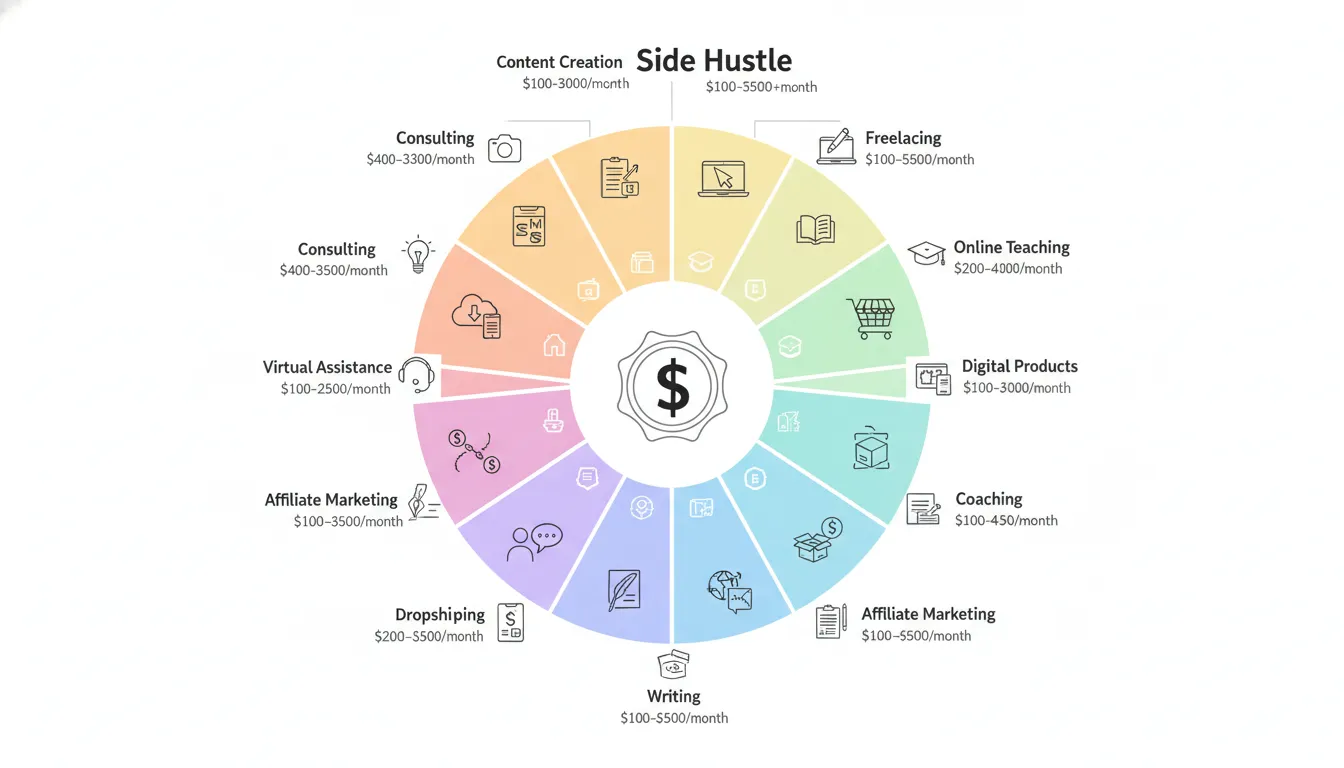
This guide breaks down 12 side hustles specifically suited for beginners. You’ll see real earning potential, startup costs, time commitment, and which ones compound over time. More importantly, you’ll understand how to pick the right one based on your existing skill set and audience size.
What Is a Side Hustle and Why It Matters for Creators
A side hustle is any income stream outside your primary employment. For creators, it’s not just about extra money—it’s about diversifying income before algorithm changes, platform changes, or audience shifts hurt your primary revenue source.
The creator economy grew 14% year-over-year in 2024. Yet most creators earn money from a single source: YouTube ad revenue, Patreon, or sponsorships. One platform policy change can devastate income overnight. A side hustle acts as insurance while building additional revenue that compounds long-term.
For beginners specifically, side hustles serve three critical purposes:
1. Income Diversification — You’re not dependent on one platform’s algorithm or one brand’s sponsorship budget.
2. Skill Development — Side hustles force you to learn new skills: sales, marketing, customer service, business operations. These directly improve your primary content.
3. Audience Expansion — Many side hustles (digital products, coaching, community building) deepen relationships with existing audiences while attracting new people.
The key difference between successful and failed side hustles is strategic fit. You need to choose something that:
– Aligns with your existing skills or audience
– Requires reasonable startup time and money
– Has proven income potential
– Scales without proportional time investment (ideally)
Creators already have advantages most beginners don’t. You understand content, audience dynamics, and online marketing. The side hustles that work best leverage these existing strengths rather than starting from zero.
1. Affiliate Marketing: Passive Income From Recommendations
Affiliate marketing is recommending products and earning commission when your audience buys. For creators, this is often the easiest income stream to add because you’re already recommending tools, products, or services in your content.
How it works:
– Join affiliate programs (Amazon Associates, ShareASale, individual brands)
– Add unique affiliate links to your content (videos, blog posts, social media)
– Earn 5-50% commission when someone clicks and buys
Earnings potential: $100-$5,000/month for established creators. Beginners with under 10K followers typically earn $50-$500/month initially.
Time commitment: 5-10 hours/month after initial setup. You’re recommending products you already mention—adding links takes minutes.
Startup cost: $0. Completely free to start.
Why it works for creators: You already recommend products. Affiliate marketing just monetizes recommendations you’re already making. If you have 1,000 engaged followers and recommend a $20 product with 20% commission, you could earn $50-$100 from that one mention.
Best practices:
– Only promote products you genuinely use and recommend
– Disclose affiliate relationships (required by FTC)
– Focus on high-commission products in high-intent categories (software, courses, tools pay 20-50% commission)
– Test different products to find what your audience actually buys
– Track which products convert best, then double down
The Germany digital ad market data points to a critical insight: high-intention niches (software, finance, B2B tools) have higher affiliate payouts than entertainment or lifestyle. If you create content about productivity, writing tools, or SaaS platforms, affiliate commissions can be substantial.
2. Digital Products: Build Once, Sell Forever
Digital products (courses, templates, ebooks, presets, guides) are the ultimate leverage play. You create something once and sell it infinite times. For creators with an audience of 1,000+, this is often the highest-ROI side hustle.
What creators successfully sell:
– Courses (filmmaking, writing, editing, content strategy)
– Email swipe files and templates
– Photoshop/Lightroom presets
– Notion templates and systems
– Checklists and guides
– Design elements (fonts, brushes, backgrounds)
Earnings potential: $500-$20,000/month. Top creators earn $100K+ annually from digital products alone. A beginner with a small engaged audience can make $1,000-$3,000 launching their first product.
Time commitment: 40-80 hours to create the product. Then 5-10 hours/month for marketing and customer support.
Startup cost: $0-$200 (hosting platform like Gumroad, Teachable, or Thinkific is free to start, $30-$100/month at scale).
Why it works: You’re teaching what you already know. Your audience has specific problems—create a solution they’ll pay for.
Real example: A YouTube creator with 50,000 subscribers launches a “YouTube Growth Blueprint” course for $97. If 2% of their audience buys, that’s 1,000 customers × $97 = $97,000 revenue (before platform fees). Even 0.5% conversion = $24,250.
Creation framework:
1. Identify your audience’s #1 problem
2. Create a 5-10 hour solution (video lessons, templates, worksheets)
3. Price at $27-$97 (beginners) to $197-$497 (established creators)
4. Launch to existing audience first (warm traffic converts 2-5%)
5. Use email and social to keep promoting
6. Iterate based on feedback
The barrier isn’t difficulty—it’s execution. Most creators never launch because they wait for perfection. Your first product doesn’t need to be perfect. It needs to solve a real problem your audience has.
Key Takeaways
3. Freelance Services: Sell Your Core Skills
Freelancing (writing, editing, design, consulting, coaching) converts your expertise directly into hourly or project-based income. For creators, this often means offering services related to your content specialty.
Common creator freelance services:
– Content strategy consulting ($50-$150/hour)
– Video editing ($25-$75/hour or $500-$5,000/project)
– Copywriting for brands ($50-$200/hour)
– Social media management ($500-$3,000/month per client)
– Podcast editing and production ($300-$1,000/month)
– Course creation consulting ($100-$250/hour)
– Personal coaching (fitness, business, writing: $50-$500/hour)
Earnings potential: $2,000-$10,000/month. You’re exchanging time for money, so earnings cap at how many hours you can work. But rates for experienced creators are high.
Time commitment: 20-40 hours/week if this is your primary side hustle.
Startup cost: $0-$500 (portfolio website, Upwork premium, LinkedIn optimization).
Why it works: Your audience trusts your expertise. They’ll pay for it directly.
How to launch:
1. Pick one specific service (not “everything”)
2. Build a simple portfolio or case studies
3. List on Upwork, Fiverr, or Fancy Hands
4. Promote to your email list or social followers
5. Price below market initially to get reviews, then raise rates
Pricing strategy: Most beginners undercharge. A content strategist with a proven track record should charge $75-$150/hour minimum. Video editors with a portfolio should start at $35-$50/hour. As you get reviews and testimonials, raise rates 10-20% annually.
The advantage of freelancing as a side hustle is immediate revenue. You don’t need to build products or audiences—you’re selling to people who already value your skills. The disadvantage is that it doesn’t scale beyond your time.

4. YouTube Monetization: Ads, Sponsorships, and Super Chat
YouTube monetization seems obvious, but many beginners don’t maximize it because they focus only on ad revenue (CPM). The real money comes from sponsorships and diversified streams.
YouTube income streams:
– Ad revenue (CPM varies by niche: $2-$50 per 1,000 views)
– Sponsorships ($1,000-$50,000+ per video depending on channel size)
– Super Chat and channel memberships (YouTube takes 30%, you keep 70%)
– YouTube Shorts fund (invitation-only, pays $100-$10,000/month depending on views)
Earnings potential: A channel with 10,000 subscribers in a high-RPM niche can earn $500-$2,000/month from ads alone. Add sponsorships and the range jumps to $2,000-$10,000/month.
Time commitment: 10-20 hours/week to maintain upload schedule and engagement.
Startup cost: $0 (basic camera) to $500 (decent audio, lighting, editing software).
Why Germany’s digital ad market matters: The creator economy isn’t equally valuable across all niches. High-intent niches (B2B, finance, software, productivity, marketing, real estate) have CPMs 5-10x higher than entertainment niches. A productivity channel earning $20 CPM outperforms an entertainment channel earning $3 CPM at the same view count.
Maximizing YouTube earnings:
– Choose a high-RPM niche (B2B, finance, software, productivity over entertainment)
– Diversify beyond ad revenue: 30-50% from sponsorships, 20-30% from products/affiliates, 20% from ads
– Build in the YouTube Shorts format (easier to grow, unlocks Shorts Fund)
– Engage audience in memberships and Super Chat (community tab helps)
– Use YouTube analytics to identify which videos earn the most per view
YouTube is not truly a side hustle—it’s a long-term platform play. Expect 6-12 months to monetize. But once monetized, earnings compound as your catalog builds.
5. Content Monetization Platforms: Substack, Patreon, and Beyond
Email lists and membership communities are creator gold. Platforms like Substack, Patreon, and Circle let you monetize audiences directly, without algorithm dependence.
Popular platforms:
– Substack: Newsletter subscription (you set price, Substack takes 10%)
– Patreon: Tiered membership model ($3-$50/month tiers)
– Circle or Mighty Networks: Community-based membership with exclusive content
– OnlyFans: Creator subscriptions (often adult content, but used across niches)
Earnings potential: Highly variable. A newsletter with 10,000 subscribers at 5% conversion rate to $10/month paid tier = $5,000/month. A Patreon with 500 supporters averaging $8/month = $4,000/month.
Time commitment: 10-15 hours/month (depends on exclusivity level).
Startup cost: $0 (all platforms offer free tiers, paid features $10-$100/month).
Why it works: Direct relationship with audience. No algorithm. Predictable recurring revenue.
How to launch:
1. Identify your most engaged followers
2. Choose platform (Substack for newsletters, Patreon for tiered membership, Circle for community)
3. Create compelling exclusive content (not just repackaged public content)
4. Price at $5-$15/month for beginners (higher conversion rates)
5. Promote in your existing content and email
Real example: A productivity YouTuber launches a Patreon with three tiers: $3 (early access to videos), $10 (weekly productivity worksheets), $30 (monthly 1:1 coaching call). Month one brings 50 supporters at an average of $9/month = $450. By month six with promotion, 200 supporters = $1,800/month.
These platforms work because they provide exclusivity and community. Your audience wants deeper access to you. They’ll pay for it.
6. Coaching and Consulting: High-Ticket Income
Coaching and consulting is the highest-income side hustle for established creators because you’re selling expertise and transformation, not time.
Coaching specialties for creators:
– Personal development coaching ($100-$500/hour)
– Business coaching for solopreneurs ($200-$500/hour)
– Writing or content creation coaching ($75-$250/hour)
– Fitness or health coaching ($50-$200/hour)
– Career or life coaching ($75-$300/hour)
– Niche-specific consulting (marketing, productivity, skill development)
Earnings potential: $3,000-$15,000/month for established coaches. You don’t need a massive audience—even 100 followers with a specific problem can generate 5-10 coaching clients at $200-$500/month each.
Time commitment: 10-20 hours/week (5-10 clients at 1-2 hours per client per week).
Startup cost: $0-$500 (Calendly, coaching platform like Mighty Networks or Circle, basic website).
Why it works: Your audience knows you and trusts you. They want your direct guidance.
How to price:
– Beginners: $50-$100/hour or $300-$500/month
– Intermediate (with testimonials): $150-$250/hour or $1,000-$2,000/month
– Established (proven results): $300-$500+/hour or $3,000-$5,000+/month
Launch framework:
1. Offer free sessions to 5-10 people (collect testimonials)
2. Create a simple service page on your website
3. Use Calendly for scheduling
4. Start with $75-$100/hour (undercharge initially)
5. Raise rates 20% after every 5 satisfied clients
6. Transition to package deals ($1,000-$3,000 per month) for recurring revenue
The key advantage of coaching is that rates scale with expertise and results. A coach who can prove they help people lose 20 lbs, get promoted, or launch a business can charge 2-3x more than a coach with no track record.
7. Social Media Management for Small Businesses
Small businesses desperately need social media help but can’t afford $5,000/month agency rates. This is your opportunity. Offer social media management at $500-$2,000/month per client, and you can earn $2,000-$10,000/month with just 5-10 clients.
What you’ll do:
– Create content calendar and schedule posts
– Design graphics and copy
– Engage with audience
– Track analytics and report results
– Manage paid ads (if client requests)
Earnings potential: $500-$2,000 per client per month. 5 clients = $2,500-$10,000/month.
Time commitment: 10-20 hours/week (2-4 hours per client per
Advertisement