

Here’s the reality: blogging isn’t dead. It’s actually thriving. The U.S. digital ad market continues its steady climb into 2024, with creators who understand one simple principle crushing it—pick the right niche from day one. Most beginner bloggers fail because they chase vanity metrics instead of revenue. They write about their hobbies, build an audience of thousands, and make almost nothing. Meanwhile, savvy creators in high-RPM niches (finance, health, technology, business) are hitting $5,000-$10,000 monthly income from modest audiences of just 10,000-50,000 readers.
The difference? Strategy. This guide walks you through every step of launching a blog that makes money. Not in five years. Within months. We’re talking real numbers, real monetization methods, and the exact framework successful creators use. Whether you’re starting from scratch or reviving an old blog, you’ll learn how to pick a niche that pays, create content that ranks, build an audience that converts, and implement monetization that actually generates revenue. Let’s build your profitable blog.
What Is a Profitable Blog and Why Start One in 2024?
A profitable blog is a content asset that generates consistent revenue through multiple income streams. It’s not just a place to share thoughts—it’s a business. The key difference between a hobby blog and a profitable one is intention. You’re building for an audience with a specific problem, and you’re solving that problem in exchange for revenue.
Why now? Three reasons. First, competition is fragmented. Unlike five years ago, you don’t need a massive audience to make serious money. Micro-audiences in high-intent niches convert at incredible rates. Second, the U.S. digital ad market is projected to exceed $350 billion in 2024, meaning advertising CPMs (cost per thousand impressions) are healthy for quality publishers. Third, multiple monetization methods exist today that didn’t exist even two years ago. You can combine ads, affiliate marketing, digital products, sponsorships, and membership models simultaneously.
The creator economy has matured. Platforms are saturated. Blogs, owned by you, on your domain, build equity. A successful blog becomes an asset—something you can sell, license, or leverage for years. A successful TikTok account dies the moment the algorithm changes.
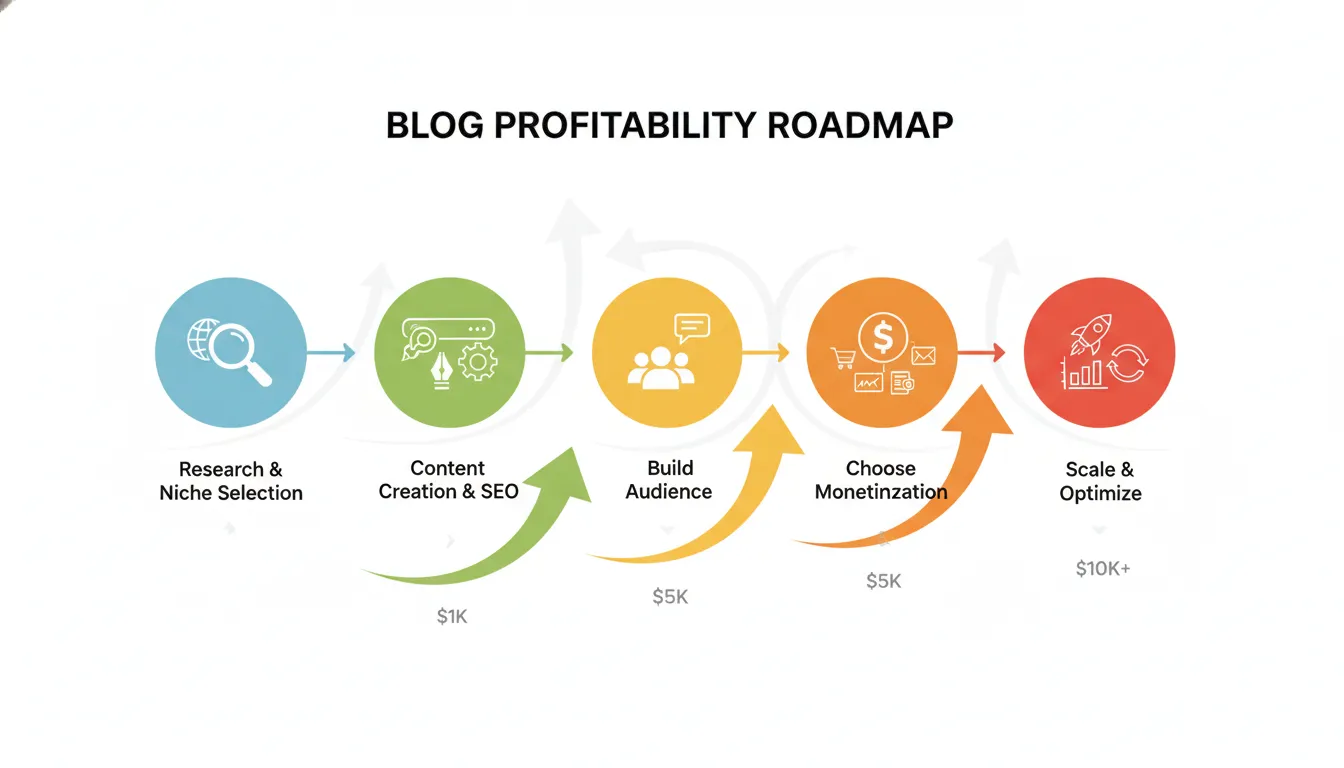
Financial reality: A profitable blog averaging 50,000 monthly visitors in a high-RPM niche (health, finance, technology) can generate $2,000-$5,000 monthly from ad revenue alone. Add affiliate marketing, digital products, or sponsorships? You’re looking at $5,000-$15,000+. Starting zero to that point typically takes 12-18 months with consistent effort.
How to Choose Your Blog Niche: The Foundation of Profitability
Your niche determines everything. It determines your CPM (how much advertisers pay), your audience conversion rates, and how fast you’ll grow. Picking wrong here means grinding for months only to realize you can’t monetize profitably. Picking right means building leverage fast.
The three criteria for a profitable niche:
1. Audience intent matters more than audience size. A niche with 100,000 monthly searches paying high intent (people ready to buy or invest) beats a niche with 1,000,000 searches of casual browsers. Financial advice, health solutions, B2B tools, and business strategies command premiums because the audience has money and intent.
2. Competition exists, but it’s not saturated in subcategories. “Make money online” is oversaturated. “How to build a profitable micro-course for fitness professionals” is not. Pick a niche broad enough to have audience but narrow enough to own a subsection quickly.
3. You can monetize it through multiple channels. A niche where you can run ads, sell affiliate products, create digital courses, and attract sponsorships beats one where you’re limited to a single revenue stream. Health, finance, business, technology, and self-improvement all pass this test.
Niches that currently outperform (high RPM, strong demand):
– Personal finance and investing
– Health and fitness (specific: diabetes management, fitness for women over 40, etc.)
– B2B software and business tools
– Productivity and remote work
– Real estate and property investment
– Technology and AI
– Career development and job search
– Mental health and wellness
Niches that typically underperform (low RPM, entertainment-focused):
– Movie and TV reviews
– Celebrity gossip
– General lifestyle or “life advice”
– Pet care (unless hyperspecific like “luxury pet grooming”)
– Hobby crafts or DIY (low monetization despite high traffic)
The validation process: Before committing, spend 20 minutes researching. Search your niche idea on Google Trends. Look at search volume. Check five competitor blogs—do they have sponsorship mentions, affiliate links, or digital products? If yes, it’s monetizable. If not, keep looking.

Step 1: Set Up Your Blog Infrastructure (The Right Way)
Don’t overthink this. You need three things: a domain, hosting, and a content management system. Fortunately, the setup is cheaper and easier than ever.
Domain name ($12-15/year):
Register at Namecheap or Google Domains. Pick something memorable, relevant to your niche, and available on social media. Avoid numbers and hyphens. Examples: TheFinancePlaybook.com, FitnessOver40.com, BuildMoreB2B.com. Your domain is your brand. Treat it accordingly.
Hosting ($100-300/year):
Use WordPress with a reputable host. Bluehost, SiteGround, or WP Engine are solid. Shared hosting works for your first 100,000 monthly visitors. Don’t overspend here initially. As you grow and monetize, reinvest in better infrastructure.
Content Management System:
WordPress powers 43% of all websites for a reason. It’s flexible, SEO-friendly, and built for publishers. Alternatives like Webflow or Substack are trendy but limit monetization. WordPress is the pro’s choice.
Essential plugins (all free or affordable):
– Yoast SEO or Rank Math (SEO optimization)
– MonetizePress or AdThrive (ad management)
– Elementor (page building, easier than coding)
– Akismet (spam protection)
– Google Analytics and Search Console (tracking)
Setup time: 2-3 hours. You don’t need a fancy design. Clean, fast, mobile-responsive beats beautiful-but-slow every single time. Use a lightweight theme like GeneratePress or Neve.
Investment: $300-500 for your first year (domain + hosting + premium plugins).
Key Takeaways
Step 2: Create an SEO Content Strategy That Ranks and Converts
Traffic without monetization is a hobby. Monetization without traffic is a dream. You need both. SEO is how you get traffic at scale without paying for ads. It’s the only sustainable growth engine for a blog.
The SEO framework:
1. Keyword research (Week 1-2): Use Ahrefs, SEMrush, or the free Google Keyword Planner. Find keywords your audience searches for. Look for search volume (200+ monthly searches) with low competition (easier to rank). Long-tail keywords (specific, multi-word phrases) are your friends: “How to start a budget-friendly fitness blog” ranks easier than “fitness blog.”
2. Cluster content around topic pillars (Week 3-4): Don’t write random articles. Map your niche into 5-10 core topics (pillars). Create cornerstone content (2,000+ word guides) for each pillar, then satellite articles (800-1,500 words) that link back. Example: Pillar—”Personal Finance.” Satellites—”How to create a budget,” “Best high-yield savings accounts,” “Retirement account comparison.”
3. Publish strategically, not constantly (Ongoing): Quality over quantity. One 2,500-word SEO-optimized article beats ten 500-word fluff pieces. Aim for 4-8 articles monthly in your first year. Each article should target a specific keyword and provide answer-seeking, actionable value.
4. Build internal links (Every article): Link from new articles to relevant existing ones. This distributes authority and helps Google understand your site structure. Use natural anchor text (actual words, not “click here”).
Content types that rank and convert:
– How-to guides (highest conversion intent)
– Comparison articles (buyers comparing options)
– Tool reviews (high affiliate potential)
– List-based posts (how-tos, best-of compilations)
– Case studies (specific results and proof)
– Beginner’s guides (funnel-top content, builds authority)
Example: High-performing article structure
– Intro with hook and value proposition (150 words)
– Table of contents (helps ranking, improves UX)
– H2 sections with subheadings and practical steps (200+ words each)
– Real examples and case studies
– Comparison table (if relevant)
– FAQ section (captures voice search)
– Strong CTA linking to monetization
Realistic timeline: Your first 10-15 articles (2-3 months) will get minimal traffic. By month 4-5, you’ll see traction. By month 8-12, you’ll have established content getting 100-500 monthly visits per article. This is when monetization begins working.

Step 3: Build Your Audience and Email List
Traffic from Google is great, but it’s not owned. An email list is. Grow both simultaneously.
Email list building strategies:
1. Create a lead magnet (mandatory): A free resource your niche desperately wants. Examples:
– “The 10-Point Investing Checklist for Beginners” (finance niche)
– “Complete Home Workout Plan for Women Over 40” (fitness niche)
– “B2B SaaS Pricing Guide” (business tech niche)
Your lead magnet should take 30-90 minutes to create and deliver immediate value. Host it on Gumroad or as a PDF. You don’t need an app for this.
2. Place opt-in forms strategically: Exit-intent pop-ups (when users leave), sidebar forms, and in-article forms. Use OptinMonster or built-in tools. Don’t oversell—aim for a 2-5% conversion rate from readers to email subscribers.
3. Publish valuable emails (twice weekly minimum): Share exclusive insights, new article announcements, and occasional monetized offers. Your email should be helpful, not salesy. Ratio: 80% value, 20% promotion.
4. Use automation: Create welcome sequences (5-7 emails that nurture new subscribers). Use ConvertKit, Brevo (free tier), or MailerLite. Automation is your leverage.
Social media strategy (supplementary):
Don’t chase followers on every platform. Pick one. LinkedIn for B2B and business creators. Instagram for lifestyle and fitness. Twitter for tech and news. Share article snippets, key takeaways, and unique insights. Your social job is to amplify your blog, not replace it. One post per day is plenty.
Building community: Create a private Facebook group or Discord server once you have 500+ email subscribers. Engaged communities become your most loyal customers.
Realistic growth: 0-3 months, you’ll build 100-500 email subscribers. 3-6 months, 500-2,000. 6-12 months, 2,000-10,000+. Faster with consistent content and strong lead magnets.
Step 4: Set Up Monetization (Multiple Revenue Streams)
This is where most creators fail. They think a blog makes money automatically. It doesn’t. You must intentionally implement monetization. The beauty? You can start before you have huge traffic.
1. Display Advertising (Ads on Your Site)
CPMs (cost per thousand impressions) vary by niche and audience quality:
– Finance/investment: $15-50 CPM
– Technology/business: $10-30 CPM
– Health/fitness: $5-15 CPM
– Entertainment/general: $0.50-5 CPM
At 50,000 monthly visitors with a $20 CPM, you’d earn $1,000/month. With 100,000 visitors, $2,000/month.
Networks to use:
– Google AdSense (easiest to start, lowest pay)
– Mediavine ($50,000+ monthly traffic required, higher payouts)
– AdThrive ($100,000+ monthly traffic, premium rates)
– Direct sponsorships (highest pay, requires outreach)
Timeline: Join Google AdSense immediately (takes 2 days to approve). Aim to hit Mediavine requirements (25,000 monthly visitors) within 6-9 months.
2. Affiliate Marketing
Recommend products or services your audience needs. Earn 5-40% commission per sale.
High-converting affiliate products by niche:
– Finance: investment platforms, budgeting apps, credit card tools
– Fitness: workout equipment, supplements, personal training programs
– Business: software (Zapier, ConvertKit, Airtable), courses, hosting
Affiliate networks to join:
– Amazon Associates (easiest, lowest commission)
– ShareASale and CJ Affiliate (diverse products, mid-tier payouts)
– Direct partnerships (reach out to brands, negotiate commission)
– High-ticket affiliate programs (software, courses, $200+ commissions per sale)
Strategy: Review products genuinely. Link to relevant tools within your content naturally. Example: In an article about “How to Start a Fitness Blog,” recommend WordPress hosting, email software, and fitness-tracking tools you actually use. Disclose affiliate links transparently.
Realistic earnings: 1-3% of your audience clicks affiliate links. Of those, 2-5% buy. At 50,000 monthly visitors, you’re looking at $300-800/month from affiliate commissions. Grows with your traffic.
3. Digital Products (Courses, Templates, Guides)
Create once, sell repeatedly. Margins are massive (70-90% profit after payment processing).
Product ideas by niche:
– Finance: budget template, investment portfolio tracker, negotiation scripts
– Fitness: workout program, meal planning template, progress tracker
– Business: email templates, sales framework, LinkedIn content calendar
Tools to sell:
– Gumroad (easiest for creators)
– Teachable or Kajabi (if creating courses)
– Thinkific (white-label courses)
Pricing: Price at 10-20x your monthly hosting cost. A $200 product at 30% conversion from your audience of 5,000 email subscribers = $300,000 potential. Realistic? 0.5-2% convert. That’s $3,000-$30,000 annually.
4. Sponsorships and Brand Partnerships
Brands pay creators for featured content. It’s the highest-paying monetization method once you have established traffic.
How to attract sponsors:
– Create a “media kit” (one-page PDF showing your traffic, audience demographics, engagement rates)
– Reach out to brands your audience would love
– List sponsorship opportunities on your site
– Join platforms like Letterhead (sponsorship marketplace)
Pricing: Charge $500-$2,000 per sponsored post, depending on your traffic and engagement. Aim for 2-4 sponsored articles monthly = $1,000-$8,000 additional revenue.
5. Membership or Subscription
Create exclusive content for paying members. Builds recurring revenue.
Membership models:
–
Advertisement