

You’re scrolling through LinkedIn during your lunch break, and there it is again—another success story about someone who built a six-figure blog while working full-time. You think: “That’s not realistic for me. I barely have time to answer emails.” But here’s the truth: in 2025, the digital landscape has fundamentally shifted. Unlike five years ago, you don’t need to quit your job to build a profitable blog. You don’t need to spend 40 hours a week creating content. You don’t even need deep technical knowledge anymore.
The numbers back this up. According to recent data, the Singapore digital ad market alone is projected to exceed $2.3 billion in 2027, growing at 8.5% annually. That growth translates into real opportunities for content creators and bloggers who understand how to capture audience attention and monetize strategically. More importantly, research shows that niche blogs in finance, technology, and professional development consistently outperform entertainment blogs in RPM (revenue per thousand impressions)—sometimes by 300% or more. This is significant because it means that as a working professional, your expertise is your biggest asset. You already understand your industry. You already have credibility. You just need the right blueprint.
The challenge isn’t opportunity. It’s clarity. Most working professionals who start blogs fail not because they’re too busy, but because they launch without a monetization strategy. They create content randomly. They don’t understand their audience’s problems. They give up after three months when they have 200 page views and zero revenue. This guide is different. We’re going to walk through the exact system successful professional bloggers use—from day one to their first profitable month.
What Is a Profitable Blog and Why It Matters for Working Professionals
A profitable blog is more than just a website where you write articles and hope someone clicks an ad. It’s a deliberate business asset that generates recurring revenue through multiple channels while you sleep. For working professionals specifically, it’s the ultimate leverage play: you build it once, and it works for you indefinitely.
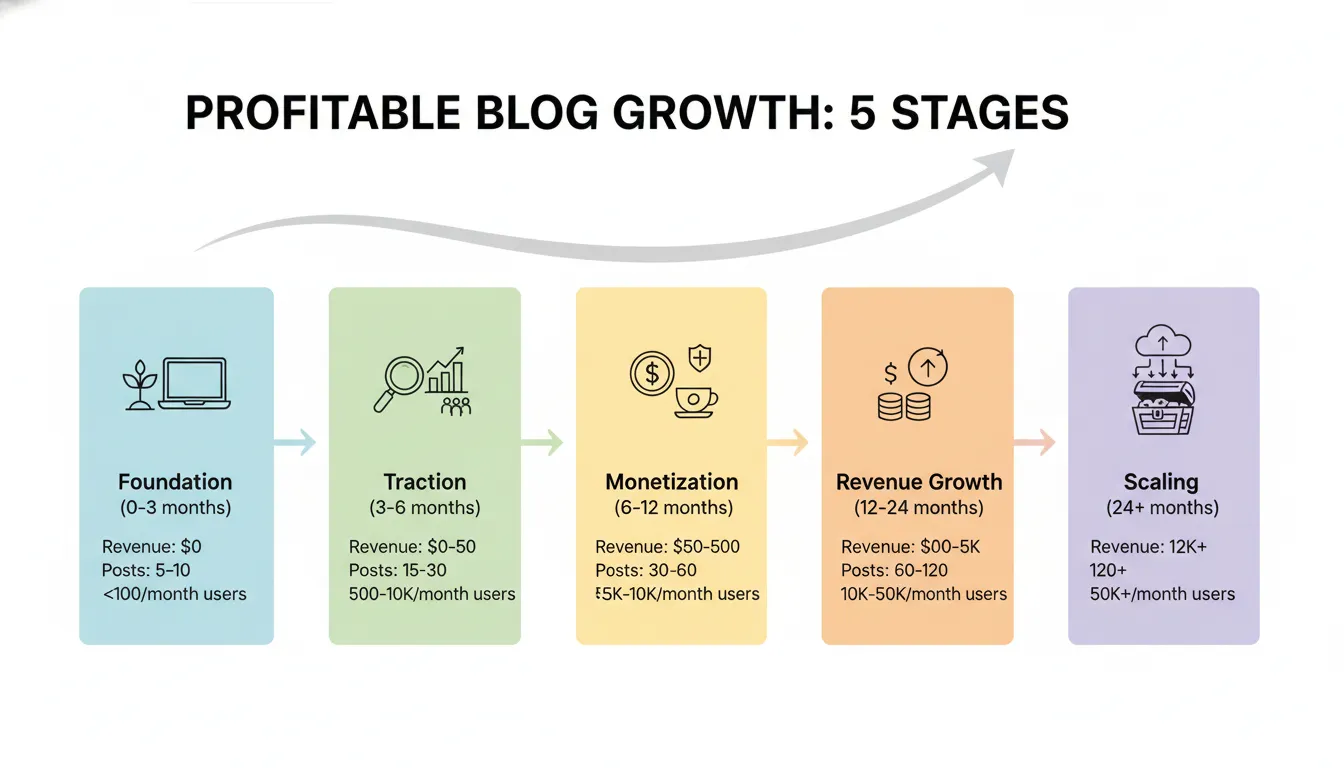
Let’s be clear about what profitability means here. Many new bloggers celebrate when they hit 1,000 page views. That’s great for validation. But 1,000 page views typically generates $0.50 to $3.00 in ad revenue, depending on your niche. That’s not profitable. Profitable means your blog consistently generates income that exceeds your time and monetary investment. For a blog bootstrapped on a $200 domain and hosting budget, profitability starts at $50-100 per month. For most professionals, the goal is $500-2,000 monthly within 12-18 months, often scaling to $5,000+ within three years.
Here’s why this matters specifically for working professionals. Your time is your most valuable asset. Unlike an e-commerce business that requires constant inventory management or a consulting practice that trades hours for dollars, a blog compounds. The article you write today can generate income for 5, 10, or 15 years. A single guide about “how to negotiate a raise” or “best project management tools for remote teams” can serve thousands of professionals annually, generating thousands in cumulative revenue. That’s leverage. That’s what separates blogs from other side projects.
The earning models are diverse too. You’re not limited to Google AdSense (which pays poorly anyway—typically $1-5 per 1,000 views). Successful professional bloggers earn through affiliate marketing (recommending tools and products), digital products (courses, templates, e-books), sponsored content (companies paying you to mention their solutions), coaching or consulting (your blog drives leads), and membership communities (exclusive content for paying subscribers).
For working professionals, this matters because you can start with zero audience and grow methodically during lunch breaks and weekends. You’re not competing with full-time content creators who can publish 10 articles per week. Instead, you’re competing on depth, expertise, and trust—all of which you already possess in your professional domain.
Step 1: Choose Your Niche (The Foundation of Profitability)
This is where most blogs fail. Creators choose a niche based on passion alone. “I love travel!” “I’m interested in mindfulness!” These are terrible reasons to start a professional blog. Profitable niches require three specific elements: audience demand, monetization potential, and your genuine expertise.
Finding Your Intersection:
The best niche for your blog sits at the intersection of three circles: (1) What you know deeply from your professional experience, (2) What people actively search for online, and (3) What generates meaningful revenue per visitor.
Start by listing five areas where you have genuine professional expertise. Not casual knowledge—real expertise from years of work. A project manager might write about Agile methodology. A HR professional might write about employee retention. A software developer might write about debugging or system architecture. A marketer might write about conversion rate optimization. These are spaces where you have unfair advantages over hobbyists.
Next, validate demand. Open Google Keyword Planner or Ahrefs and search for keywords in your potential niche. Look for monthly search volume. Anything consistently getting 500+ monthly searches for related terms indicates audience demand. If you search “best project management software” and see 20,000+ monthly searches, that’s demand. If you search “how to organize my life with mindfulness journaling” and see 50 searches monthly, that’s not.
Finally, research monetization. High-RPM niches—those where advertisers pay more per impression—include finance, technology, business, and professional development. Entertainment and lifestyle niches average $1-3 per 1,000 views. B2B niches average $5-15 per 1,000 views. Finance-related niches average $10-50 per 1,000 views. Why? Because a company selling accounting software gets more value from a click than a clothing retailer.
Niche Examples for Working Professionals:
– Finance niche: “How to build wealth on a corporate salary” + affiliate links to investment apps = $15-30 RPM
– Tech niche: “Cloud migration strategy for mid-size companies” + sponsored content from AWS, Azure = $20-40 RPM
– Career niche: “How to transition from management to IC (individual contributor) roles” + executive coaching services = $10-25 RPM
– Operations niche: “Cost optimization for manufacturing businesses” + B2B SaaS recommendations = $12-35 RPM
Your niche shouldn’t be so broad that you can’t own it (don’t write about “business” generally). It shouldn’t be so narrow that it lacks audience (don’t write about “Slack workflows in accounting departments specifically”). It should be specific enough to establish authority, but broad enough to sustain 100+ articles.

Step 2: Set Up Your Blog Platform and Technical Foundation
You need a home. This doesn’t need to be complicated or expensive. Most professionals overthink this phase. Here’s the reality: the platform doesn’t matter as much as consistency and content quality. Successful blogs run on WordPress, Webflow, Substack, Medium, Ghost, and dozens of other platforms. You don’t need the “perfect” setup.
Platform Comparison for Professionals:
| Platform | Cost | Monetization Control | Learning Curve | Best For |
| ———- | —— | ———————- | —————– | ———- | <br /> |
|---|---|---|---|---|---|
| WordPress.org | $12-30/month | Complete control | Moderate | Most professionals | |
| Substack | Free + revenue share | Limited | Easy | Email-first creators | |
| Medium | Free + revenue share | Limited | Easiest | Quick starters | |
| Webflow | $20-165/month | Complete control | High | Design-focused creators | |
| Ghost | $39-199/month | Complete control | Moderate | Membership focus | |
| Squarespace | $12-33/month | Limited | Easy | Minimal technical users |
My recommendation for working professionals: Start with WordPress.org hosted on a service like SiteGround or Bluehost ($12-15/month) paired with a domain ($12/year). This costs roughly $160 in year one and gives you complete control over monetization. You can install plugins for SEO, affiliate disclosures, email capture, and analytics. You own your content. You’re not dependent on a platform changing its terms.
If you want zero technical friction: start on Substack or Medium. They’re genuinely good platforms. The tradeoff is that you have less monetization flexibility and less control. That’s acceptable for the first three months while you validate your niche and find your voice.
Essential Setup Steps:
1. Register domain name (GoDaddy, Namecheap, Route53) = $10-15/year
2. Choose hosting (SiteGround, Kinsta, WP Engine) = $12-50/month
3. Install WordPress (one-click install available on most hosts)
4. Select a lightweight theme (GeneratePress, Neve, or Astra) = $0-40
5. Install essential plugins: Yoast SEO, Google Analytics 4, UpdraftPlus for backups, WPForms
6. Create essential pages: Home, About, Contact, Privacy Policy, Disclosure Policy
7. Set up Google Search Console and Google Analytics 4
8. Install an email capture tool (ConvertKit, MailerLite, or built-in WordPress plugins)
Critical: Don’t spend more than a week on setup. Don’t switch platforms every month. Don’t create a perfect site and then publish nothing. Most professionals fail because they spend three weeks perfecting their design and then run out of motivation to create content. The platform is unimportant. Content is everything.
Key Takeaways
Step 3: Create Your Content Strategy and Publishing System
This is where professionals gain their advantage. You’re not creating content based on viral trends or guessing what people want. You’re solving specific problems your audience faces daily.
The Content Pyramid:
Your blog needs three content tiers:
Tier 1 – Pillar Content (40% of output): These are your flagship 2,500-4,000 word guides that address the core problems in your niche. Examples: “Complete Guide to Agile Retrospectives,” “How to Build a Remote Onboarding Program,” “Treasury Management for Manufacturing Companies.” Each pillar article takes 10-15 hours to create, but it drives 30-40% of your blog’s long-term traffic. Publish one pillar article every 4-6 weeks.
Tier 2 – Supporting Content (40% of output): These are 1,000-1,500 word articles that expand on pillar topics and capture specific long-tail keywords. Examples: “5 Mistakes in Sprint Planning,” “Remote Onboarding Tools Comparison,” “Cash Flow Forecasting Spreadsheet Template.” Publish one supporting article every 1-2 weeks.
Tier 3 – Quick-Win Content (20% of output): These are 400-800 word pieces that answer specific questions or provide quick value. Examples: “What Is Agile Methodology (Simple Explanation),” “Remote Onboarding Checklist,” “Treasury Management KPIs to Track.” These are fast to write (2-3 hours) and rank for high-intent keywords.
Creating a Sustainable Publishing System:
Working professionals can’t publish 4 articles per week. Your system needs to match your capacity. Here’s a realistic rhythm for someone with 5-10 hours weekly:
– Week 1-2: Write one Tier 2 article + publish one Tier 3 article (research from existing notes)
– Week 3-4: Write one Tier 1 pillar article
– Repeat quarterly:
– Months 1-3: Publish 8-10 total articles
– Months 4-6: Publish 10-12 total articles (you’re faster now)
– Months 7-12: Publish 12-16 total articles (systems are optimized)
This approach gets you to 40-50 published articles by month 12, which is the inflection point where blogs typically see significant traffic growth.
The Writing Process That Saves Time:
Most professionals write slowly because they create articles in isolation. Instead, batch your work:
1. Batch research (2 hours): Spend 90 minutes researching 3-4 article topics simultaneously. Collect links, statistics, and quotes in a shared document.
2. Batch outlining (1 hour): Create detailed outlines for all articles before writing. This reduces decision fatigue and makes writing faster.
3. Batch writing (4-5 hours): Write one article per sitting. Don’t edit yet. Aim for 500 words per hour—achievable with an outline.
4. Batch editing (2-3 hours): Edit all articles together. You develop rhythm. Editing gets faster.
This batching approach cuts your per-article time from 12 hours to 5-6 hours. Over a year, that’s 200+ hours saved.
Content Ideas That Work for Professional Bloggers:
– How-to guides addressing specific workplace challenges
– Tools comparison and reviews (high affiliate potential)
– Case studies showing results in your domain
– Interviews with other professionals in your field
– Trend analysis based on your professional observations
– Problem-solution articles addressing common questions
– Templates, checklists, and downloadable resources

Step 4: Implement Your Monetization Strategy
Here’s the hard truth: a blog with no monetization plan will never be profitable. You need multiple revenue streams. You need them set up before you have massive traffic. You need to understand which ones align with your audience and niche.
Monetization Method Breakdown:
1. Display Advertising (Passive, starts early)
– Google AdSense: $1-5 per 1,000 views
– Mediavine: $20-50 per 1,000 views (requires 50,000 monthly visitors)
– AdThrive: $25-60 per 1,000 views (requires 100,000 monthly visitors)
– Best for: Established blogs with 50,000+ monthly visitors
Reality check: Don’t rely on ads until you have consistent monthly traffic above 10,000 visitors. Early on, ads distract from content quality and conversions. Most pros enable ads around month 8-12, after organic traffic is growing steadily.
2. Affiliate Marketing (Medium effort, high ROI)
Recommend tools, products, or services relevant to your audience. You earn a commission when someone purchases through your link.
Examples:
– Project management software blog → recommend Asana, Monday.com, Notion ($20-50 commission per signup)
– Finance blog → recommend investment apps, accounting software, credit cards (2-5% commission on annual subscriptions)
– B2B operations blog → recommend supply chain software, ERP systems, enterprise tools ($100-500+ commissions per deal)
Affiliate marketing works because you’re solving a real problem. You’re genuinely recommending tools you’ve researched. Honest recommendations build trust, which converts.
3. Sponsored Content (High revenue, but requires audience)
Companies pay you to write about their solution. A sponsored article from a B2B SaaS company might pay $1,000-5,000. Requirements: 5,000-10,000+ monthly visitors, clear audience demographics, and professional credibility in your niche.
4. Digital Products (Time-intensive, but scalable)
Create once, sell infinitely. Examples: Courses ($29-299), templates ($9-49), e-books ($9-47), or checklists ($0-29).
A course on “How to Transition to Remote Management” could sell for $97-197. An Excel template for “Budget Forecasting” could sell for $29-49. A detailed checklist for “Successful Product Launch” could sell for $9-19.
5. Membership or Paid Newsletter (Recurring revenue)
Offer
Advertisement