

Introduction: Why Freelance Income Varies by 1000%
Here’s a reality that most freelancers won’t tell you: two freelancers with similar experience can earn vastly different incomes. One might charge $30 per hour while another in the same niche charges $200. The difference isn’t always experience or quality. It’s often the *type of skill* they’ve chosen to monetize.
Recent market data shows that specialized freelance skills now command premium rates globally, with particular strength in the German digital advertising market—projected to grow continuously through 2027. Meanwhile, generalized skills like basic content writing or social media posting remain commoditized and underpaid.
The gap is staggering. A generic virtual assistant might earn $15-25/hour, while a specialized fractional CTO for startups can charge $150-300/hour for the same time commitment. Both work 40 hours a week. One makes $31,200 annually. The other makes $312,000.
This guide identifies the 15 highest-paying freelance skills based on real market rates, demand trends, and earning potential. We’ve researched platforms like Upwork, Toptal, and industry-specific marketplaces. We’ve interviewed active freelancers. We’ve analyzed niche RPM rates (which consistently outperform entertainment verticals). By the end, you’ll have a clear map of which skills generate premium income and how to position yourself in those markets.
What Makes a Freelance Skill “High-Paying”?
Before we list specific skills, it’s important to understand what determines freelance income. It’s not arbitrary. Several factors drive premium pricing:
Specialization Level: Generalists earn commodity rates. Specialists earn premium rates. A “video editor” might charge $30/hour. A “SaaS explainer video editor for B2B fintech companies” charges $150/hour.
Barrier to Entry: Skills requiring significant training, certification, or experience naturally command higher rates because fewer people can deliver them. Machine learning engineers are rarer than Instagram content creators.
Business Impact: Skills that directly affect client revenue (like conversion rate optimization or paid advertising) earn more than skills that support operations. A copywriter who increases sales gets paid more than an administrative assistant.
Market Demand vs. Supply: When demand exceeds supply, prices rise. AI implementation consulting barely existed three years ago. Now it commands premium rates because demand exploded before supply caught up.
Industry Vertical: Not all industries pay equally. SaaS, fintech, and enterprise software companies budget significantly more than nonprofits or startups with limited funding.
Location Independence: Freelancers who can serve global markets (rather than local ones) access higher-paying clients in developed economies like the US, UK, Germany, and Australia.
With these factors in mind, let’s examine the actual skills commanding top dollar in 2024-2025.

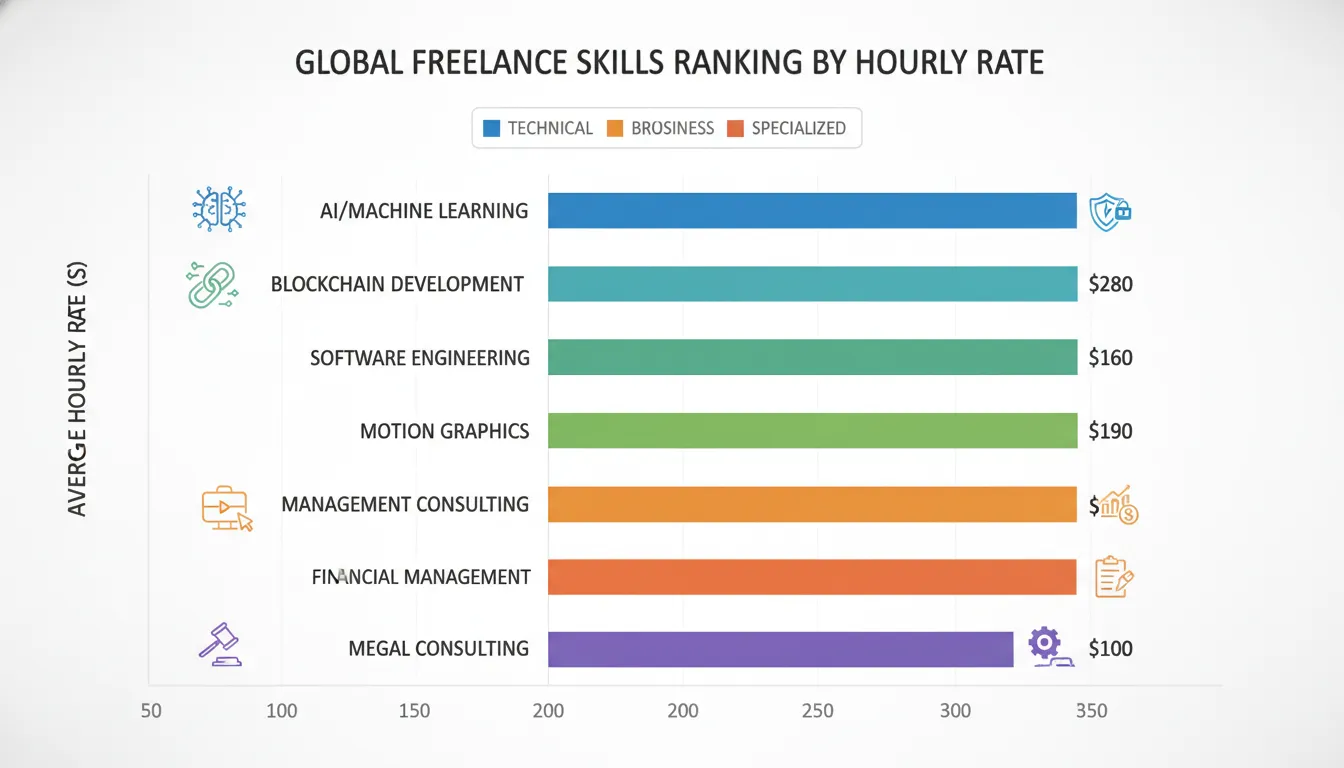
The 15 Highest-Paying Freelance Skills (Ranked by Average Hourly Rate)
1. AI/Machine Learning Engineer: $120-300+/hour
Machine learning engineers are the new gold standard of freelancing. Companies racing to implement AI solutions need expertise immediately, and they’ll pay for speed and quality.
These professionals build predictive models, develop neural networks, and implement machine learning systems for companies across industries. Unlike junior developers, ML engineers require deep knowledge of mathematics, statistics, and advanced programming. Demand vastly exceeds supply.
What they do: Build recommendation algorithms, predictive analytics systems, anomaly detection models, and AI-powered applications.
Why they earn top rates: They directly impact company profitability through automation and optimization. A machine learning model that improves manufacturing efficiency by 5% might be worth millions annually to a client.
Typical clients: SaaS platforms, fintech firms, enterprise software companies, e-commerce operations, manufacturing firms.
Experience level: Typically requires 5+ years as a developer plus advanced ML knowledge. Many are advanced degree holders.
—
2. Fractional CTO/VP of Engineering: $150-350+/hour
Startups and scaling companies need senior technical leadership but can’t justify $250K+ full-time salaries. Enter the fractional CTO.
Fractional CTOs provide strategic technical direction, architecture decisions, hiring guidance, and technical debt management on a part-time or project basis. This is one of the fastest-growing segments in freelance consulting.
What they do: Guide technical strategy, architect systems, make build-vs-buy decisions, oversee engineering teams, manage technical hiring.
Why they earn premium rates: Decision-making ability. A poor architectural choice costs hundreds of thousands. Good strategic guidance saves that amount. Clients pay accordingly.
Typical clients: Series A-C startups, scale-ups adding engineering teams, companies transitioning from founder-led to professional tech leadership.
Experience level: Requires 10+ years in engineering, ideally 5+ years in leadership roles. Usually someone who’s successfully scaled teams or companies.
—
3. Conversion Rate Optimization (CRO) Specialist: $100-250/hour
Digital entrepreneurs understand this: a 5% improvement in conversion rate often outpaces customer acquisition spending in ROI. CRO specialists are directly responsible for this type of revenue impact.
These professionals audit funnels, design A/B tests, analyze user behavior, and implement changes that increase the percentage of visitors who become customers.
What they do: Identify conversion barriers, design and execute A/B tests, analyze data, implement improvements, train teams on optimization frameworks.
Why they earn premium rates: Direct revenue impact. Unlike brand designers (who improve perception), CRO specialists improve bottom-line metrics. A CRO engagement that increases conversion from 2% to 2.5% on $10M annual revenue adds $500K in revenue.
Typical clients: E-commerce brands, SaaS companies, digital agencies, online course platforms, subscription services.
Experience level: Usually requires 5+ years in digital marketing or analytics with deep understanding of statistics and data interpretation.
—
4. Blockchain/Web3 Developer: $100-300+/hour
Despite market volatility, blockchain development remains highly specialized and highly compensated. Companies building decentralized applications, smart contracts, and blockchain infrastructure need scarce expertise.
What they do: Write smart contracts, build dApps, design blockchain architectures, conduct security audits, implement consensus mechanisms.
Why they earn premium rates: Extreme scarcity. Far fewer developers have blockchain expertise compared to traditional development. Barrier to entry is high.
Typical clients: Crypto platforms, DeFi applications, enterprise blockchain implementations, cryptocurrency exchanges, blockchain security firms.
Experience level: Requires solid software engineering foundation (5+ years) plus additional blockchain-specific knowledge. Many have computer science backgrounds.
—
5. Enterprise SEO Strategist: $80-200+/hour
Most SEO freelancers are cheap commodities. Enterprise SEO strategists are different. They work on $10M+ sites, implement strategies across thousands of pages, and report to C-level executives.
What they do: Develop large-scale SEO strategies, conduct competitive analysis, design content architectures, oversee technical implementations, manage complex link-building campaigns.
Why they earn premium rates: They manage multi-million dollar search traffic. A 10% improvement in organic traffic for an enterprise client represents massive revenue impact.
Typical clients: Enterprise e-commerce platforms, large media companies, international brands, established SaaS platforms.
Experience level: Typically 8+ years in SEO, with proven track record of growing organic traffic for major sites. Deep knowledge of search algorithms, technical SEO, and content strategy.
—
6. Full-Stack Product Designer: $80-200/hour
Product designers who understand the full journey from research through implementation command premium rates. They’re not just making things pretty—they’re solving complex user problems.
What they do: Conduct user research, create wireframes and prototypes, design interfaces, conduct usability testing, iterate based on feedback, handoff designs to development.
Why they earn premium rates: They understand business context. Good product design increases retention, reduces support costs, and improves revenue. Poor design wastes engineering resources.
Typical clients: Venture-backed startups, SaaS companies, fintech platforms, tech-forward consumer brands.
Experience level: Usually 5+ years in product design with portfolio demonstrating strategic thinking, not just visual design skills.
—
7. Paid Advertising Strategist (Google Ads, Facebook, LinkedIn): $75-200/hour
For companies that spend $10K-$100K+ monthly on ads, hiring a strategic advertising freelancer beats hiring a full-time employee. The right strategist pays for themselves in improved ROAS (return on ad spend).
What they do: Develop advertising strategies, build and manage campaigns, optimize bids and targeting, conduct A/B tests, analyze performance, provide strategic recommendations.
Why they earn premium rates: Direct revenue responsibility. A $50K/month ad budget managed optimally vs. poorly represents six-figure annual differences.
Typical clients: E-commerce businesses, SaaS companies, digital agencies, service-based businesses, lead generation companies.
Experience level: Usually 5+ years managing large ad budgets with demonstrated performance improvements. Certification from platform providers (Google, Meta) is valuable but not always required.
—
8. Ruby on Rails Developer: $80-180/hour
Experienced Rails developers are increasingly rare. Many have moved to other languages. Companies with legacy Rails systems and new Rails projects still need skilled developers willing to specialize in this niche.
What they do: Build and maintain Rails applications, implement features, optimize performance, design databases, write tests.
Why they earn premium rates: Specialization + scarcity. Most developers learn JavaScript or Python. Rails specialists command premiums.
Typical clients: Established startups, bootstrapped SaaS companies, companies maintaining legacy systems, agencies specializing in Rails.
Experience level: Typically 5+ years in Rails development with strong understanding of Ruby, Rails conventions, and web development principles.
—
9. Technical Writer for SaaS/Software: $60-150/hour
Technical writers who understand software, developers, and how to translate complex concepts into clear documentation are essential for SaaS companies. Poor documentation costs companies in support expenses and user churn.
What they do: Write API documentation, create user guides, develop knowledge bases, record tutorial videos, manage documentation systems.
Why they earn premium rates: Specialization. Most writers aren’t technical. Technical writers who understand code, architecture, and developer needs are scarce.
Typical clients: SaaS companies, software platforms, developer tools, API providers, enterprise software companies.
Experience level: Usually 3+ years in technical writing, ideally with software development background or deep technical knowledge.
—
10. Growth Marketing Consultant: $75-175/hour
Growth marketing specialists combine product, marketing, data, and psychology to accelerate company growth. They’re particularly valuable for companies between $1M-$10M in revenue.
What they do: Develop growth strategies, design experiments, analyze retention and churn, optimize funnel metrics, build growth loops, coordinate across departments.
Why they earn premium rates: They focus on metrics that matter. A successful growth consultant can double a company’s growth rate. That’s worth $50K-$150K annually in additional revenue.
Typical clients: Venture-backed startups, scaling SaaS companies, e-commerce platforms, marketplace companies.
Experience level: Usually 5+ years in growth or marketing roles, typically at high-growth companies. Deep data analysis and strategic thinking skills.
—
11. Brand Strategy & Positioning Consultant: $80-180/hour
Strong brands command premium prices and customer loyalty. Companies spend millions on development and acquisition but often neglect brand strategy. Consultants who help articulate brand positioning and strategy are increasingly valuable.
What they do: Conduct market research, define brand positioning, develop messaging frameworks, create brand guidelines, advise on brand extensions.
Why they earn premium rates: Brand value directly impacts business value. A company with strong brand can raise capital easier, charge higher prices, and reduce churn.
Typical clients: Growing SaaS companies, venture-backed startups, established brands exploring repositioning, B2B companies.
Experience level: Usually 8+ years in marketing/branding with track record of developing successful brand strategies. Often comes from agency backgrounds.
—
12. Fractional CFO/Financial Strategist: $100-250+/hour
Startups and small businesses need financial guidance but can’t afford full-time CFOs earning $150K+. Fractional CFOs fill this gap, advising on capital strategy, financial planning, and metrics.
What they do: Build financial models, advise on fundraising, manage cash flow planning, develop financial strategy, analyze unit economics.
Why they earn premium rates: Financial decisions compound over time. A company that raises capital at good terms, manages cash effectively, and makes smart investment decisions outperforms competitors significantly.
Typical clients: Venture-backed startups, bootstrapped companies seeking growth capital, established businesses planning exits.
Experience level: Usually requires 10+ years in finance, often including startup experience and demonstrated success in financial strategy roles.
—
13. Cybersecurity Consultant: $90-220+/hour
As cyberattacks increase, companies desperately need security expertise. Cybersecurity consultants help companies prevent breaches, comply with regulations, and audit security posture.
What they do: Conduct security audits, identify vulnerabilities, design security architecture, advise on compliance (GDPR, HIPAA, etc.), train teams.
Why they earn premium rates: The cost of a single breach can exceed millions. Companies pay significantly to prevent this risk.
Typical clients: SaaS companies, fintech firms, healthcare providers, enterprises with significant data assets.
Experience level: Usually requires 8+ years in cybersecurity with certifications (CISSP, CEH) and demonstrated expertise.
—
14. Interim Executive/Consultant: $100-250+/hour
Companies facing challenges often hire interim executives or senior consultants to guide them through transitions, turnarounds, or major decisions. This requires both expertise and credibility.
What they do: Provide strategic guidance, manage transitions, solve specific business problems, advise leadership teams.
Why they earn premium rates: They carry accountability and credibility. Companies trust them with major decisions.
Typical clients: Venture-backed companies, established businesses facing transitions, nonprofits and organizations undergoing change.
Experience level: Usually requires 15+ years of experience, ideally with track record of solving problems at high levels.
—
15. Specialized Content Strategist (High-RPM Niches): $60-150/hour
Not all content strategists earn premium rates. Those specializing in high-RPM niches—like fintech, healthcare, B2B software, and legal—earn significantly more than those writing about entertainment or lifestyle.
What they do: Develop content strategy, identify topics, oversee content production, optimize for search and user intent, analyze performance.
Why they earn premium rates: High-RPM niches have higher ad rates and more revenue per user. Clients can afford to pay more. Additionally, these niches require deeper expertise to explain complex concepts.
Typical clients: Fintech companies, healthcare organizations, B2B software firms, legal tech platforms, complex B2B companies.
Experience level: Usually requires 5+ years in content strategy plus domain expertise in the specific niche.
—
Key Takeaways
How Hourly Rates Translate to Annual Income
Here’s how these rates translate to actual annual income. Using 1,000 billable hours annually (roughly 20 hours/week for 50 weeks):
| Skill | Hourly Rate Range | Annual Income (1,000 hours) | Annual Income (1,500 hours) |
| ——- | ——————- | —————————– | —————————– | <br /> |
|---|---|---|---|---|
| AI/ML Engineer | $120-300 | $120,000-$300,000 | $180,000-$450,000 | |

Advertisement