
You’re creating content, building an audience, and asking the right question: *How much can I actually make?*
Here’s the reality: A freelancer in Germany posting the same quality entertainment video as a finance expert will earn a fraction of the revenue. According to recent industry data, YouTube CPM rates in Germany have diversified dramatically heading into 2026, with certain niches commanding 5-7 times the advertising rates of others. The German digital advertising market continues its upward trajectory, projected to exceed €10 billion annually, and content creators who understand where that money flows position themselves to capture it.
But CPM is only half the story. RPM (Revenue Per Mille)—what *you* actually receive after YouTube’s cut—is what matters for your freelance income. The gap between CPM and RPM can be significant, and knowing how to bridge it determines whether YouTube becomes meaningful income or pocket change.
This guide breaks down everything freelancers need to know about YouTube earnings in Germany for 2026: current rates by niche, the metrics that actually matter, proven strategies to increase revenue, and how to calculate your realistic earning potential.
What Is YouTube CPM and Why Does Germany Matter?
CPM stands for Cost Per Mille (cost per thousand impressions). It’s the amount advertisers pay YouTube for every 1,000 times their ad displays on your video. If your video generates 100,000 views and your CPM is $5, YouTube (before taking their cut) earns $500 from ad revenue on that video.
RPM is Revenue Per Mille—the money *you* receive per 1,000 views after YouTube takes its 45% commission. So in the example above, if your CPM is $5, your RPM might be around $2.75 (depending on your exact cut and content type).
Germany matters because it’s one of Europe’s most valuable advertising markets. German advertisers and international brands targeting German-speaking audiences have substantial budgets. This means CPM rates in Germany are consistently higher than in many other regions. Additionally, Germany has strict data privacy regulations (GDPR compliance, NetzDG law) that influence which ads run, but those same regulations make German users valuable to premium advertisers willing to pay more for access.
For freelancers specifically, understanding Germany’s CPM landscape matters because:
1. Location of your audience, not your residency, determines advertiser demand and rates
2. Content category determines CPM value more than video quality alone
3. Seasonal fluctuations (Q4 being strongest) create earning peaks and valleys
4. Diversification beyond CPM (affiliates, sponsorships, Patreon) becomes critical when base CPM is low
The German digital advertising market continues to grow in 2026-2027, with programmatic advertising and AI-driven targeting pushing quality over quantity. Freelancers who create content in high-value niches capture disproportionate earnings.
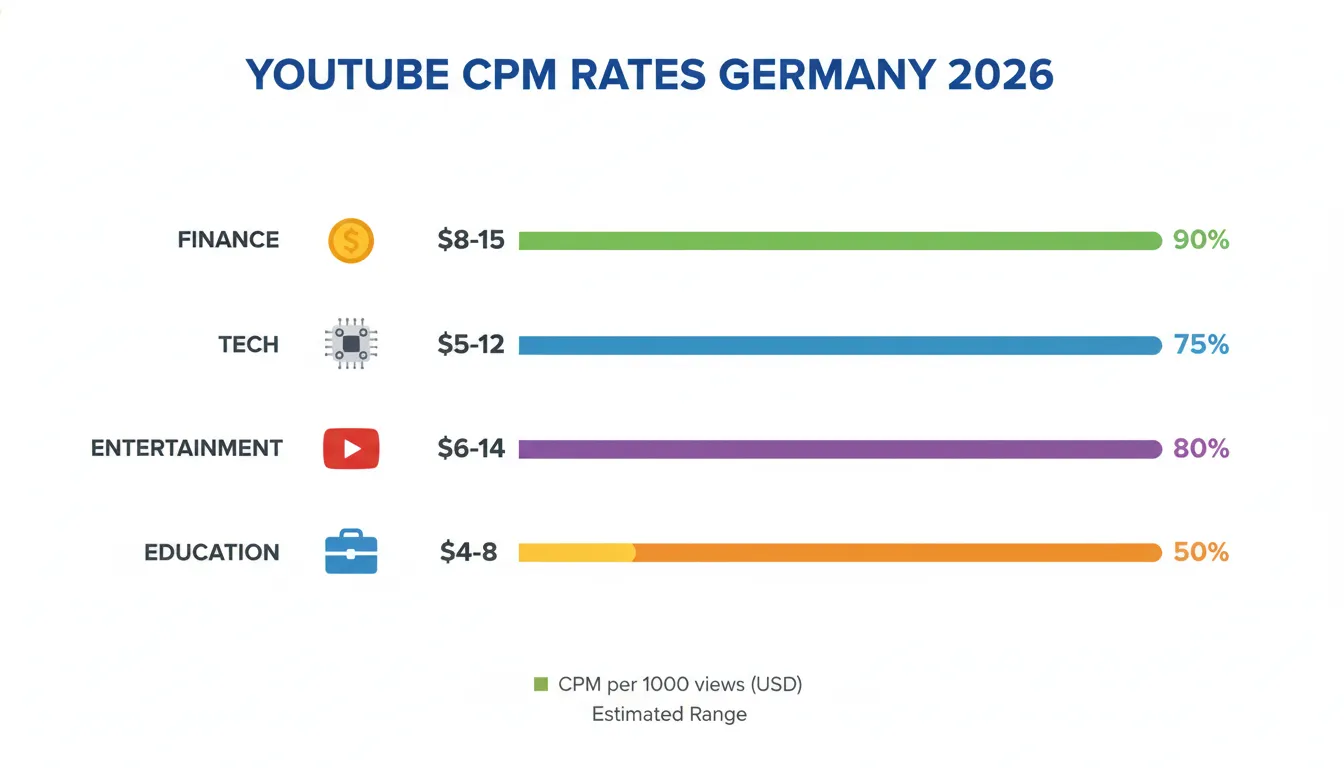
Current YouTube CPM Rates in Germany by Niche (2026 Data)
CPM rates fluctuate monthly and vary by content category. Here’s what freelancers should expect in Germany for 2026:
| Niche Category | CPM Range (EUR) | CPM Range (USD) | Advertiser Demand | Volatility |
| — | — | — | — | — | <br /> |
|---|---|---|---|---|---|
| Finance & Investing | €7-14 | $8-15 | Very High | Low | |
| Technology & Software | €4.50-11 | $5-12 | High | Medium | |
| Business & Entrepreneurship | €5.50-13 | $6-14 | High | Medium | |
| B2B SaaS | €6-15 | $7-16 | Very High | Low | |
| Education & Courses | €3.50-8 | $4-8.50 | Medium | Medium | |
| Real Estate | €4-10 | $4.50-11 | High | High | |
| Health & Wellness | €3-7 | $3.50-7.50 | Medium | High | |
| Travel & Lifestyle | €2-4.50 | $2.50-5 | Low-Medium | High | |
| Entertainment & Comedy | €1.50-3 | $2-4 | Low | High | |
| Gaming | €2-5 | $2.50-6 | Low-Medium | Very High | |
| DIY & Craft | €2.50-5 | $3-5.50 | Low-Medium | Medium |
Key Insight: Finance and B2B content earns 4-5x more per view than entertainment. A 100,000-view finance video might generate €1,000-1,400 in CPM revenue. The same views on an entertainment video? €150-300. This single fact should drive your content strategy if you’re serious about freelance YouTube income.
Rates vary based on:
– Viewer location concentration (German viewers command higher rates than global)
– Viewer demographics (professionals/business decision-makers earn more than hobbyists)
– Time of year (Q4 and January are strongest; July-August are weakest)
– Content freshness (new vs. evergreen content)
– Advertiser brand safety perception (controversial content sees advertiser pullback)
How to Calculate Your Realistic YouTube Revenue Potential
Many freelancers chase view counts, but views alone are meaningless. You need to calculate actual revenue potential based on *your* niche and audience composition.
The Real Calculation:
1. Start with projected monthly views (be conservative)
2. Apply your niche’s CPM range (use middle estimate)
3. Multiply by YouTube’s creator payout (roughly 55% of CPM, though it varies)
4. This gives you realistic RPM and monthly earnings
Example 1: Finance Content Creator
– Monthly views: 50,000
– Niche CPM: €10 (middle of €7-14 range)
– YouTube payout (55%): €10 × 0.55 = €5.50 RPM
– Monthly revenue: 50,000 views ÷ 1,000 × €5.50 = €275
Example 2: Entertainment Content Creator
– Monthly views: 50,000
– Niche CPM: €2.50 (middle of €1.50-3 range)
– YouTube payout (55%): €2.50 × 0.55 = €1.37 RPM
– Monthly revenue: 50,000 views ÷ 1,000 × €1.37 = €68.50
Same audience size. Different niche. 4x revenue difference.
Real-World Variables That Affect Your Actual Numbers:
– YouTube’s exact revenue split varies by region and creator program status (standard 55%, but can range 50-60%)
– Click-through rates (CTR) on ads vary by content type (business content typically 1-2%, entertainment 0.3-0.8%)
– Advertiser fill rates (not every impression gets an ad; average fill is 60-80%)
– Brand safety filtering (YouTube demonetizes content it deems risky, even if you’ve enabled ads)
– Seasonal demand (rates drop 30-50% in summer, spike 40-100% in Q4)
The gap between CPM and what you receive can be substantial. This is why diversification matters.
Key Takeaways
Three Strategies to Maximize YouTube Revenue as a Freelancer
Strategy 1: Shift Content Toward High-CPM Niches (Without Losing Authenticity)
If your current content is low-CPM entertainment, you don’t need to abandon your audience. You reposition.
The Shift Method:
A gaming creator with 50,000 subscribers earning €50-100/month could transition to “game development tutorials” (tech niche), “streamer business advice” (business niche), or “esports investing” (finance niche). Same audience. Higher CPM.
Real example: A German YouTuber with comedy skits (€2.50 CPM) shifted to “creator business breakdowns” (€10+ CPM) and tripled monthly earnings within 4 months without losing subscribers.
Action Steps:
1. Audit your current audience (YouTube Analytics → Audience tab)
2. Identify what professional value they have (What do they do for work?)
3. Create 3-5 test videos shifting your content angle toward that professional interest
4. Measure CPM results in YouTube Studio after 2 weeks
5. Double down on whatever shows the highest CPM
Time Investment: 2-3 hours planning, plus normal video production.
Strategy 2: Expand Revenue Beyond CPM (The 60/40 Principle)
The smartest YouTube creators don’t rely solely on ad revenue. They follow what I call the 60/40 principle:
– 60% of YouTube revenue from diversified sources (sponsorships, affiliates, courses, Patreon)
– 40% from CPM/ads
For a freelancer with 10,000-100,000 subscribers, this means:
Sponsorship Deals:
– Typical rate: €500-5,000 per video (depending on subscriber count)
– Frequency: 1 sponsorship per 4-8 videos
– Monthly potential: €500-2,000 with just 1-2 deals
Affiliate Marketing:
– Products you genuinely recommend (software, tools, courses)
– Typical commission: 5-30%
– Monthly potential: €100-1,000 (if audience buys)
Digital Products:
– Online course, Gumroad templates, Notion templates
– One-time creation, recurring sales
– Monthly potential: €200-5,000+ (if audience size supports it)
YouTube Membership/Patreon:
– Recurring revenue from superfans
– Typical: €5-15/month per member
– Monthly potential: €100-2,000 (requires 20-200 paying members)
A freelancer earning €200/month from CPM but landing just one €800 sponsorship monthly has quadrupled income.
Strategy 3: Optimize for German Viewers Specifically (Geographic Targeting)
YouTube CPM rates vary dramatically by viewer location. German viewers on German-targeted content command 2-3x higher rates than global viewers watching the same video.
Optimization Steps:
1. Research keyword demand in German using Google Keyword Planner (set location: Germany)
2. Create German-language content or German subtitles (boosts German audience concentration)
3. Target German pain points (German business/finance creators reference German regulations, taxes, market conditions)
4. Build community in German (YouTube comments, Discord, email—in German)
5. Include German case studies/examples (shows viewers you understand their context)
Example: A B2B SaaS creator making English content reaches 60% German, 40% global audience. By creating German-language versions or German-focused episodes, they shift to 85% German audience. CPM jumps from €8 to €12 automatically because advertiser demand is higher for concentrated German audiences.
Time Investment: 1-2 extra hours per video for German subtitles or dubbed sections.

Tools, Resources & Cost Breakdown for YouTube Creators
Revenue Calculation & Analytics Tools
| Tool | Purpose | Cost | Best For |
| — | — | — | — | <br /> |
|---|---|---|---|---|
| YouTube Studio (Native) | View CPM, RPM, earnings over time | Free | Basic tracking | |
| VidIQ | CPM estimates, competitor analysis, niche research | Free – $99/month | Planning content strategy | |
| TubeBuddy | Keyword research, competitor CPM data, optimization | Free – $39/month | SEO optimization | |
| Social Blade | Track subscriber growth, earnings estimates (public channels) | Free | General benchmarking | |
| RPM Calculator (Google Sheets Template) | Custom calculations for your numbers | Free | Personalized projections |
Recommended Setup for Freelancers:
– YouTube Studio (required, free)
– VidIQ free version (provides competitive CPM insights)
– Custom spreadsheet (track your actual CPM month-to-month)
– Total monthly cost: €0 (free tools work fine for most creators)
Content Production Tools (One-Time Investment)
If you’re starting from scratch, basic equipment:
– Microphone: Blue Yeti or Audio-Technica AT2020 (€50-120)
– Camera: Smartphone or used mirrorless (€0 if using phone, €300-800 for dedicated)
– Editing Software: DaVinci Resolve (free) or Adobe Premiere Pro (€55/month)
– Thumbnail Design: Canva Pro (€13/month)
Total startup: €0-500 (if using existing phone + free software)
Pros and Cons of YouTube Monetization as a Freelancer Income Stream
Pros
✅ Passive income potential: Created once, generates revenue indefinitely (if audience remains)
✅ Multiple revenue streams: CPM + sponsorships + affiliates + products = diversified income
✅ Low barrier to entry: €0 startup cost (use your phone)
✅ Audience building: Every subscriber is potential customer for your freelance services
✅ Scalable without time commitment increase: 100,000 views earns same CPM per 1,000 as 10,000 views (just need bigger audience)
✅ High-niche value: Finance/B2B creators can earn €5,000-20,000/month with modest audiences (10k-50k subscribers)
✅ Geographic flexibility: Work from anywhere, earn in euros/dollars
Cons
❌ Slow to profitability: Takes 3-12 months to reach monetization threshold (1,000 subscribers, 4,000 watch hours)
❌ Algorithm unpredictability: Views fluctuate wildly; no guaranteed income
❌ Niche-dependent earnings: Low-CPM content creators earn minimal income regardless of effort
❌ Time-intensive: Creating consistent, quality content requires 10-20 hours/week
❌ Requires audience scale: Need 50k+ subscribers for income approaching full-time (in low-CPM niches)
❌ Platform risk: YouTube algorithm changes, demonetization, policy shifts can kill earnings overnight
❌ Highly competitive: Entering established niches is difficult; standing out requires months of effort
❌ CPM volatility: Summer earnings may be 30-50% lower than Q4; unpredictable month-to-month
❌ Advertiser-dependent: CPM rates set by advertiser demand, not creator; you have limited control
Real-World Case Studies: German Freelancers Earning on YouTube
Case Study 1: Tech Freelancer → Software Tutorial Creator
Profile: Marcus, freelance software developer (Germany, Munich)
Starting point:
– 8,000 subscribers, 2,500 watch hours (eligible for monetization)
– Content: Django and Python tutorials
– CPM: €4-6
– Monthly earnings: €80-120
What changed:
– Added “freelance pricing strategy” and “software business” videos alongside tutorials
– Shifted toward business/tech niche positioning
– Attracted business decision-makers, not just hobbyists
Results after 6 months:
Advertisement