

Introduction
YouTube monetization has fundamentally changed how working professionals view content creation as a side income or primary business. In 2026, the United States digital ad market continues to expand, projected to reach over $300 billion, with YouTube capturing a significant portion of programmatic ad spending. But here’s what most creators don’t realize: CPM rates have become increasingly stratified by niche and audience quality.
If you’re running a YouTube channel, your earnings aren’t just determined by subscriber count or view volume anymore. They’re determined by what advertisers are willing to pay for access to *your specific audience*. A finance channel with 50,000 subscribers can earn more per month than an entertainment channel with 500,000 subscribers—and it comes down to CPM (Cost Per Mille) rates.
In 2026, we’re seeing a clear market bifurcation. High-RPM niches like business, finance, technology, and professional development are outperforming traditional entertainment by enormous margins. Meanwhile, general entertainment and lifestyle channels are facing increasing competition and ad-rate pressure. This guide breaks down exactly what’s happening with YouTube CPM rates in 2026, gives you actionable benchmarks, and shows you how to position your channel for maximum earnings—regardless of your niche.
Whether you’re thinking about starting a channel, optimizing an existing one, or trying to understand why your earnings fluctuate, the data and strategies in this guide will give you a competitive edge.
What Is CPM and Why Does It Matter in 2026?
CPM stands for “Cost Per Mille,” which means the cost advertisers pay for every 1,000 ad impressions on your videos. This is different from RPM (Revenue Per Mille), which is what *you* actually earn after YouTube takes its 45% cut. Understanding this distinction is critical because CPM is what determines your channel’s revenue potential.
Here’s the straightforward breakdown:
– CPM: What advertisers pay YouTube for 1,000 impressions
– RPM: What you earn per 1,000 impressions after YouTube’s revenue share
– Formula: RPM typically equals 55% of CPM (though this varies by factors like advertiser demand and seasonality)
In 2026, average CPM rates across the United States platform range from $2 to $50+, depending on multiple factors. The variation isn’t random—it’s based on advertiser demand, audience demographics, content category, and seasonal trends.
Why does CPM matter so much? Because it directly impacts your channel’s viability as an income source. A channel with 100,000 monthly views at a $5 CPM will earn roughly $500 per month. The same 100,000 views at a $25 CPM will earn $2,500. That’s a 400% difference from the exact same amount of traffic. For working professionals exploring YouTube as a side income or transition into full-time creation, understanding and optimizing CPM is the difference between negligible earnings and meaningful revenue.
The 2026 landscape also reflects shifting advertiser priorities. Brands are increasingly focused on brand-safe content with engaged, higher-income audiences. They’ll pay premium rates to reach accountants, entrepreneurs, software engineers, and business owners. Simultaneously, they’re pulling budgets from lower-engagement general content. This represents a major shift from the earlier days of YouTube, where view counts were the primary currency.

2026 YouTube CPM Rates by Niche: Real Benchmarks
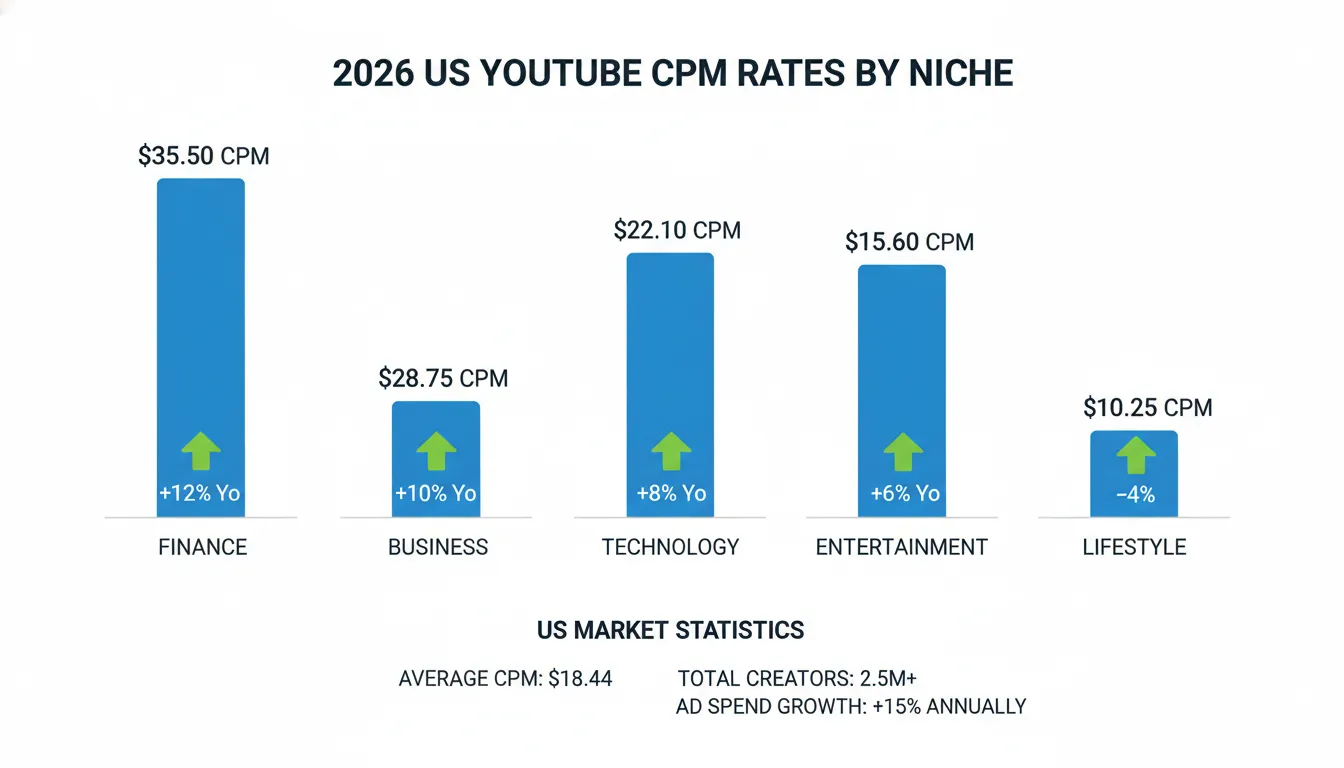
The most important data point for your channel’s earnings potential is understanding what CPM rates look like in your specific niche. 2026 data shows dramatically different rates across categories, and these benchmarks are critical for realistic income projections.
Finance & Investing: $35–$65 CPM
This niche continues to dominate in terms of advertiser willingness to pay. Content about stocks, cryptocurrency, personal finance, and investing attracts premium advertisers because the audience typically has higher disposable income and purchasing power. Fintech companies, investment platforms, and financial advisories bid aggressively for this audience. A finance channel with 250,000 monthly views can realistically earn $8,750–$16,250 per month from CPM alone.
Business & Entrepreneurship: $25–$50 CPM
B2B and entrepreneurship channels attract course creators, software platforms, accounting firms, and business service companies. The ROI for these advertisers is measurable and trackable, which keeps CPM rates elevated. Content about startups, scaling businesses, management, and professional development commands consistent advertiser demand.
Technology & Software: $20–$45 CPM
Tech channels benefit from both consumer tech advertising and B2B software companies. This niche has maintained strong CPM rates because tech audiences are typically early adopters with higher engagement rates and longer average view duration. Viewers in this space are also more likely to click through to advertiser links.
Digital Marketing & SEO: $18–$40 CPM
Marketing-focused channels attract both agency advertising and advertiser spending from companies wanting to reach marketing professionals. The complexity of the content and engaged audience keeps these rates elevated.
Health & Wellness (Professional): $15–$35 CPM
This category is nuanced. General fitness content earns $3–$8 CPM, but professional health content—medical education, clinical training, professional wellness programs—commands much higher rates from medical device companies, pharmaceutical marketers, and healthcare institutions.
Productivity & Personal Development: $12–$28 CPM
Courses, software platforms, and productivity tools actively advertise in this space. However, rates are lower than pure business content because audiences may have lower average incomes.
Entertainment & Vlogging: $2–$8 CPM
This is the most competitive and lowest-CPM category. Even channels with massive viewership struggle with earnings because advertiser demand is high but advertiser budgets are stretched thin across millions of creators. A vlogging channel with 1 million monthly views might earn $2,000–$8,000 per month.
General Lifestyle: $3–$10 CPM
Cooking, home improvement, fashion, and general lifestyle content occupy a middle ground. These categories have moderate advertiser interest but also significant competition.
News & Current Events: $5–$15 CPM
News and opinion content has variable CPM rates depending on advertiser sentiment toward the specific topics covered. Political sensitivity can impact advertiser willingness to place ads.
Gaming: $4–$12 CPM
Gaming channels remain competitive with low CPM rates despite massive viewership. The audience is often younger with lower purchasing power, which reduces advertiser value. Specific gaming categories (esports analysis, professional gaming commentary) earn higher rates.
This variation is crucial to understand because it directly affects your channel strategy. If you’re a working professional looking to build YouTube income, niche selection matters enormously.
Key Takeaways
Factors That Impact Your Actual CPM Rate in 2026
Not every finance channel earns a $50 CPM. Not every entertainment channel earns $5. Your actual CPM rate depends on multiple factors that operate together to determine what advertisers will pay for access to your specific audience.
Audience Geographic Location & Purchasing Power
CPM rates vary significantly based on audience geography. US-based audiences command higher CPM rates than international audiences. Within the US, audiences in major metropolitan areas and higher-income zip codes attract more premium advertising. If 80% of your audience is in the United States, your CPM will be substantially higher than if only 30% is US-based. This is why creators often report CPM fluctuations when their audience composition changes.
Audience Age Demographic
Audiences aged 25–54 (particularly 25–44) attract the highest CPM rates. This working-age demographic with purchasing power and business decision-making authority is the most valuable to advertisers. Audiences under 18 or over 65 typically generate lower CPM rates because advertisers perceive lower purchasing power or relevance to their product offerings.
Audience Income Level & Professional Status
Advertisers use viewer data to assess audience income. If your analytics show that your audience consists largely of professionals earning $75,000+, you’ll see higher CPM rates. This is why business and finance channels naturally command premium rates—the audience profile matches what high-paying advertisers are seeking.
Content Category & Brand Safety
Certain content categories are simply more advertiser-friendly. Content about finance, business, technology, and professional development attracts premium advertisers. Content that’s controversial, politically polarizing, or deals with sensitive topics (even if handled professionally) may see advertiser hesitation, reducing CPM rates. YouTube’s brand safety filters also affect this—content that triggers demonetization or limited advertiser-friendly content warnings will see dramatically reduced CPM.
Viewer Engagement Metrics
CPM rates increase when your audience engages with content. Higher average view duration, better click-through rates on cards and end screens, and more frequent comments signal to advertisers that your audience is engaged. YouTube’s algorithm rewards engaged creators with better ad placement, which also attracts premium advertisers. A channel with a 50% average view duration will earn more CPM than a channel with 25% average view duration, even with identical traffic.
Seasonality & Time of Year
Q4 (October–December) consistently sees higher CPM rates because advertiser budgets are highest and businesses are spending more to reach holiday shoppers. Q1 and early Q2 typically see lower rates as advertiser budgets tighten after holiday spending. Summer months (June–August) also see reduced CPM rates as advertising budgets are reallocated. In 2026, this pattern continues, with Q4 rates typically 25–40% higher than Q1 rates in the same niche.
Video Length & Ad Format
Longer videos (10+ minutes) accommodate more ads and generate higher total revenue. However, CPM itself isn’t directly affected by video length. What matters is the number of ad placements and where they’re positioned. Mid-roll ads (ads in the middle of videos) typically have higher CPM rates than pre-roll or post-roll ads because viewers are more engaged at that point.
Historical Channel Performance & Authority
YouTube’s algorithm and advertiser bidding systems favor established channels with consistent performance. A channel with a 2-year track record of strong viewer retention and engagement will command higher CPM rates than a brand-new channel with identical audience demographics. This is why CPM rates typically increase as your channel grows.
Advertiser Demand Trends
Real-time advertiser demand affects CPM rates. When a particular product category (like cryptocurrency or AI software) experiences high advertiser spending, CPM rates in related content categories spike. Similarly, when advertiser demand drops for a particular category, CPM rates fall accordingly.

How to Calculate Your Potential Monthly YouTube Earnings
Understanding the formula for calculating potential earnings is essential for planning whether YouTube makes sense as an income source for you. Here’s the straightforward calculation:
Formula:
Monthly Earnings = (Monthly Views ÷ 1,000) × Your Average RPM
Example calculation:
– Monthly views: 100,000
– Average niche CPM: $20
– Your average RPM (55% of CPM): $11
– Monthly earnings: (100,000 ÷ 1,000) × $11 = $1,100
Here are realistic earnings scenarios for different channels:
Finance Channel (CPM: $40)
– 50,000 monthly views: $1,100 per month
– 100,000 monthly views: $2,200 per month
– 500,000 monthly views: $11,000 per month
– 1,000,000 monthly views: $22,000 per month
Business Channel (CPM: $30)
– 50,000 monthly views: $825 per month
– 100,000 monthly views: $1,650 per month
– 500,000 monthly views: $8,250 per month
– 1,000,000 monthly views: $16,500 per month
Entertainment Channel (CPM: $5)
– 50,000 monthly views: $137.50 per month
– 100,000 monthly views: $275 per month
– 500,000 monthly views: $1,375 per month
– 1,000,000 monthly views: $2,750 per month
The contrast is dramatic. This is why niche selection is strategically crucial. A finance creator hitting 100,000 views monthly earns what an entertainment creator needs 800,000 monthly views to earn.
Strategies to Maximize Your YouTube CPM in 2026
Understanding CPM rates is one thing. Actually increasing your CPM and RPM is another. Here are the most effective, implementable strategies for maximizing your earnings in 2026.
Strategy 1: Attract High-Value Audience Demographics
Focus your content marketing on reaching professionals and decision-makers in your niche. If you’re creating finance content, directly target accountants, financial advisors, business owners, and investors through your YouTube titles, descriptions, and community posts. Use analytics to understand who’s watching and adjust your content to attract higher-income viewers.
This is specific and measurable. Look at your YouTube Analytics “Audience” tab and check the income and professional status of your viewers. If you’re attracting lower-income demographics than your niche suggests, your content positioning or target keywords may be off.
Strategy 2: Create Content Series That Increase Watch Time
CPM is influenced by view duration and total watch time. Creating episodic series, educational multi-part content, and binge-worthy formats keeps viewers watching longer. The longer your average view duration, the more ad inventory you can include, and the more attractive your channel becomes to premium advertisers.
A 12-minute video with two mid-roll ads generates more total revenue than a 6-minute video with one pre-roll ad, even if CPM rates are identical. Strategic series structure increases both view duration and total revenue.
Strategy 3: Optimize for Search and Discovery, Not Just Recommendations
YouTube search-based traffic (viewers actively searching for specific topics) tends to come from more intentional, engaged audiences. These audiences often have higher income and professional status, which attracts premium advertisers. Entertainment and gaming content relies heavily on YouTube’s recommendation algorithm, which brings more casual viewers with lower advertiser value.
Use Google Keyword Planner, TubeBuddy, or VidIQ to identify high-search-volume keywords in your niche with commercial intent. Create content specifically targeting these searches rather than relying purely on algorithmic recommendations.
Strategy 4: Maintain Consistent Brand Safety
Avoid controversial topics, political content, and sensitive subjects that trigger advertiser hesitation. This isn’t about being bland—it’s about being intentional. You can still be opinionated and compelling while maintaining advertiser-friendly positioning. Channel demonetization or advertiser-friendly content warnings directly tank CPM rates.
Review YouTube’s advertiser-friendly content guidelines and audit your channel’s recent content for potential issues. Even one controversial video can damage your channel’s CPM rates for months.
Strategy 5: Leverage Seasonal Trends and Q4 Budget Spending
Plan your content calendar to produce peak-performing content during high-CPM seasons. Q4 is your biggest opportunity. Release major series, comprehensive guides, and high-effort content during October–December to capitalize on 25–40% higher CPM rates.
Conversely, during low-CPM seasons (Q1, summer), focus on building audience growth and optimization rather than expecting maximum earnings.
Strategy 6: Collaborate With Premium Brands in Your Niche
Brand deals and sponsorships often pay 2–5x more than ad-based CPM earnings. While this isn’t technically CPM, sponsorships are a crucial revenue lever. Position your channel as an authority in your niche to attract premium brand partnerships. A $5,000 sponsorship deal might pay more than an entire month of CPM earnings for mid-size channels.
Strategy 7: Implement Mid-Roll Ads Strategically
Mid-roll ads (ads in the middle of videos) command higher CPM rates than pre-roll ads because viewers are more engaged. YouTube allows mid-roll ads on videos 8+ minutes long. Structure your videos to hit 10–15 minutes and strategically place mid-roll ads at natural
Advertisement