

The YouTube creator economy in Saudi Arabia is experiencing unprecedented growth, and the numbers are striking. According to recent market data, Saudi Arabia’s digital advertising market is projected to exceed $2.8 billion by 2027, with YouTube commanding a significant share of that investment. For freelancers looking to monetize video content, understanding RPM (Revenue Per Mille) rates specific to the Saudi market is no longer optional—it’s essential.
Here’s the reality: a freelancer creating entertainment content in Saudi Arabia might earn $2–$5 per 1,000 views, while a creator in the fintech or B2B technology space could pull in $18–$30 per 1,000 views for the same volume of traffic. That’s a potential 6-10x difference in revenue.
The Saudi market presents unique opportunities. The Kingdom has one of the fastest-growing digital advertising sectors globally, with advertisers increasingly willing to pay premium rates for targeted content. Government initiatives like Saudi Vision 2030 have accelerated digital transformation, boosting demand for high-quality content across niche categories. For freelancers, this means opportunity. But you need to know where the money actually is.
This guide breaks down YouTube RPM rates in Saudi Arabia for 2026, shows you which niches are crushing it financially, reveals the strategies high-earning creators are using, and provides actionable steps to maximize your revenue. Whether you’re just starting or already running a channel, the data here will reshape how you think about content strategy.
What Is YouTube RPM and How Does It Work?
YouTube RPM (Revenue Per Mille) is the amount you earn for every 1,000 ad impressions on your videos. This is different from CPM (Cost Per Mille), which is what advertisers pay YouTube per 1,000 impressions. YouTube takes a 45% cut, and creators keep 55%.
The formula is straightforward:
RPM = (Total Revenue ÷ Total Views) × 1,000
If your channel earned $550 from 50,000 views, your RPM would be $11. Sounds simple, but RPM fluctuates constantly based on geography, audience demographics, content category, season, and advertiser demand.
RPM isn’t the same across regions. A creator targeting US audiences will typically see significantly higher RPM rates ($8–$20+) compared to creators in developing nations. Saudi Arabia sits in a middle-to-upper tier globally, with RPM rates that have climbed dramatically since 2023.
Why Geography Matters for RPM:
The Saudi market attracts premium advertisers—luxury brands, B2B companies, fintech platforms, and international corporations targeting high-income audiences. When advertisers compete for inventory in wealthy regions with purchasing power, CPM and RPM rates rise. Saudi Arabia’s affluent middle class and business sector create this premium advertising environment.
Seasonality in Saudi RPM:
RPM rates vary throughout the year. Q4 (October-December) typically sees the highest rates due to holiday spending and year-end marketing budgets. Ramadan (March-April in 2026) also impacts rates, with some advertisers increasing spend, while others pull back. Summer months (June-August) traditionally see lower RPM across most markets.
Content Category Impact:
Not all views are created equal. A video about stock trading optimization generates higher advertiser CPM than a video about cooking breakfast. This directly impacts your RPM. Categories like finance, business software, professional development, and technology consistently outperform lifestyle and entertainment categories.
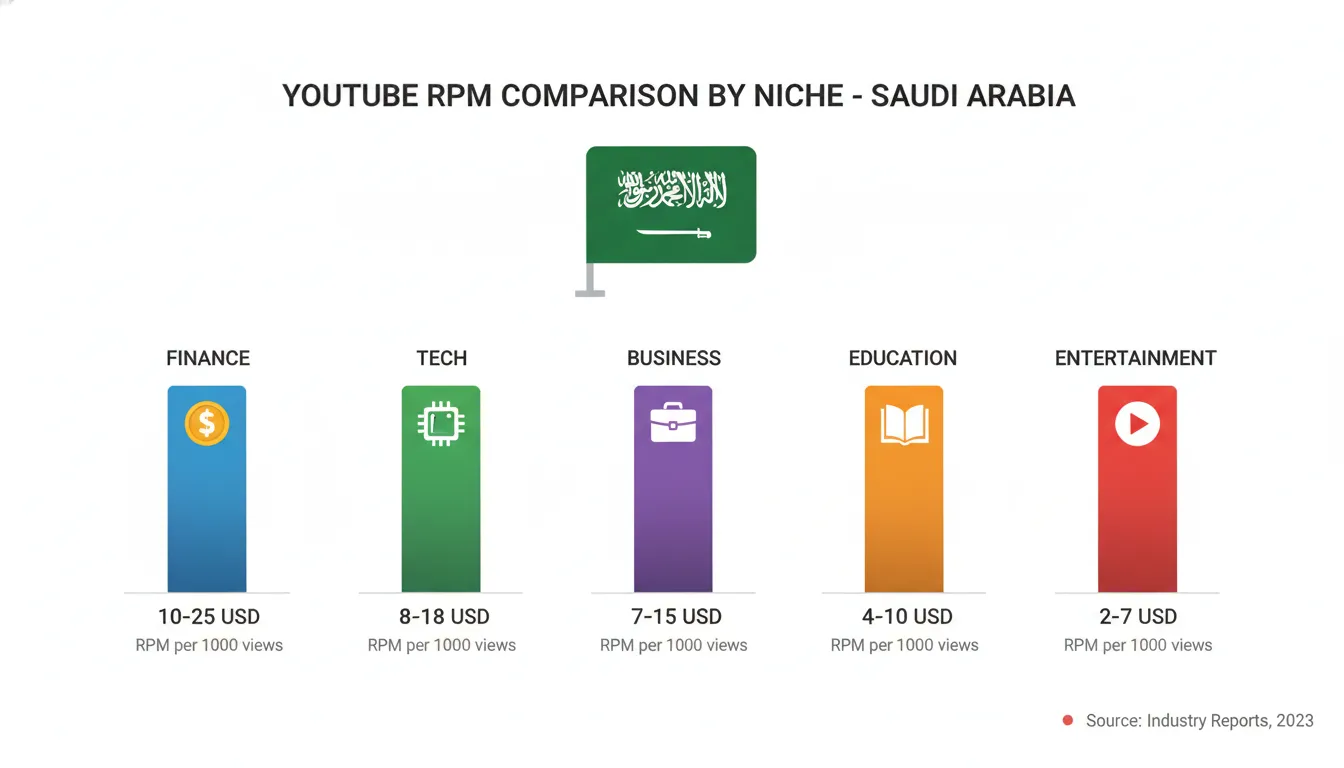
YouTube RPM Rates by Niche in Saudi Arabia (2026)
The Saudi advertising market has matured significantly. Here’s what actual data shows for different content niches:
| Niche | Estimated RPM Range | Advertiser Demand | Best Audience |
| ——- | ——————- | —————— | ————— | <br /> |
|---|---|---|---|---|
| Finance & Trading | $20–$35 | Very High | High-income individuals, business owners | |
| B2B Technology & SaaS | $18–$32 | Very High | Business decision-makers, companies | |
| Real Estate & Construction | $16–$28 | High | Investors, developers, high-net-worth individuals | |
| Professional Development & Courses | $14–$26 | High | Career-focused professionals, entrepreneurs | |
| Automotive & Luxury Goods | $15–$25 | High | Affluent consumers, business executives | |
| Health & Wellness (Medical) | $12–$22 | High | Health-conscious professionals | |
| Digital Marketing & Business | $14–$24 | High | Entrepreneurs, marketing professionals | |
| Lifestyle & Fashion | $6–$14 | Medium | General consumers | |
| Gaming & Entertainment | $3–$8 | Low-Medium | Younger audiences, gaming enthusiasts | |
| News & Commentary | $5–$12 | Medium | Diverse audiences |
Why High-Ticket Niches Dominate Saudi Arabia:
Saudi Arabia’s economy is heavily weighted toward high-income earners and business owners. The Kingdom has the highest concentration of millionaires in the Middle East. When your audience consists of affluent individuals, advertisers pay premium rates to access them. A financial services company will spend $50 CPM to reach a potential investor but only $2 CPM to reach a general entertainment audience.
Additionally, Saudi Vision 2030 initiatives have driven investment in tech startups, fintech, real estate development, and professional services. Companies in these sectors have substantial marketing budgets and compete aggressively for visibility. This competition drives RPM up.
Geographic Targeting Within Saudi Arabia:
Major cities—Riyadh, Jeddah, and Dammam—have higher advertiser demand and RPM rates than smaller cities. If your audience is concentrated in these metros, you’ll likely earn higher RPM than channels targeting rural areas or smaller cities.

Step-by-Step Strategy to Maximize YouTube RPM in Saudi Arabia
Step 1: Identify and Validate High-RPM Niche Opportunities
Start by researching which niches align with your expertise and the Saudi market demand. Don’t just pick what’s popular globally—focus on what’s valuable locally.
Research Actions:
1. Open YouTube Studio and navigate to your Analytics dashboard (even if you’re starting new, test with shorts or community posts).
2. Search for top-performing channels in your potential niche within Saudi Arabia. Look for channels with strong engagement from Saudi audiences.
3. Check the Comments section on these channels—are audiences from Saudi Arabia actively engaging? What questions are they asking?
4. Use Google Trends to search for keyword demand within Saudi Arabia. Filter by country and time period.
5. Visit Social Blade to review competitor channels’ estimated monthly earnings (take these with a grain of salt, but they provide directional insight).
Validation Checklist:
– Does the niche have consistent monthly search volume in Saudi Arabia?
– Are there 10+ established channels already successful in this space?
– Can you identify 3+ potential advertiser categories that would target this audience?
– Is this a niche you can sustain content creation in for 2+ years?
A freelancer might realize that “Saudi fintech tutorials” has massive demand but already has 200 established competitors. However, “fintech for women entrepreneurs in Saudi Arabia” might have 10% of the search volume but 95% less competition. Pick the right wedge into the market.
Step 2: Optimize Channel Fundamentals for High-RPM Advertisers
High-CPM advertisers are selective about where their ads appear. They want brand safety and quality environments. You need to signal that your channel is a premium placement.
Channel-Level Optimizations:
1. Channel Description: Write a professional, keyword-rich description that clearly defines your niche and audience. Include your target audience demographics (e.g., “For Saudi business owners and entrepreneurs exploring digital transformation”).
2. Channel Banner & Logo: Invest in professional design. A polished look signals credibility to both viewers and advertisers. Spend $50–$150 on Fiverr if needed.
3. Playlists: Organize videos into strategic playlists by topic. This increases watch time and signals organization to the algorithm and advertisers.
4. About Section: Add detailed information about who you serve and why. Include keywords naturally.
5. Upload Consistency: Establish a predictable schedule. Advertisers favor channels with consistent, reliable content. Commit to weekly uploads minimum.
High-CPM advertisers review channels before placing ads. A sloppy, disorganized channel gets marked as “risky” and receives lower CPM bids. A professional channel attracts premium advertiser dollars.
Step 3: Create Content That Attracts Premium Advertisers
Your video content directly impacts the CPM advertisers will bid. Some content attracts $30 CPM; other content attracts $3 CPM.
Content Strategies for High CPM:
1. Problem-Solution Format: Instead of entertainment, create tutorials and guides that solve specific business or financial problems. Example: “How to Set Up a Dropshipping Business in Saudi Arabia” attracts e-commerce advertisers. “Funny cooking fails” does not.
2. Target High-Intent Keywords: Research keywords that indicate commercial intent. “How to start a consulting business” (high CPM) beats “what is consulting” (low CPM).
3. Speak to Business Decision-Makers: If your content is business-focused, address the decision-maker directly. Explain ROI, cost savings, or business impact. This attracts B2B advertisers.
4. Quality Production: Invest in decent audio, lighting, and editing. Production quality signals professionalism to both viewers and advertisers. You don’t need Hollywood-level production, but you need clarity and polish.
5. Niche Authority: Go deep rather than broad. A channel with 50 videos on “Saudi fintech regulations” attracts higher CPM than a channel with 200 random business videos.
Step 4: Implement Advanced Monetization Strategies
YouTube AdSense is your baseline, but high-earning freelancers diversify revenue streams to compound earnings.
Additional Monetization Beyond YouTube Ads:
1. Channel Memberships: Enable YouTube memberships ($0.99–$99.99/month). Loyal viewers pay for exclusive content. If 1% of your audience joins at $4.99, that’s meaningful additional revenue. Target: 50–100 members within 6 months.
2. Super Chat & Super Thanks: Enable these features. They cost viewers $1–$500 per Super Chat. During live streams or premiere events, these add up. Estimate: $50–$300/month if you have 5,000+ subscribers.
3. Affiliate Marketing: Recommend tools, courses, or products genuinely useful to your audience. Saudi-based affiliate programs for business tools, courses, and software. Commission rates: 10–50% per sale. High-ticket items (business software: $2,000+) mean $200–$1,000 per affiliate sale.
4. Sponsored Content: Reach out to companies in your niche directly. A B2B software company might pay $2,000–$10,000 for a sponsored video featuring their solution. Always disclose sponsorships clearly.
5. Digital Products: Create and sell courses, templates, or guides. A $97 course sold to 10 viewers per month = $970/month in additional revenue. Use Gumroad or Teachable.
6. Consulting or Freelance Services: Monetize your expertise directly. If you run a “digital marketing tips” channel, offer consulting to businesses. $100/hour × 10 hours/month = $1,000.
Example Revenue Breakdown (1M Views/Month):
– YouTube AdSense (RPM $12): $12,000
– Channel Memberships (200 members @ $4.99): $1,000
– Affiliate Commissions (3 sales/month @ $300): $900
– Sponsored Content (1 video/month): $3,000
– Digital Products: $500
– Total Monthly Revenue: $17,400
Compare this to AdSense alone ($12,000). Diversification increases income by 45%.
Step 5: Build and Maintain Saudi Arabia-Focused Audience Growth
You can’t maximize RPM without scale. You need views. But not just any views—targeted Saudi views.
Audience Growth Strategies:
1. Keyword Optimization: Use TubeBuddy or VidIQ to research keywords with high search volume in Saudi Arabia. Create videos targeting these keywords. Example: “How to get a business visa in Saudi Arabia 2026” (seasonal spike pre-Vision 2030 investment announcements).
2. Community Building: Engage with comments consistently. Respond within 24 hours. Ask questions in videos to encourage comments. High engagement signals quality to YouTube’s algorithm and improves recommendations.
3. Collaborate with Local Creators: Partner with other Saudi creators in complementary niches. Cross-promote. This exposes your channel to relevant audiences.
4. Use YouTube Shorts: Create short-form content that funnels viewers to long-form videos. Shorts have lower CPM, but they drive channel growth. Use them as funnel builders, not primary revenue.
5. Localize Thumbnails & Titles: Use Arabic text strategically. Include local references. If your niche allows, create some content in Arabic or heavily reference Saudi context. This signals relevance to the local algorithm.
6. Advertise Strategically: Once you’re monetized, run YouTube ads targeting Saudi Arabia to promote your channel. Use a small budget ($20–$50/day) to test audience growth. Calculate: if it costs $0.30 to acquire a subscriber and each subscriber watches 10 videos (avg), you need RPM above $0.03 to break even. At $10+ RPM in high niches, this math works.
Key Takeaways
Tools and Resources to Track and Optimize RPM
Freelancers need visibility into their earnings and performance. Here are essential tools:
Free Tools:
1. YouTube Studio Analytics – Native tracking of views, watch time, revenue, and CPM trends.
2. Google Trends – Track keyword demand in Saudi Arabia.
3. TubeBuddy Free Plan – Basic keyword research and SEO audit.
4. Social Blade – Track channel growth and estimated earnings (rough estimates only).
Paid Tools (Worth the Investment):
1. TubeBuddy Pro ($9.99–$49.99/month) – Advanced SEO, competitor analysis, A/B testing thumbnails. ROI: If it helps you improve RPM by $100/month, it pays for itself.
2. VidIQ ($19.99–$49.99/month) – SEO, keyword research, trend alerts for your niche.
3. Semrush ($120–$400/month) – SEO, competitor analysis, market research. Overkill for solo creators but useful if managing multiple channels.
4. Spreadsheet Tracking (Free) – Create a simple Google Sheet to track monthly views, revenue, and RPM trends. This gives you directional data to spot seasonal patterns.
Estimated Monthly Cost for Freelancer Stack: $50–$100 in tools. This is minor compared to potential earnings gains.

Pros and Cons of Monetizing YouTube in Saudi Arabia
PROS:
✅ High RPM Rates in Premium Niches – Saudi Arabia’s affluent market means business and finance content earn $15–$35 RPM, significantly higher than global average ($5–$10).
✅ Growing Advertiser Demand – Vision 2030 has boosted investment in tech, fintech, and business services. Advertisers aggressively bid for relevant inventory.
✅ Less Saturation Than Western Markets – English-language business content targeting Saudi Arabia has less competition than US-focused content. Earlier movers can capture audience quickly.
✅ Scalable Income – Once a channel is established (1M+ views/month
Advertisement