
The Swiss digital advertising market is booming. In 2025, Switzerland’s online ad spending reached record levels, and projections for 2026-2027 show continued growth exceeding 8% annually. For YouTube creators and freelancers monetizing their channels, this means one critical metric matters more than ever: RPM (Revenue Per Mille).
But here’s the problem: Most freelancers don’t understand how RPM works, what rates to expect in Switzerland specifically, or how to actually increase their earnings. You might be creating content regularly, hitting the YouTube Partner Program requirements, yet still struggling to earn meaningful income from your channel. The difference between earning 5 CHF and 50 CHF per 1000 views often comes down to one thing: knowing which niches and strategies actually generate revenue in the Swiss market.
This guide reveals exactly what YouTube RPM looks like in Switzerland during 2026, why rates vary so dramatically between content types, and the actionable strategies freelancers are using right now to maximize earnings. Whether you’re starting out or looking to scale your channel income, the data-driven insights here will help you make better decisions about what to create and how to monetize it effectively.
What Is YouTube RPM and Why It Matters for Swiss Creators
RPM stands for “Revenue Per Mille,” which is the amount you earn per 1000 video views. Unlike CPM (Cost Per Mille), which is what advertisers pay YouTube, RPM is what you actually receive after YouTube takes its cut. YouTube typically keeps 45% of advertising revenue, meaning if CPM is 30 CHF, your RPM might be around 16.50 CHF.
Understanding RPM is essential for freelancers because it directly determines your channel’s viability as an income source. A channel with 100,000 monthly views earning 5 CHF RPM generates roughly 500 CHF monthly. The same channel earning 50 CHF RPM generates 5,000 CHF monthly. The viewer count is identical. The content quality might be similar. The difference is RPM.
In Switzerland specifically, RPM rates are higher than global averages. Switzerland ranks among the top countries for advertiser spending per capita, alongside Norway, Denmark, and Luxembourg. This is because Swiss advertisers are targeting a wealthy, educated demographic with high purchasing power. Brands marketing financial services, luxury goods, software, B2B solutions, and premium consumer products are willing to pay significantly more to reach Swiss audiences than audiences in lower-income regions.
Key metrics to understand:
– CPM: What advertisers pay YouTube (typically 20-80 CHF in Switzerland)
– RPM: What you earn after YouTube’s share (typically 10-45 CHF in Switzerland)
– CPV: Cost Per View for skippable ads (advertisers only pay when someone watches past 5 seconds)
– CTR: Click-through rate on display ads shown alongside your videos
– Watch time: Total minutes people spend watching your content (affects ad placement and frequency)
The Swiss market in 2026 is heavily influenced by regulatory changes around data privacy, advertising standards, and content policies. GDPR compliance remains strict, which actually benefits creators who focus on quality content in specific niches rather than mass-market entertainment. Advertisers in Switzerland spend more selectively but pay more when they find the right audience.
Current YouTube RPM Rates in Switzerland for 2026
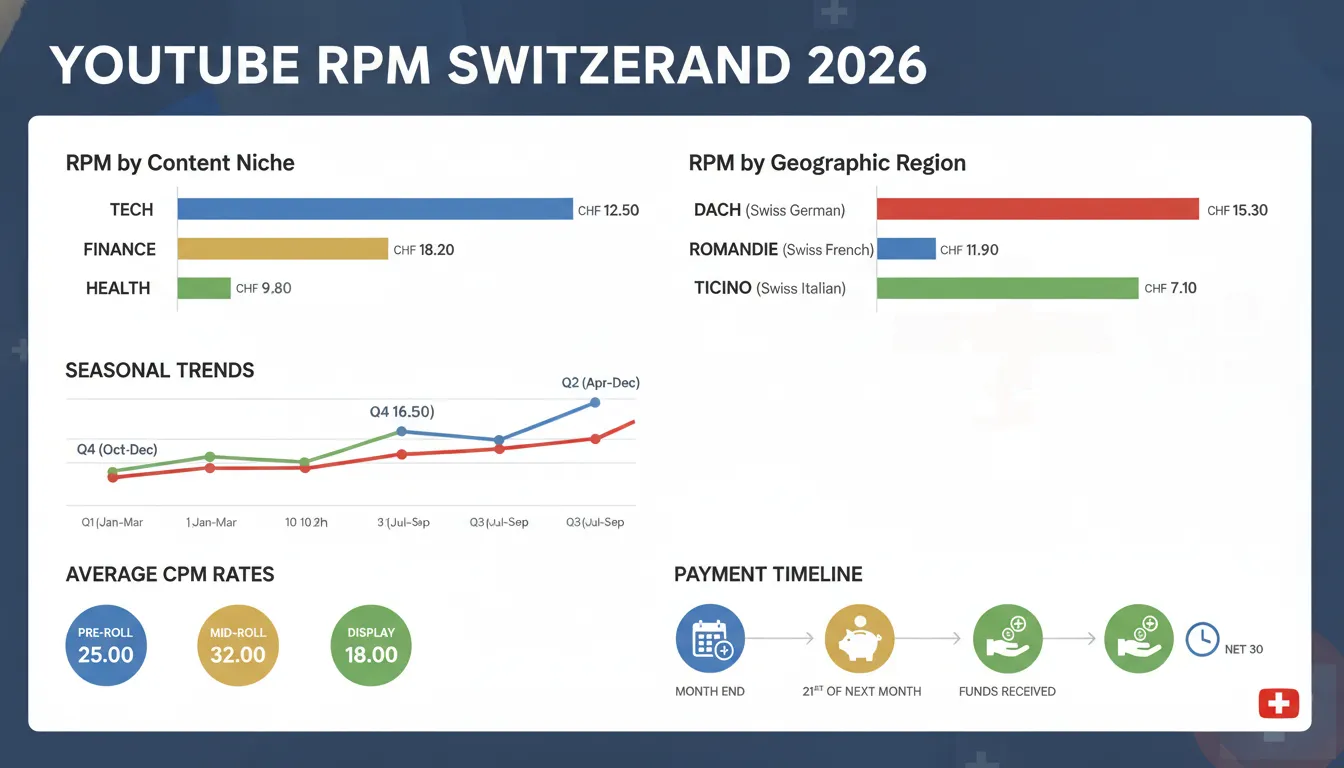
Average RPM rates vary considerably by niche and season. Based on 2025 data and early 2026 trends, here’s what freelancers are actually earning:
High-RPM Niches (40-80+ CHF per 1000 views):
– Finance and investing (52-78 CHF RPM average)
– Software and B2B SaaS (48-72 CHF RPM average)
– Real estate and property investment (45-70 CHF RPM average)
– Legal and tax services (50-75 CHF RPM average)
– Healthcare and medical education (42-68 CHF RPM average)
– Business and entrepreneurship (38-65 CHF RPM average)
Mid-Tier RPM Niches (20-40 CHF per 1000 views):
– Technology reviews and gadgets (25-38 CHF RPM average)
– Career advice and professional development (22-35 CHF RPM average)
– Language learning (20-32 CHF RPM average)
– Productivity and personal development (18-30 CHF RPM average)
– Travel (specific luxury travel: 25-35 CHF RPM average)
Lower RPM Niches (5-20 CHF per 1000 views):
– Entertainment and comedy (8-18 CHF RPM average)
– Gaming and streaming (6-15 CHF RPM average)
– Music and music covers (5-12 CHF RPM average)
– Lifestyle and fashion (8-16 CHF RPM average)
– DIY and crafts (7-14 CHF RPM average)
Why such dramatic differences? The answer comes down to advertiser intent and audience purchasing power. When someone watches a video about cryptocurrency investing, YouTube can serve ads from financial services companies willing to pay premium rates because the viewer is clearly interested in finance products. When someone watches a funny cat video, the advertiser pool is broader but less targeted, so CPM and RPM both drop significantly.
Seasonal variations matter too. In Switzerland, RPM rates typically peak during:
– Q4 (October-December): Holiday shopping season, year-end corporate budgets
– Q1 (January-March): New Year resolutions, business planning season
– During Swiss holiday periods, rates often dip as advertiser spending decreases
Data from early 2026 shows Q1 rates were approximately 15-25% higher than Q2 rates in most niches.

Step 1: Assess Your Current Channel Performance and Niche Position
Before you can increase RPM, you need to understand where you currently stand. This requires honest analysis of three factors: your content niche, your audience demographics, and your current earnings metrics.
Start by answering these questions:
1. What is your primary content niche? Be specific. “Business” is too broad. “Personal finance for Swiss millennials” is useful. The more precisely you can define your niche, the better you can target advertiser interests and understand your RPM potential.
2. Who is your audience? Age range, geographic location, income level, professional background—this information is available in YouTube Analytics under the “Audience” tab. Swiss creators with audiences primarily from Switzerland, Germany, and Austria typically see higher RPM than those with global audiences in lower-income regions.
3. What are you currently earning? Check your YouTube Analytics for the last 90 days. Calculate your current RPM by dividing your revenue by total views and multiplying by 1000. This baseline is crucial for measuring improvement.
4. What’s your watch time and engagement? Channels with high average view duration (people watching 50%+ of videos) earn more than channels where viewers drop off quickly. Similarly, higher engagement (likes, comments, shares) signals quality content to YouTube’s algorithm, which leads to better ad placements.
Create a simple spreadsheet to track:
– Monthly views
– Monthly revenue
– Calculated RPM
– Average view duration percentage
– Audience retention rate
– Top performing videos (by views and by revenue)
Most freelancers underestimate how much their niche choice determines earnings. If you’re currently in a low-RPM niche earning 8 CHF RPM, you could potentially double or triple earnings by pivoting to high-RPM niches, even without increasing total views. That said, pivoting requires honest assessment of your expertise and ability to create authoritative content in the new niche.
Key Takeaways
Step 2: Optimize Your Content Strategy for Higher-Paying Advertisers
The Swiss market rewards specificity and authority. Advertisers in high-RPM niches are actively searching for channels that reach their target audience. Your job is making your channel an attractive advertising environment.
Implement these optimization tactics:
A. Align content with high-intent keywords. High-paying advertisers target specific search terms. They’re looking for people searching “how to invest in cryptocurrency,” not “what is cryptocurrency.” Use tools like TubeBuddy or VidIQ to identify search terms with high CPC (cost per click) rates. These terms attract high-paying advertisers.
B. Create content clusters around high-value topics. Instead of scattered videos, develop 10-15 videos around a single valuable topic. A cluster of videos about “Swiss tax optimization for freelancers” attracts tax software companies, accounting firms, and wealth management companies—all willing to pay premium rates. A single random video has less appeal.
C. Target professional and business audiences. B2B and professional content commands higher RPM. A 15-minute video explaining accounting software features might earn 60 CHF per 1000 views because accounting firms are the target audience. A 15-minute entertainment video might earn 12 CHF per 1000 views. Both take similar effort to create.
D. Include valuable information that solves specific problems. Videos about “how to file taxes in Switzerland as a freelancer” or “best health insurance options in Zurich” attract highly targeted ads. The viewer is clearly in a decision-making phase, which makes them valuable to advertisers.
E. Maintain consistent upload schedule. YouTube’s algorithm favors consistent creators. Channels uploading weekly earn more than channels uploading sporadically, partly because consistent channels build larger audiences, partly because consistent channels signal professional, monetization-ready content to advertisers.
Real RPM improvement through content optimization: A freelancer channel focusing on “productivity tips” was earning 18 CHF RPM with 50,000 monthly views (900 CHF monthly). After analyzing audience data, the creator noticed significant interest from small business owners. They pivoted to “productivity systems for small business owners in Switzerland.” RPM increased to 32 CHF within two months as the content attracted business software companies and management consulting firms. Same upload frequency, similar video quality—just better niche alignment.

Step 3: Build Audience Targeting and Demographic Advantages
YouTube’s algorithm connects creators with appropriate ads based on multiple factors. Your audience composition directly influences which advertisers serve ads on your channel. Swiss audiences, particularly high-income Swiss audiences, attract premium advertisers.
Strategies for optimizing audience quality:
1. Target Swiss and Alpine region audiences specifically. If you’re creating content relevant to Switzerland (which has many advantages), make this clear in your titles, descriptions, and content. Videos titled “The Swiss Freelancer’s Guide to…” attract Swiss viewers and signal to YouTube that your audience is geographically valuable. Premium advertiser budgets are often allocated by geographic region, and Switzerland gets significant allocation.
2. Build audience in secondary German-speaking markets. Germany and Austria have large, wealthy populations. Content that appeals to German-speaking professionals (even if not specifically Swiss) attracts the same premium advertisers. Titles in German can help, along with references to German business regulations or consumer behavior.
3. Emphasize professional and B2B over consumer-focused content. B2B channels attract different, higher-paying advertisers. “How to manage a small team” might earn 35 CHF RPM while “How to be a better friend” earns 10 CHF RPM. One has B2B appeal; the other doesn’t.
4. Monitor and improve audience demographics. YouTube Analytics shows audience age, gender, and income ranges. If you notice higher RPM from specific demographics, create more content targeting those groups. For example, if viewers aged 35-54 generate higher RPM, you know this demographic is more valuable to advertisers, and you should adjust thumbnails, titles, and content depth accordingly.
5. Engage with your audience in comments. Comments section activity affects RPM because it signals engagement quality. Channels with active, professional comment discussions attract better ads. Spammy or low-quality comments can reduce RPM. Reply to professional comments, remove spam, and encourage thoughtful discussion.
Geographic RPM data for Switzerland 2026:
– Swiss-based viewers: 50-80 CHF RPM (highest)
– German and Austrian viewers: 35-60 CHF RPM (high)
– Other Western European viewers: 25-40 CHF RPM (mid-range)
– Global/developing country viewers: 5-15 CHF RPM (low)
If your audience is 60% Swiss, 25% German/Austrian, and 15% global, your effective RPM will be higher than a channel with the reverse split.
Step 4: Technical Optimization for Maximum Ad Placement and Monetization
YouTube’s algorithm decides where and how many ads appear on your videos. Creators who understand and optimize these factors earn significantly more from the same view count.
Critical technical factors affecting RPM:
A. Video length and ad placement strategy. Longer videos (15+ minutes) allow multiple ad placements, increasing total revenue. A 25-minute video with 4 ad placements earning 25 CHF per placement generates 100 CHF from 1000 views, even if the per-placement CPM is lower. Short 5-minute videos allow only 1-2 placements maximum.
Optimal strategy for Swiss freelancers: Aim for 15-25 minute videos in high-RPM niches. This allows sufficient ad placements without excessive ad fatigue. In low-RPM entertainment niches, shorter videos are acceptable because longer length won’t significantly improve RPM.
B. Enable all monetization features. Make sure you have:
– Mid-roll ads enabled (YouTube requires 8 minutes for mid-roll eligibility; aim for 15+ minutes)
– Display ads enabled
– Overlay ads enabled
– Skippable video ads enabled
Each feature adds monetization potential. Channels with all features enabled earn 20-40% more than channels with limited features.
C. Optimize for watch time over view count. YouTube prioritizes watch time when deciding ad frequency. A 30-minute video with 8-minute average watch time generates more ad impressions than a 10-minute video with 7-minute average watch time, even if both have the same view count. The longer video keeps viewers engaged longer, allowing more ads.
D. Create content optimized for desktop viewing. While mobile viewing is dominant globally, desktop viewers in wealthy countries like Switzerland watch longer, watch more ads, and generate significantly higher RPM. Optimize for desktop: clear text, readable charts, well-organized slides, and professional presentation rather than quick cuts and vertical video elements.
E. Use strategic content warnings to improve ad rates. Content flagged as “for mature audiences” or containing “controversial topics” often has reduced advertiser interest and lower RPM. Conversely, content clearly appropriate for mainstream corporate advertisers gets better rates. If your content walks a fine line, consider whether explicit language or controversial framing is necessary, or if you could adjust to attract broader, higher-paying advertiser pools.
Technical optimization impact: A Swiss software reviewer channel was earning 28 CHF RPM on 15-minute videos. After optimizing video length to 22 minutes and ensuring mid-roll ads were enabled, RPM increased to 38 CHF within 60 days—a 36% improvement without changing content quality or audience size. The increase came purely from better ad placement and frequency.
Step 5: Diversify Revenue Beyond Ad Revenue
Most freelancers focus exclusively on YouTube ad revenue (RPM). However, RPM growth has limits because it depends on advertiser spending patterns. Diversifying revenue creates more stable, higher total income.
Revenue diversification strategies for YouTube creators:
1. Channel memberships: YouTube takes 30%, you keep 70%. Memberships don’t depend on advertiser spending. If 2% of your audience becomes members at 5 CHF
Advertisement
