

The freelance economy has fundamentally shifted. Five years ago, the barrier to earning six figures as an independent contractor was nearly impossible for most. Today? It’s entirely achievable—but only if you’re positioned in the right niche.
Here’s the reality: While the global digital advertising market continues its explosive growth (with France’s digital ad market alone expected to surge through 2027), not every freelancer is capturing that value. The difference between a freelancer earning $35,000 annually and one consistently pulling $120,000+ isn’t just hard work—it’s strategic skill selection.
Recent market analysis reveals that high-RPM (revenue per mille) niches consistently outperform entertainment and content-heavy sectors. This means certain skill categories command premium rates because they directly drive revenue for clients. When your work generates measurable ROI for businesses, you can charge accordingly.
This comprehensive guide breaks down the 7 freelance skills currently commanding six-figure incomes, reveals exactly what clients pay, explains the market dynamics driving these premiums, and provides a practical roadmap for breaking into each niche. Whether you’re transitioning from employment or scaling an existing freelance practice, this data-driven approach will help you position yourself in the most lucrative segments of the market.
What Constitutes a “High-Paying” Freelance Skill?
High-paying freelance skills share specific characteristics that justify premium pricing. It’s not arbitrary. Understanding these markers helps you evaluate whether a skill is worth developing.
The defining factors of lucrative freelance work:
A high-paying freelance skill directly impacts client revenue or saves them significant money. A software developer building a custom integration that processes $10 million in annual transactions can command $150/hour—not because the work is hard, but because the value is measurable and transformational. Similarly, a conversion rate optimization specialist who increases an e-commerce site’s checkout completion from 2.1% to 3.4% has generated hundreds of thousands in additional revenue.
These skills require genuine expertise. They can’t be learned in a weekend. Most high-paying freelance categories demand 3-7 years of concentrated skill development before you can credibly charge premium rates. This barrier to entry protects your pricing. If anyone could do it, anyone would charge less.
The skills are in measurable short supply relative to demand. Technical abilities like cloud architecture, specialized programming languages, and proprietary platform expertise face genuine talent shortages. Meanwhile, general writing or basic graphic design face oversupply, which depresses pricing.
High-paying skills typically serve B2B clients or business owners directly. Individual consumers rarely pay $150/hour for anything. But companies whose profit margins depend on optimized systems will absolutely pay that (and more). The client’s ability to pay fundamentally shapes your potential pricing.
The work produces recurring, long-term client relationships. One-off projects often command lower rates because of project acquisition overhead. Retainer-based work—where a client pays $8,000-$15,000 monthly for ongoing optimization, management, or development—creates stability and enables higher annual earnings.
Skill #1: Full-Stack Software Development & Custom Application Development
Software development remains the highest-paid freelance category, and the market is actually getting more lucrative, not less.
Current market rates:
– Senior full-stack developers: $120-$200 per hour
– Specialized backend engineers: $130-$250 per hour
– Mobile app developers (iOS/Android): $100-$180 per hour
– Niche tech stack specialists (Rust, Go, Elixir): $150-$300 per hour
– Project-based contracts: $40,000-$250,000 per project
Why it pays so well:
Client acquisition costs for software projects are substantial. A business investing in custom software expects transformation—whether that’s automating workflows that currently consume 200 hours monthly, or building a product that becomes a new revenue stream. A developer charging $150/hour on a 6-month project ($156,000 total) is often negotiated down from a quoted $200,000-$300,000 range because the ROI is so apparent.
The talent shortage is genuine. Companies consistently report inability to hire full-time developers at any price point. Freelance developers can cherry-pick projects, set their hours, and maintain pricing power because demand vastly exceeds supply in most technology stacks.
How to break in and charge premium rates:
Start with demonstrated expertise. You need a portfolio of real projects. If you’re transitioning from employment, that’s your advantage—your previous work provides credibility. If you’re starting from scratch, build 3-5 solid projects before raising rates above $60/hour.
Specialize aggressively. A “full-stack developer” might charge $80/hour. A developer specializing in healthcare SaaS applications using React, Node.js, and PostgreSQL can command $150/hour because you’ve narrowed the competition significantly.
Target clients in high-margin industries. SaaS companies, financial services, real estate tech, and healthcare tech have larger budgets than e-commerce or content sites. Your rates should reflect your target client’s ability to pay.
Realistic income projection:
At $120/hour with 30 billable hours weekly = $156,000 annually. Most experienced developers operate on retainer models ($5,000-$12,000 monthly) that provide higher consistency and annual earnings of $120,000-$180,000+.

Skill #2: Specialized SEO Services & Technical SEO Auditing
SEO has evolved dramatically. Generalist SEO consultants ($40-$75/hour) struggle to compete. Specialists (particularly technical SEO, enterprise-level SEO, and niche-specific optimization) command six-figure incomes.
Current market rates:
– Technical SEO specialists: $100-$200 per hour
– Enterprise SEO strategy (retainer): $8,000-$30,000+ monthly
– Local SEO for agencies (white-label): $3,000-$8,000 per client monthly
– E-commerce SEO optimization: $80-$150 per hour
– Industry-specific SEO (legal, medical, SaaS): $100-$175 per hour
Why it’s become a high-income skill:
The France digital advertising market continues its growth trajectory through 2027, and with that growth comes intense competition for visibility. Companies are no longer asking “should we invest in SEO?” but rather “why is our competitor ranking higher?” This shift creates urgency and funding.
Technical SEO is genuinely complex. It requires understanding server architecture, crawl budgets, Core Web Vitals, log file analysis, and structured data implementation. Most marketing agencies don’t have this expertise in-house. When they encounter a client with a 200,000-page website facing severe crawl efficiency issues, they’ll pay $5,000-$15,000 for a technical audit and remediation plan.
High-RPM niches outperform entertainment. This data point is crucial: SEO for SaaS companies, financial services, and B2B software can generate massive ROI (a single ranking improvement might generate $100,000+ in qualified leads annually). Clients in these niches budget accordingly and understand the value of premium SEO work.
How to break in and charge premium rates:
Develop certification credentials. Google Analytics certification and Google Ads certification take 3-5 hours and cost $39. Semrush and Moz offer certifications that clients notice. They’re not substitutes for experience, but they signal credibility during the sales process.
Build case studies that show revenue impact. Instead of “improved rankings from 15 to 5,” document: “improved rankings for target keywords, generating 12,000 additional monthly impressions and an estimated 280 additional leads” for a client who then attributes $340,000 in annual revenue to this improvement.
Specialize by industry. Medical SEO, legal SEO, and SaaS SEO have distinct challenges and premium pricing. A medical practice might pay $5,000/month for specialized SEO because a single high-value patient (orthopedic surgery) is worth $8,000+.
Target local SEO for agency partnerships. Agencies resell your technical SEO work under their own brand. You handle 10-15 client audits monthly at $4,000-$8,000 each = $40,000-$120,000 monthly income stream.
Realistic income projection:
At $100/hour with 35 billable hours weekly = $182,000 annually. More realistically, enterprise retainer work at $12,000-$18,000 monthly = $144,000-$216,000 annually.
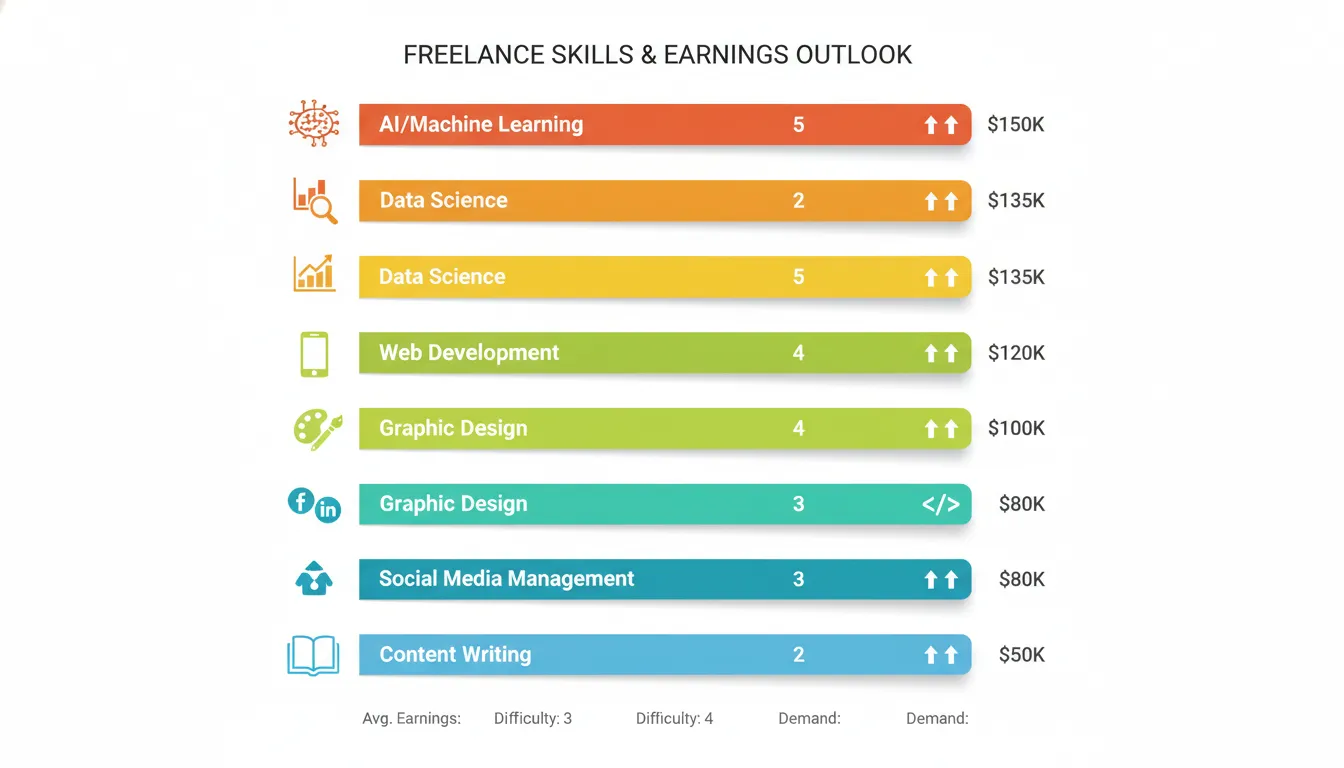
Key Takeaways
Skill #3: Conversion Rate Optimization & User Experience Strategy
CRO is still undervalued by most businesses, creating an information asymmetry that you can exploit for premium pricing.
Current market rates:
– CRO consultation & strategy: $120-$250 per hour
– CRO audits (project-based): $3,000-$12,000
– Ongoing optimization retainers: $4,000-$15,000 monthly
– A/B testing program management: $80-$150 per hour
– E-commerce conversion optimization: $100-$180 per hour
Why it’s highly lucrative:
Conversion rate improvements are directly quantifiable. A business with 10,000 monthly website visitors and a 2.0% conversion rate generates 200 customers. If their average customer value is $500, that’s $100,000 monthly revenue. Improving conversion to 2.3% adds $30,000 monthly ($360,000 annually). Clients understand this math and budget accordingly.
The work compounds. Initial audits and strategy development are billed high (often $8,000-$15,000 projects). But ongoing testing, analysis, and implementation work becomes recurring retainer revenue. Many CRO specialists operate at $8,000-$12,000 monthly retainers with 8-12 active clients = $64,000-$144,000 monthly income.
Most businesses don’t have in-house CRO expertise. While development and marketing teams are more common, dedicated conversion specialists are rare. This scarcity drives pricing power.
How to break in and charge premium rates:
Specialize by vertical. E-commerce CRO, B2B SaaS CRO, and B2C service CRO each have distinct playbooks. Specializing in B2B SaaS CRO allows you to command premium rates because your understanding of sales cycles, buying committees, and decision timelines is valuable.
Master statistical significance fundamentals. Most marketers don’t understand why 87% conversion improvement over 10 days isn’t statistically meaningful. You understanding power calculations, sample sizes, and false positives differentiates you dramatically.
Build attribution models. Connect CRO improvements to downstream revenue. When you can show that a landing page test improvement drove $47,000 in attributed revenue over three months, renewal conversations are easy.
Target high-ticket industries. A law firm’s client is worth $5,000-$25,000+. A 15% improvement in contact form submissions is worth tens of thousands in revenue. Conversely, a T-shirt store might only see 5-10% annual uplift from optimization work.
Realistic income projection:
At $150/hour with 25 billable hours weekly (the rest is admin/sales/analysis) = $195,000 annually. With retainer-based work at $10,000 monthly with 6 active clients = $720,000 annually (though more realistically 2-4 clients = $240,000-$480,000 annually).

Skill #4: Cloud Architecture & DevOps Engineering
Cloud infrastructure has become business-critical. The specialists managing it command premium compensation.
Current market rates:
– Cloud architects (AWS, GCP, Azure): $130-$220 per hour
– DevOps engineers: $110-$200 per hour
– Infrastructure optimization specialists: $120-$180 per hour
– Serverless architecture development: $140-$240 per hour
– Cloud security/compliance specialists: $150-$250 per hour
Why it’s explosively profitable:
Companies run their entire operations on cloud infrastructure. A misconfigured database doesn’t cost time—it costs money in real-time. A business running on AWS might have monthly bills of $30,000-$500,000+. A DevOps specialist who optimizes that infrastructure and reduces bills by 20-30% ($6,000-$150,000 monthly savings) has provided immense value.
The barrier to entry is legitimately high. You need deep hands-on experience managing production systems, understanding networking concepts, database optimization, and deployment automation. This takes years to develop.
Cloud certifications (AWS Solutions Architect, Google Cloud Architect, Azure Administrator) are respected credentials that justify high rates.
How to break in and charge premium rates:
Obtain foundational certifications first. AWS Solutions Architect Associate ($150 exam) is the entry credential. Solutions Architect Professional ($300) comes next. Azure and GCP certifications further expand your market.
Build case studies around cost optimization. Document: “Restructured application architecture from on-demand to reserved instances and spot instances, reducing monthly cloud bills from $47,000 to $28,000.” Cost savings are immediately quantifiable.
Specialize in specific migration challenges. Helping legacy monolithic applications transition to microservices is expensive, complex work commanding $150-$200+/hour.
Target enterprise and scale-up SaaS companies. These organizations have the infrastructure complexity and budget to hire cloud specialists at premium rates.
Realistic income projection:
At $140/hour with 30 billable hours weekly = $218,400 annually. Many cloud architects work on fixed-fee projects ($30,000-$100,000+ per engagement) enabling higher effective hourly rates.
Skill #5: Specialized Copywriting for High-Ticket B2B Sales
“Copywriting” is oversaturated. “B2B SaaS copywriting for enterprise financial software” is not.
Current market rates:
– B2B SaaS copywriters: $75-$150 per hour
– Sales page copywriting (project): $3,000-$15,000 per page
– Email sequence copywriting: $2,000-$8,000 per sequence
– Technical copywriting: $100-$180 per hour
– Sales enablement content: $8,000-$25,000 per project
Why specialization commands premiums:
A business spending $8 million on customer acquisition has enormous budgets for copywriting that improves conversion rates. A single sales page improvement that increases contact form submissions by 12% might generate 50 additional qualified leads valued at $10,000 each = $500,000 in additional pipeline.
Enterprise buyers have fundamentally different psychology than consumers. They’re risk-averse, committee-driven, and interested in measurable outcomes. Copywriting that resonates with this audience is genuinely scarce.
High-RPM niches demand skilled copywriting. A SaaS platform selling to financial services has budget for copywriting because their total addressable market justifies it. A consumer blog does not.
How to break in and charge premium rates:
Develop deep domain expertise. If you spend 12 months studying SaaS sales psychology, enterprise buying committees, and financial services regulations, you become genuinely differentiated.
Build portfolio case studies showing conversion improvements. “Rewrote product page, increasing demo request rate from 3.2% to 4.1% (28% improvement)” documents impact clearly.
Master the specific formats that drive revenue. B2B landing pages, sales emails, product description copy, and proposal cover letters are the high-leverage copywriting categories.
Position yourself as a specialist in specific verticals (SaaS, B2B services, financial tech) rather than generalist.
Realistic income projection:
At $100/hour with 25 billable hours weekly = $130
Advertisement
