

Hook: Why Student Bloggers Are Earning Real Money Now
Here’s a statistic that should grab your attention: the global digital advertising market hit $876 billion in 2024, and it’s only accelerating. For students, this means one thing—there has never been a better time to start a profitable blog. But the real opportunity isn’t just in the size of the market. It’s in the *shift* happening right now.
Traditional entertainment blogs? They’re getting crushed by saturation. But high-RPM niches—finance, technology, health, career development—are absolutely booming. Students who launch blogs in these spaces are reporting first earnings within 3-6 months, not years. We’re talking $100-$500 monthly from day one, scaling to thousands as their audience grows.
Why is this possible for students specifically? You have something professionals don’t: authenticity, relatability, and genuine expertise in your peer group. Your classmates trust you more than they trust corporate content. They want to hear *your* perspective on how to earn money online, how to manage student debt, or how to land internships. That’s gold in the blogging world.
The challenge isn’t finding an opportunity. The challenge is knowing *where to start*. This guide breaks down the entire process—from picking your niche to hitting your first $1,000 in monthly revenue. You’ll learn the exact steps successful student bloggers are taking right now, the tools you actually need (and the ones you don’t), and the monetization strategies that actually work.
—
What Is a Profitable Blog? (And Why It’s Different From a Hobby Blog)
A profitable blog is a digital publication that generates consistent income through multiple revenue streams while serving a specific audience. But let’s be clear—not every blog that exists becomes profitable. The difference between a hobby blog and a profitable one comes down to three core elements: audience targeting, content strategy, and monetization planning.
The Key Difference:
A hobby blog publishes whatever interests the author. A profitable blog publishes content that solves specific problems for a specific audience, and then converts that audience into revenue.
Here’s the brutal truth: 90% of blogs fail because they try to be everything to everyone. They write about their day, share random recipes, discuss their favorite TV shows, and wonder why they have 12 readers. Meanwhile, blogs with a crystal-clear focus on a specific niche (say, “How to Get Your First Tech Job as a Career Changer”) attract thousands of monthly visitors and generate five or six figures annually.
Why Students Have an Unfair Advantage:
Students sit at the intersection of several profitable niches naturally. You understand college finances. You know about career transitions. You’re navigating remote work, side hustles, and online education. These topics have *massive* demand from your peers. The monetization opportunity comes from serving that specific audience with valuable content.
A profitable blog also operates on a system. You’re not just writing when you feel like it. You publish consistently (usually 2-4 posts weekly), you build an email list, you track analytics, and you continuously optimize for better performance. It’s a business, not a hobby.
—

Step 1: Choose Your Niche (The Foundation Everything Else Rests On)
This is where most student bloggers mess up. They either choose a niche that’s too broad (“technology” instead of “how to get certified in cloud computing”) or a niche with zero monetization potential (“my dog’s daily activities” instead of “training tips for new dog owners”).
The Niche Selection Framework:
Your profitable niche must satisfy three conditions:
1. Audience demand – People are actively searching for information in this space. You can verify this using Google Trends, Ahrefs, or Semrush.
2. Monetization potential – Advertisers actually pay for this niche. Niches like finance, health, technology, and career development have CPMs (cost per 1,000 ad impressions) of $15-$150. Compare that to entertainment niches at $2-$5 CPM.
3. Your genuine knowledge or passion – You either know this topic well, or you’re willing to become an expert. You can’t fake expertise for 12 months straight.
Best Niches for Students (High-Revenue, Achievable):
– Finance for Young Adults – How to build credit, manage student loans, invest with small amounts, side hustle ideas
– Career Transition Guides – How to switch careers, land your first job, get certified online
– Tech Career Paths – Coding bootcamps, free programming resources, landing a tech job with no degree
– Remote Work & Freelancing – How to start freelancing, best platforms, pricing your services
– Personal Productivity – Time management for students, study strategies, productivity tools
– Educational Technology – Best online courses, learning platforms, educational hacks
Notice the pattern? These are all specific enough to dominate, but broad enough to have a real audience.
How to Validate Your Niche Idea:
Before you launch, spend 48 hours validating. Open a Reddit thread in your target niche. How many subscribers does the subreddit have? Go to Google and search “how to [your niche problem]”—does Google return millions of results? Check Amazon—do books exist on this topic? (If yes, audience demand is proven.) Finally, check YouTube—are creators earning subscriber counts in the 100k+ range discussing similar topics? If yes, there’s monetization opportunity.
The niche selection process should take 2-3 days maximum. Don’t overthink this. Students who spend two months researching the perfect niche never actually launch. Pick your niche, validate it quickly, and move forward.
—
Key Takeaways
Step 2: Set Up Your Blog Platform and Domain
You need a home for your blog. This used to be complicated. Now, it’s straightforward. You have two main options: WordPress.org (self-hosted) or WordPress.com/Substack/Medium (hosted platforms).
Platform Comparison for Students:
| Factor | WordPress.org | Blogger | Medium | Substack |
| ——– | ————— | ——— | ——– | ———- | <br /> |
|---|---|---|---|---|---|
| Cost | $12-20/month hosting | Free | Free (with revenue split) | Free (with revenue split) | |
| Monetization Control | Full control | Limited | Limited | Full control but newer | |
| SEO Capability | Excellent | Good | Good | Moderate | |
| Customization | Complete | Moderate | Limited | Limited | |
| Learning Curve | Moderate | Easy | Very easy | Very easy | |
| Best For | Serious, long-term blogs | Quick starts | Niche audiences | Newsletter-focused blogs |
The Student Recommendation:
Start with WordPress.org self-hosted. Yes, it costs money (about $12-20 monthly), but it’s still cheaper than coffee per day. You get complete control over monetization, your blog won’t be shut down due to platform policy changes, and the investment mindset matters. If you pay for it, you’re more likely to actually work on it.
Alternatively, if you’re completely broke, start with Blogger (free, owned by Google) or Medium. You can always migrate later.
Your Domain Name (Keep It Simple):
Your domain should:
– Be easy to spell and remember
– Include your keyword if possible (e.g., “techcareeraccelerator.com” instead of “bobsmith123.com”)
– Use .com if available (it’s more trustworthy)
– Keep it short (ideally 1-3 words)
Buy your domain from GoDaddy or Namecheap ($10-15 yearly). Avoid fancy TLDs (.io, .co, .app) unless they’re essential to your branding. Stick with .com.
Essential Plugins and Setup (30 Minutes):
If you’re using WordPress, install these three plugins:
1. Yoast SEO (free) – Helps your content rank in Google
2. Jetpack (free version) – Site security and basic analytics
3. Contact Form 7 (free) – Email capture form
That’s it. Don’t get plugin crazy. Extra plugins slow your site and create security risks.
—

Step 3: Create Your Content System (The Engine of Your Blog)
Content is the engine. Everything else is just infrastructure. A profitable blog requires a specific content system that balances SEO optimization with audience engagement.
The Content Pillars Strategy:
Organize your blog around 3-5 core topics (pillars). Everything you write circles back to these pillars. For example, if your blog is “Career Transition for Creatives,” your pillars might be:
1. How to Switch to a Creative Career
2. Building Your Creative Portfolio
3. Finding Creative Jobs That Pay Well
4. Negotiating Creative Contracts
5. Scaling Your Creative Skills
Every piece of content you write falls into one of these pillars. This creates topical authority, which Google loves. Google sees you as a real expert in this space, not just a random blogger.
Content Structure That Actually Ranks and Converts:
Each blog post should follow this framework:
– Title – Include your main keyword, keep it under 60 characters
– Meta description – 155-160 characters, include keyword, create curiosity
– Introduction – Hook with a statistic or relatable problem (150+ words)
– Body – 1,500+ words minimum for competitive keywords. Use H2 and H3 headers. Break text with short paragraphs (2-3 sentences).
– Call-to-action – What do you want readers to do? Sign up to your email list? Check out your affiliate link?
Publishing Schedule That Works for Students:
– Minimum: 2 posts per week (consistency matters more than quantity)
– Ideal: 3-4 posts per week (especially in months 1-6)
– Realistic for most students: 3 posts per week
Block out time in your calendar just like you’d block time for classes. Sunday evening + Tuesday evening + Thursday evening = 3 hours of focused content creation per week. That’s totally doable.
Research to Ranking Timeline:
– Weeks 1-8: Research your niche deeply. Read top-ranking articles. Understand what Google favors.
– Weeks 9-26: Publish consistently. Don’t expect traffic. Google needs to see you’re serious.
– Months 7-12: Your first articles start ranking. Initial traffic appears (maybe 100-500 monthly visitors).
– Months 12-18: Momentum builds. More content ranks. Meaningful traffic emerges (5,000-15,000 monthly).
– Month 18+: Revenue becomes real.
This is why student bloggers who start in January often see their first significant earnings by September. Patience is the secret ingredient most people lack.
—
Step 4: Build Your Email List (Your Most Valuable Asset)
Traffic is nice. An email list is priceless. Here’s why: Google can change its algorithm tomorrow and your traffic disappears. Your email list? That’s yours forever.
Why Students Ignore This (And Why You Shouldn’t):
Most beginner bloggers focus 100% on getting traffic and 0% on capturing emails. This is backward. Your email list is 5-10x more valuable than your blog traffic for monetization.
Think about it: A visitor might come to your blog once and never return. An email subscriber receives your message 2-3 times weekly for *years*. Which is a better customer?
Setting Up Email Capture:
You need an email service provider. The best options for student bloggers are:
– Substack – Completely free, handles everything, built-in monetization
– Mailchimp – Free up to 500 subscribers, then around $12/month
– ConvertKit – $25/month, better for email monetization, more professional
Start with Mailchimp if you want standard email marketing. As you grow, you’ll graduate to a tool built more for creators.
What to Offer for Email Signups (Lead Magnets):
You need to give something valuable in exchange for emails. Your lead magnet should be worth enough that someone will happily hand over their email address.
Good lead magnets for student bloggers:
– Free guide/PDF – “The 30-Day Side Hustle Blueprint for Students”
– Checklist – “Your Pre-Job Interview Checklist” (5-20 items)
– Email course – 5 days of emails teaching a specific skill
– Templates – Freelance contract templates, resume templates, budget templates
– Calculator or tool – Salary calculator, investment compound interest tool, side hustle income tracker
Your lead magnet should take 2-4 hours to create. Don’t overthink this. It doesn’t need to be perfect. It just needs to be useful enough that readers want it.
Email List Growth Targets:
– Month 1-3: 50-200 subscribers
– Month 4-6: 200-800 subscribers
– Month 7-12: 800-3,000 subscribers
– Year 2: 3,000-10,000 subscribers
By year 2, with 5,000+ subscribers on your email list, you have a monetization machine regardless of blog traffic. This is why email list building is so critical to long-term blog profitability.
—
Step 5: Monetize Your Blog (Turn Readers Into Revenue)
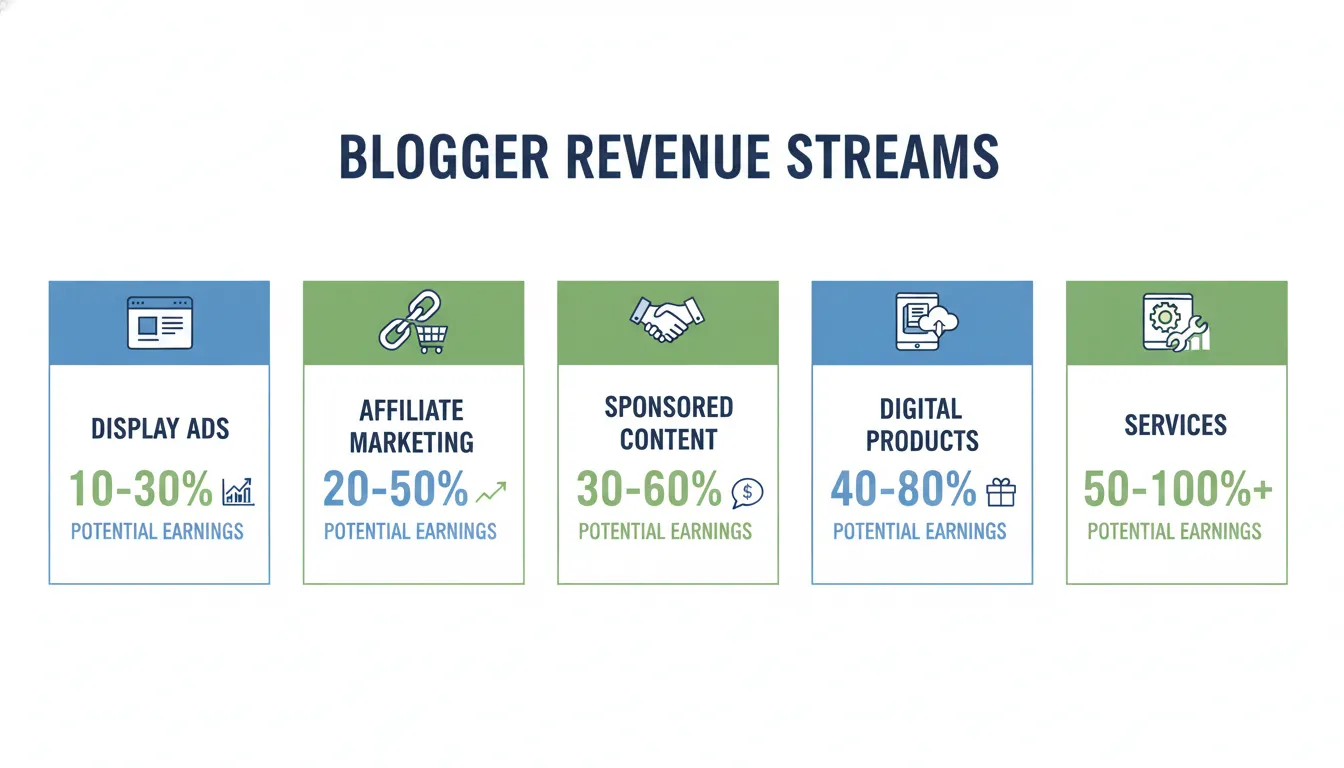
Now we get to the fun part. There are five main ways to monetize a blog. Most successful student bloggers use all five simultaneously. Each generates different revenue, and together they create a stable income.
Monetization Strategy #1: Display Ads (Google AdSense)
This is the easiest entry point. Google AdSense places ads on your blog, and you earn money when readers view or click them.
– How much: $1-15 per 1,000 views (depends on niche and audience location)
– When you can start: Usually after 1,000 monthly visitors and 6+ months of content
– Time investment: Minimal after setup
– Pros: Completely passive, works immediately
– Cons: Low revenue per visitor, requires meaningful traffic to earn real money
A blog in a high-RPM niche (finance, technology, business) earning $10 CPM with 10,000 monthly visitors makes $100/month. A blog in a low-RPM niche (entertainment, lifestyle) earning $2 CPM with the same traffic makes only $20/month. This is why niche selection matters so much.
Monetization Strategy #2: Affiliate Marketing (The Real Money)
You recommend products or services, readers click your link, they make a purchase, and you earn a commission. This is where student bloggers start making meaningful income.
Best affiliate programs for student bloggers:
– Amazon Associates – Commission: 3-10% on products. Great for recommending tools and courses.
– Skillshare – Commission: $0.50-1.50 per referred signup. Perfect if your blog is about learning.
– Coursera – Commission: $20+ per referred signup. Students need online courses.
– ConvertKit – Commission: 30% recurring. Perfect if you’re teaching creators.
– Bluehost/Hostinger – Commission: $30-65 per signup. Relevant if your niche involves blogging or websites.
– SaaS tools – Canva, Notion, Later, Grammarly often have affiliate programs paying $50-200+ per signup.
Affiliate income scales beautifully. If you have 20,000 monthly readers and 0.5% of them click your affiliate link, and 5% of those complete the purchase, and you earn $40 average commission
Advertisement