

“`json
“`
The Blogging Opportunity You’re Missing Out On
Here’s the reality: 77% of internet users actively read blogs every week. Meanwhile, the global blogging platform market is projected to reach $40.4 billion by 2028. Yet, most aspiring bloggers quit within six months because they don’t understand how to actually monetize their work.
The good news? Starting a profitable blog isn’t complicated anymore. You don’t need technical skills, significant upfront investment, or years of experience. What you need is a clear roadmap—something most people never get.
The average successful blog earns between $300-$5,000 per month within the first year. Top-tier blogs generate $10,000+ monthly. The difference isn’t talent. It’s strategy. It’s understanding that blogging isn’t about writing articles into the void. It’s about building an audience, understanding their needs, and monetizing that relationship through multiple income streams.
This guide walks you through the entire journey. From setting up your first blog to implementing advanced monetization strategies, we’ll cover everything a beginner needs to build a sustainable income. By the end, you’ll understand exactly how to position yourself for long-term success.
What Is a Profitable Blog and How Does It Work?
A profitable blog is a website where you publish valuable content regularly and generate income through multiple revenue channels. Unlike hobbyist blogs, profitable blogs are built with monetization as a core objective from day one.
Here’s how the mechanics work: You create content that ranks in search engines and attracts readers. Those readers become your audience. You then monetize that audience through ads, affiliate commissions, sponsored content, digital products, or services.
The key distinction is consistency. Profitable blogs aren’t one-off projects. They’re systematic businesses. You publish on a schedule. You optimize for search engines. You build an email list. You track metrics. You double down on what works.
The Three Pillars of a Profitable Blog:
1. Traffic — Consistent, targeted visitors who find your content through Google, social media, or email
2. Trust — An audience that perceives you as an authority and takes your recommendations seriously
3. Monetization — Multiple revenue streams that convert readers into paying customers or commission sources
Most beginners focus only on traffic. They chase pageviews. But pageviews alone don’t pay bills. You need the other two pillars. A blog with 50,000 monthly visitors that lacks trust and monetization might earn less than a blog with 5,000 highly-engaged readers.
The profit model depends on your niche and audience size. Affiliate marketing works well once you hit 5,000+ monthly visitors. Digital products typically require 1,000+ engaged subscribers. Ad networks are effective at 10,000+ monthly pageviews. Most successful bloggers use a combination of all three.

Step 1: Choose Your Niche and Validate the Opportunity
Your niche is the foundation. Get this wrong, and you’ll spend months or years creating content that doesn’t convert into income.
What Makes a Profitable Niche?
A profitable niche has four characteristics:
1. Passionate Audience — People care enough to spend time and money on solutions
2. Commercial Intent — Problems that have paid solutions (not just entertainment content)
3. Manageable Competition — You can realistically rank for keywords within 6-12 months
4. Multiple Monetization Paths — Affiliate products, ad networks, digital products, or services exist in the space
For example, “productivity” is too broad. “How to implement the Pomodoro Technique for remote workers” is specific. The second one has less competition, clearer commercial intent, and easier monetization paths.
Validation Before You Start:
Don’t just pick a niche and start writing. Spend 30 minutes validating whether money actually exists:
– Search Google for your keyword ideas. What content ranks? Are there ads showing up? If major publications are writing about it with ads nearby, money exists.
– Check Amazon for books. If 50+ books exist on your topic, there’s commercial interest.
– Look for affiliate products on Amazon, Gumroad, or Teachable. If commission-worthy products exist, you have a path to monetize.
– Join relevant communities (Reddit, Facebook Groups, Discord). How frequently do people ask questions? Do they mention spending money on solutions?
This validation process takes one hour. Most bloggers skip it. Don’t be most bloggers.
Niche Ideas with Proven Monetization:
– Finance (personal investment, debt payoff, budgeting)
– Health & Wellness (fitness, nutrition, mental health)
– Business & Entrepreneurship (startups, side hustles, productivity)
– Technology (software reviews, tutorials, career development)
– Lifestyle (remote work, digital nomadism, personal development)
– Food & Cooking (recipes, meal planning, food delivery entrepreneurship)
Each of these niches has clear monetization paths through ads, affiliates, digital products, and services.
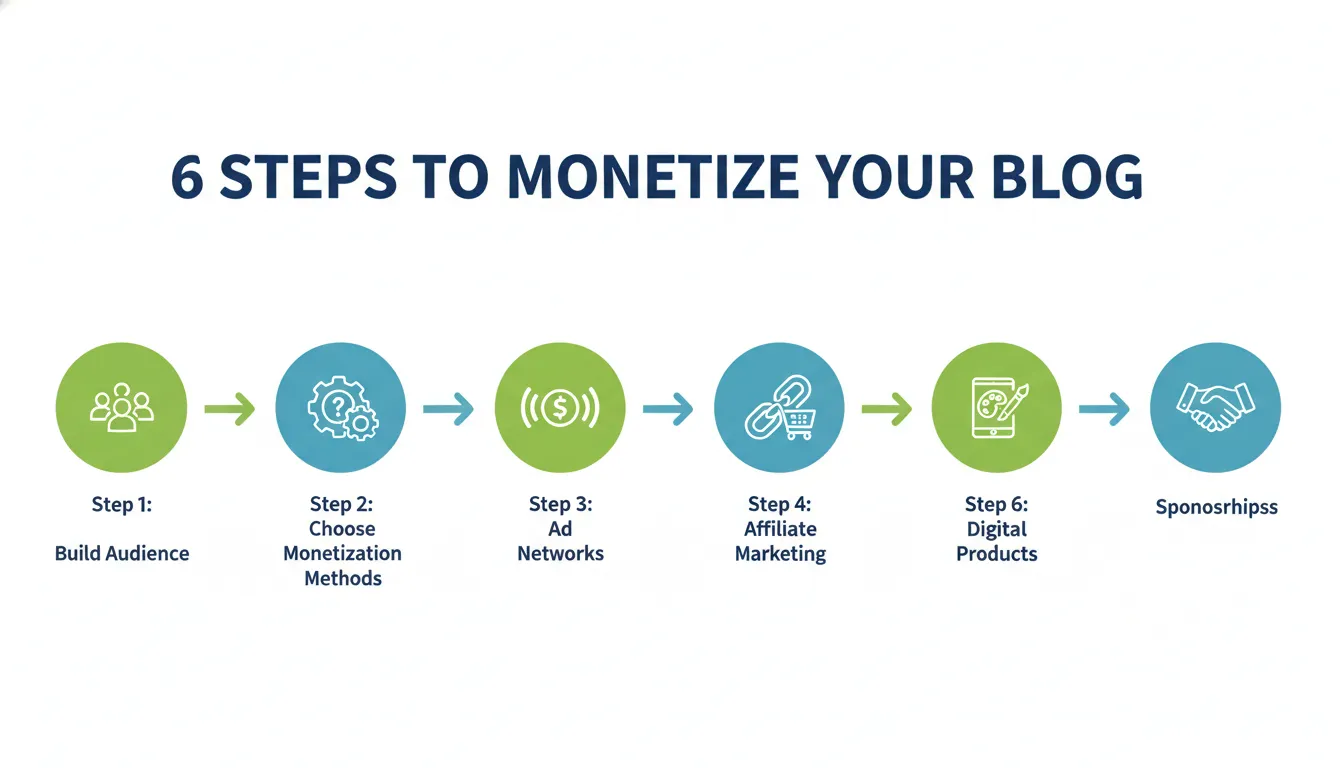
Key Takeaways
Step 2: Set Up Your Blog Platform and Technical Foundation
Choosing the right platform matters. The wrong choice can limit your monetization options or cost you thousands in unnecessary fees.
Platform Comparison: WordPress vs. Alternatives
| Platform | Startup Cost | Learning Curve | Monetization Options | Best For |
|———-|————-|—————–|———————|———-|
| WordPress.org | $100-300/year | Moderate | Unlimited (ads, affiliates, products) | Serious bloggers wanting full control |
| WordPress.com | $120-300/year | Easy | Limited without upgrades | Beginners preferring simplicity |
| Wix | $180-540/year | Very Easy | Limited, must use their ads | Non-technical users |
| Substack | Free (keep 90% of revenue) | Very Easy | Email subscriptions primarily | Newsletter-focused writers |
| Medium | Free | Very Easy | Ad revenue split (50/50) | Writers prioritizing reach over control |
| Webflow | $480-960/year | Moderate-Hard | Full monetization | Designers wanting beautiful sites |
Why WordPress.org is the Industry Standard:
WordPress powers 43% of all websites. It’s the default for serious bloggers because it offers complete monetization flexibility. You own your content. You control what ads run. You can implement any affiliate network or digital product platform.
The Setup Process (WordPress.org):
1. Get Hosting — Start with Bluehost, SiteGround, or WP Engine ($2-10/month)
2. Install WordPress — Most hosts do this automatically (one-click install)
3. Choose a Theme — Use Astra, GeneratePress, or Neve ($0-60 one-time)
4. Install Essential Plugins — Yoast SEO (free), Rank Math (free tier), MonetizePress (free tier)
5. Configure Basic Settings — Site title, tagline, timezone, permalink structure
6. Create Your First Pages — Homepage, About, Contact, Privacy Policy
Total setup time: 2-3 hours. Total startup cost: $100-300 first year, then $50-150/year thereafter.
Critical Setup Elements for Monetization:
– Google AdSense Approval requires proper pages: Privacy Policy, Terms & Conditions, About page, Contact page. Set these up before you launch.
– Email signup forms should be on every page. Integrations with ConvertKit, Mailchimp, or ActiveCampaign are essential.
– Mobile optimization is non-negotiable. Google prioritizes mobile-friendly sites, and most readers use phones.
– Site speed directly impacts both rankings and user experience. Use Cloudflare (free) and optimize images.
Don’t overcomplicate the setup. A clean, simple site with great content outperforms fancy designs with poor content every single time.

Step 3: Create Your Content Strategy and Publishing System
Content is the engine of your blog. Without a systematic approach, you’ll burn out or create inconsistent results.
The Content Strategy Framework:
Your strategy should answer four questions:
1. Who are you writing for? — Define your ideal reader (age, problems, goals, income level)
2. What will you write about? — Create a list of 30-50 topics your audience cares about
3. How often will you publish? — Pick a schedule you can maintain (1-2x weekly is ideal)
4. How will you distribute? — Email, social media, search engines, communities
Content Types That Drive Monetization:
– Ultimate Guides (2,000-5,000 words) — Build authority, rank for broad keywords, monetize with multiple affiliate products
– Tutorials & How-Tos — High commercial intent, good for ads and affiliate links
– Comparisons & Reviews — Direct monetization through affiliate commissions
– Case Studies — Show real results, build trust, sell digital products/services
– Personal Stories — Build connection and authority
Most beginners write opinion pieces or entertainment content. These don’t monetize. Write content that solves problems or provides actionable advice.
The Content Calendar System:
Use a simple Google Sheet or Asana to plan content 4-8 weeks in advance. Structure should include:
– Publication date
– Topic/Title
– Primary keyword
– Content type
– Monetization method (affiliate, ad placement, digital product mention)
– Status (outline, draft, editing, published)
Publishing on schedule matters more than perfection. A good article published on Tuesday beats a perfect article published unpredictably.
SEO Fundamentals for Blog Monetization:
You can’t monetize traffic you don’t have. Basic SEO isn’t optional—it’s how you get readers:
– Keyword research — Use Ahrefs Free, Ubersuggest, or Google Keyword Planner to find 500+ searchable topics
– Title optimization — Include your main keyword in the title naturally
– Meta descriptions — Write 150-character descriptions that include your keyword
– Internal linking — Link to 3-5 other blog posts within each article
– Header structure — Use H1 (once), H2, H3 hierarchy for readability and rankings
– Readability — Short paragraphs, subheadings, bullet points, bold text
You don’t need to be an SEO expert. Basic optimization combined with great content will rank you within 6-12 months.
Step 4: Build Your Email List and Audience
Traffic is unreliable. Social media algorithms change. Google updates affect rankings. Email is the one channel you control.
Bloggers with email lists earn 5-10x more than bloggers without them. This isn’t theory—it’s consistent data.
Why Email Lists Matter for Monetization:
An email subscriber is worth approximately $1-2 per month in direct revenue. If you have 5,000 subscribers, that’s $5,000-10,000 monthly opportunity. No platform algorithms. No content suppression. Just you and your audience.
Building Your List from Day One:
1. Create Lead Magnets — Offer free, valuable resources in exchange for email addresses. Examples:
– Free PDF guide (your first comprehensive post as a downloadable)
– Email course (5 days of tips sent automatically)
– Checklist or template
– Resource library or toolkit
2. Placement Strategy:
– Opt-in form at end of every blog post
– Sticky header or footer bar
– Pop-up after reader spends 30 seconds on page
– Dedicated landing page for high-traffic content
3. Email Service Provider Selection:
– Mailchimp (Free up to 500 contacts) — Best for beginners
– ConvertKit ($25-50/month) — Best for creators and digital products
– ActiveCampaign ($19-229/month) — Best for automation
– Substack (Free, you keep 90%) — Best for newsletter-first approach
4. Automation Setup:
– Welcome email (immediately when someone subscribes)
– Drip sequence (3-5 additional emails over next 2 weeks)
– Weekly newsletter (every Friday with top post from the week)
– Promotional emails (2-3x monthly offering products/services)
Most people underestimate email marketing because they compare it to their spam folder. Business owners who understand email marketing treat it as their most valuable asset.
Email Growth Targets:
– Month 1-3: 0-200 subscribers (focus on content quality)
– Month 3-6: 200-1,000 subscribers (optimize lead magnets)
– Month 6-12: 1,000-5,000+ subscribers (consistent publishing + email promotion)
Once you hit 5,000 subscribers, you have multiple monetization paths that don’t depend on algorithms.
Step 5: Implement Multiple Monetization Strategies
This is where most blogging guides fail. They tell you “create great content” but never explain how to actually make money. Let’s fix that.
1. Display Advertising (Ad Networks)
Display ads are passive income. Readers see ads on your site, networks pay you per impression or click.
Best Platforms:
– Google AdSense — Easiest to start ($3-8 per 1,000 pageviews)
– Mediavine — Better payouts but requires 25,000+ monthly pageviews
– AdThrive — Premium option requiring 100,000+ monthly pageviews
Realistic earnings: $100-500/month at 10,000 monthly visitors. Not a primary income source initially, but it scales.
2. Affiliate Marketing
You recommend products. You get paid a commission (typically 5-50%) when someone purchases through your link.
Best programs for bloggers:
– Amazon Associates — Lowest barrier to entry, ~4% commission
– ShareASale — Thousands of merchant programs, commissions vary
– CJ Affiliate — Similar to ShareASale with slightly better payout rates
– Niche-specific programs — Many software companies offer 20-50% recurring commissions
How to implement:
– Write comparison reviews of products your audience needs
– Include affiliate links naturally within guides
– Create buyer’s guides with affiliate links
– Build a resource page linking to recommended tools
Realistic earnings: $500-2,000/month once you have 5,000+ engaged monthly readers and a strong email list.
3. Digital Products
Create once, sell infinite times. Digital products have nearly 100% profit margins.
Popular digital products for bloggers:
– Email courses ($7-47) — 5-10 emails with video, PDF, or template
– Lead magnets upgraded to paid ($17-97) — Your free opt-in offer now has premium version
– Templates & tools ($17-97) — Notion templates, spreadsheets, Canva templates
– Video courses ($97-297) — Multi-module courses with video content
– Membership ($9-99/month) — Exclusive content, community, regular updates
Platforms: Gumroad (simplest), Teachable, LeadPages, Podia, or ConvertKit (if email-based).
Realistic earnings: $1,000-5,000+ monthly once you have 1,000+ email subscribers and authority in your space.
4. Sponsored Content
Brands pay you to create content featuring their products or services.
How to get sponsors:
– List sponsorship rates on your media kit
– Reach out to brands already mentioned in your
Advertisement
