
YouTube creators face a critical decision every single day: which revenue streams should they prioritize? The platform offers multiple ways to monetize, but each comes with a dramatically different revenue split. A creator earning $1,000 from AdSense ads takes home only $550, while the same creator earning $1,000 from Super Chat pockets $700. That’s a $150 difference on identical revenue—and it compounds quickly when you’re scaling. In 2026, understanding these nuances isn’t optional; it’s essential to maximizing your creator business. This guide breaks down exactly what YouTube keeps and what you earn across every monetization program, helping you build a diversified income strategy that works.
What YouTube Revenue Sharing Actually Means
YouTube isn’t free to run. The platform stores petabytes of video data, processes billions of hours of watch time monthly, and maintains servers across the globe. That infrastructure costs money. So YouTube splits revenue with creators—but the split varies depending on which monetization program you use.
Read also: how RPM varies dramatically by country once YouTube takes its cut.
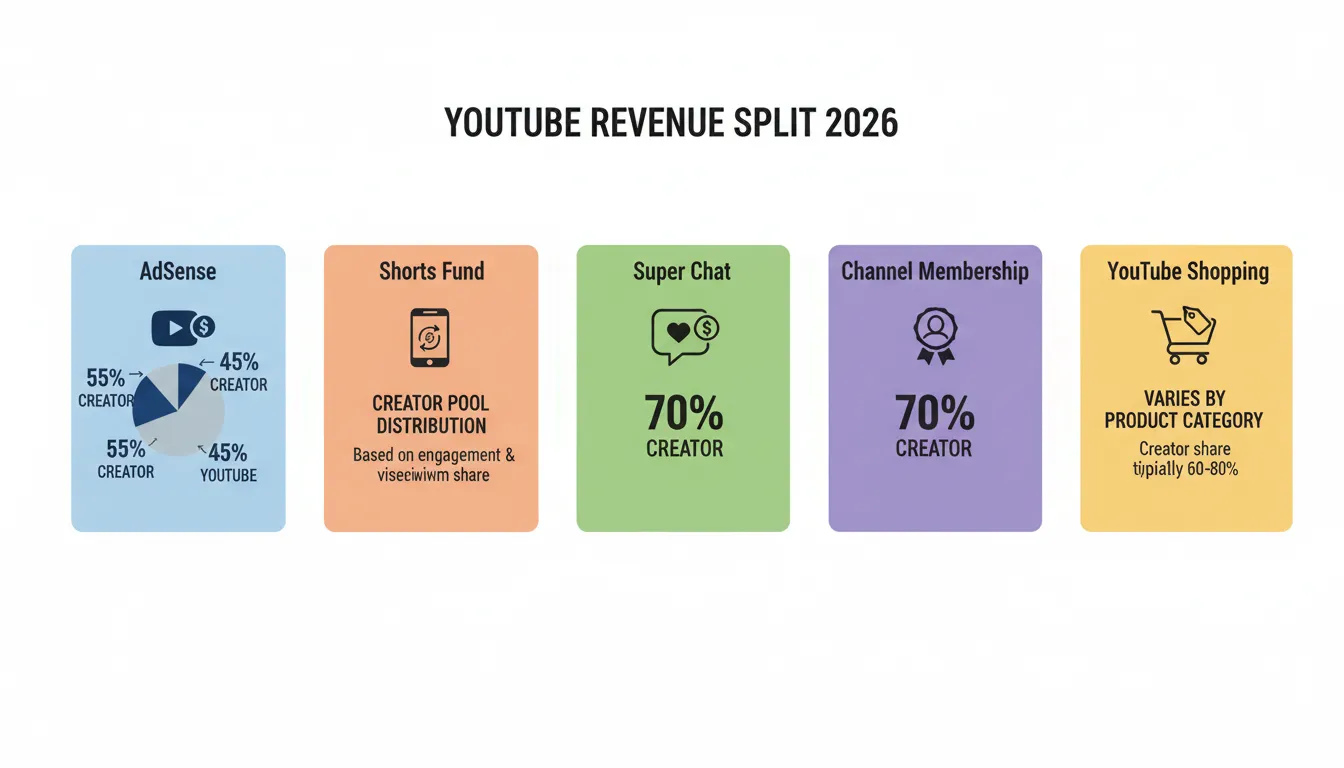
Think of it like this: YouTube is the landlord, and you’re the tenant. For traditional AdSense ads, YouTube takes a 45% cut of ad revenue, and you keep 55%. That’s the baseline split. But YouTube also operates other monetization programs where it takes different percentages because the operational costs differ. Super Chat, for example, is simpler to process—YouTube takes 30% because there’s less backend complexity. Channel Memberships work similarly.
The key insight: YouTube doesn’t negotiate individual splits. These percentages are fixed across the entire platform. Your 10-million-subscriber channel earns the same percentage as a 10,000-subscriber channel. What changes is volume. A larger channel attracts more advertisers and viewers, which means more total revenue flowing through those fixed percentages.
For 2026, the revenue splits remain largely stable compared to 2025. YouTube made adjustments to the Shorts Fund in late 2023, but the core percentages have held steady. This stability is actually good news—it means your monetization strategy from 2025 remains valid heading into 2026. However, YouTube continues testing new programs and adjusting requirements, which affects who can access which revenue streams.
Read also: the highest-RPM niches where your 55% share is worth the most.
The splits matter because they directly impact your take-home income. A creator generating $10,000 monthly from AdSense keeps $5,500. Switch that same revenue to Super Chat (if possible), and you’d keep $7,000—a 27% income increase. This is why top creators diversify across multiple programs. They’re not just chasing higher view counts; they’re optimizing their revenue mix.
YouTube AdSense Revenue Split: The 55/45 Foundation
AdSense remains YouTube’s primary monetization program for most creators. It’s automatic (YouTube handles advertiser placement), passive (you earn while sleeping), and straightforward. The revenue split is simple: YouTube takes 45%, creators keep 55%.
This 55/45 split applies to all AdSense inventory across YouTube—long-form videos, embedded videos, and technically applies to Shorts (though Shorts Fund operates differently in practice). The split covers YouTube’s operational costs: data center maintenance, content moderation, advertiser support, and platform development.
Read also: why Q4 delivers 40-80% higher earnings on the same revenue share.
Here’s what happens when an advertiser buys an ad:
1. The advertiser pays Google (YouTube’s parent company) a certain amount (let’s say $100)
2. Google/YouTube takes 45% for platform operations and profit ($45)
3. The creator receives 55% in their AdSense account ($55)
4. The creator must exceed the $100 payment threshold before receiving earnings
That $100 advertiser payment doesn’t equal $100 CPM (cost per thousand impressions). CPM is what advertisers bid. So if the CPM is $15, an advertiser pays $15 per 1,000 ad impressions served. YouTube’s cut comes from that $15 CPM, not a flat fee. This is crucial because CPM fluctuates based on:
– Geography: US/UK advertisers bid higher ($20-50 CPM) than Southeast Asian advertisers ($1-5 CPM)
– Content niche: Finance and SaaS content attracts higher CPM than casual vlogs
– Season: Q4 (October-December) sees 2-3x higher CPM than January
– Viewer demographics: Older, wealthier audiences command higher CPM
– Watch time length: Longer content allows more ads, generating more per-video revenue
Read also: credit card content — one of the highest CPM niches on YouTube.
For 2026, the 55/45 split hasn’t changed, but CPM is rising gradually. Advertisers are increasing budgets, and more international brands are entering the YouTube ecosystem. This means the actual dollar amount you earn per 1,000 views might increase even with the same revenue percentage.
The math matters here. If you’re earning $2,000 monthly from AdSense, YouTube is taking $1,636 in total value (45% of gross), but you see $2,000. YouTube doesn’t deduct it from your earnings; they deduct it earlier in the payment chain. Your $2,000 is already the 55% creator share.
One limitation: AdSense revenue depends entirely on advertiser demand and audience quality. If your audience is young, ad-blocking savvy, or in low-CPM countries, your AdSense earnings suffer even with high view counts. This is why successful creators diversify.
YouTube Shorts Fund: The Pool-Based Model
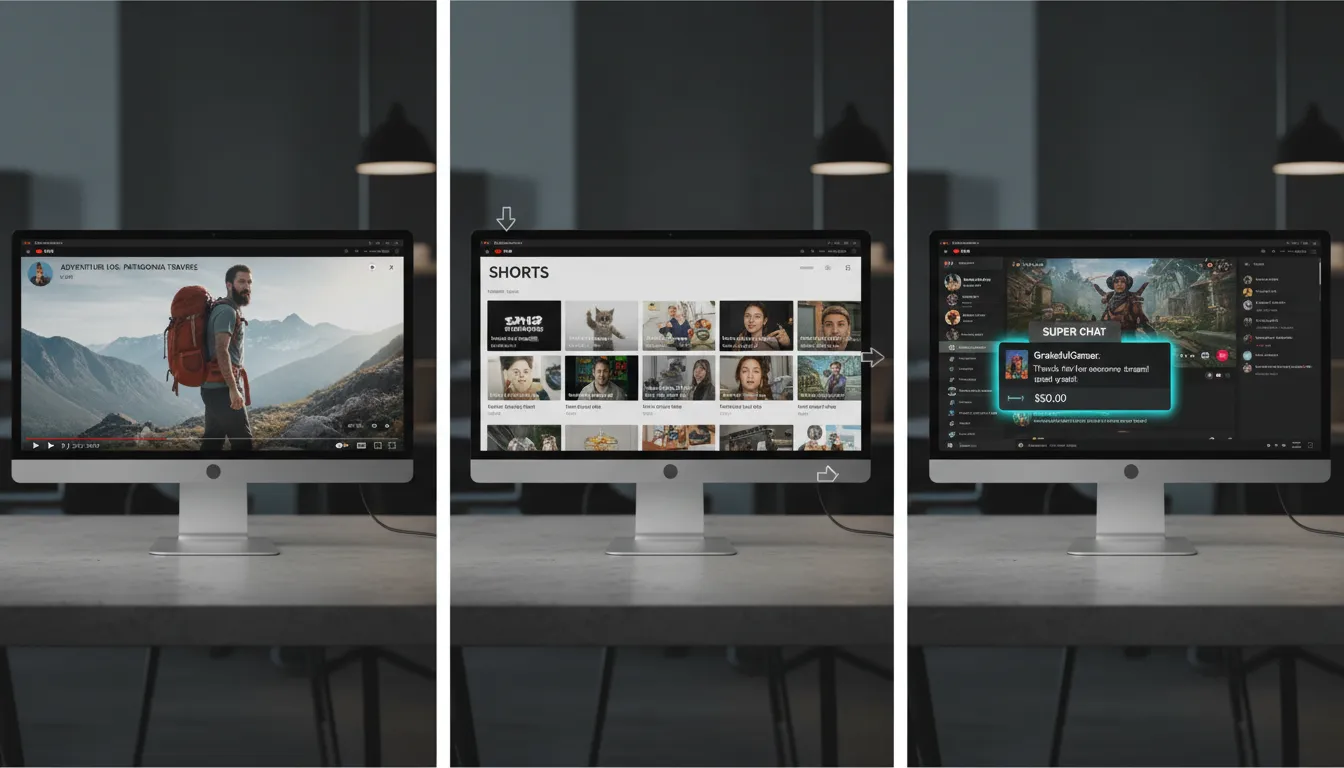
The Shorts Fund represents YouTube’s bet on short-form video. It’s fundamentally different from AdSense because it’s not directly tied to ad revenue—it’s a pool of money YouTube allocates monthly to reward Shorts creators.
Here’s how the Shorts Fund works: YouTube sets aside a fixed budget each month (historically $100 million, though this varies by region). They distribute this pool to creators whose Shorts receive views. The distribution isn’t equal—it’s merit-based. Shorts with more views get a larger slice.
The critical point: You don’t get a percentage of Shorts ad revenue. You get a portion of a predetermined pool.
This fundamentally changes the revenue model. Instead of earning based on CPM (advertiser bids), you earn based on engagement and YouTube’s budget allocation. The Shorts Fund works like this:
1. YouTube allocates the monthly budget (let’s say $10 million in your region)
2. All eligible Shorts creators share this pool
3. Your allocation depends on your share of total Shorts views that month
4. You receive your cut as a lump payment, not tied to specific ads
If you had 1% of all Shorts views in your region that month, you’d receive 1% of the $10 million pool—$100,000. But if you had 1% of views the next month when the pool was only $5 million (lower YouTube budget allocation), you’d get $50,000. The pool size fluctuates.
The Shorts Fund has strict eligibility requirements: 1,000 subscribers minimum, 100 million views of your Shorts in the last 90 days (for the 2026 tier), and compliance with community guidelines. These requirements are intentionally high to ensure the fund targets successful creators.
For 2026, YouTube changed the structure: The Shorts Fund is now tiered. Entry-level creators (1,000 subscribers, lower view requirements) receive smaller payouts but more frequent payments. Top-tier creators (10 million+ Shorts views monthly) see larger payouts because they represent the bulk of Shorts engagement.
The Shorts Fund also doesn’t include CPM variation. A creator in the US with 10 million Shorts views earns the same amount as a creator in India with 10 million Shorts views (in that month’s pool). This sounds unfair, but it’s actually strategic—YouTube wants to grow Shorts globally, so they subsidize creators in lower-CPM markets.
The downside: Shorts Fund earnings are unpredictable. You can’t forecast income because the pool size changes monthly based on YouTube’s budget decisions. Your earnings depend on platform-wide Shorts performance, not just your content. If other creators’ Shorts explode, your slice gets smaller even if your views stay constant.
Experienced creators view Shorts Fund as supplementary income, not primary. It’s a bonus, not a foundation. The real opportunity with Shorts is using them as a funnel to long-form content, which generates higher AdSense revenue through the longer engagement and higher CPM.
Key Takeaways
Super Chat & Super Thanks: The 70/30 Split
Super Chat and Super Thanks represent direct audience monetization—viewers voluntarily pay for features. YouTube’s cut is smaller here: 30%, meaning creators keep 70%.
This is YouTube’s highest creator-favorable split across all monetization programs.
Super Chat lets viewers send highlighted messages during your stream, ranging from $1 to $500 per message. Super Thanks lets viewers send a tip (typically $1-50) on your videos with a visual animation. Both are entirely optional—viewers choose to pay, YouTube doesn’t force placement.
The 70/30 split reflects lower operational complexity. YouTube processes the payment and handles payment processing fees, but there’s no advertiser involvement, no content moderation cost for matching ads to videos, and no inventory management. It’s direct creator-to-viewer monetization.
Here’s the math: If a viewer sends you a $10 Super Chat:
– Viewer pays $10
– YouTube takes $3 (30% + payment processing)
– You receive $7 (70%)
For $100 Super Chat:
– You receive $70
The appeal is obvious: higher creator percentage. But the limitation is equally clear—it depends entirely on viewer willingness to pay. Not every audience has the disposable income or desire to Super Chat. Twitch streamers often earn more from Super Chat equivalents (Twitch’s “Tips”) because gaming audiences skew younger and more engaged in live events.
For 2026, Super Chat and Super Thanks remain stable programs with no announced changes. However, YouTube is experimenting with Super Chat for pre-recorded videos, not just streams. If rolled out broadly, this could expand revenue opportunities.
The strategic use: Position Super Chat as appreciation, not necessity. Audiences resent feeling pressured. The most successful Streams acknowledge Super Chat donors, thank them publicly, and occasionally give them special privileges (early video access, shout-outs). This creates a virtuous cycle—donors feel valued, recommend the channel, and become repeat customers.
Successful creators report Super Chat earnings ranging from 5-30% of their total YouTube income, depending on community. Gaming and educational streamers typically see higher Super Chat percentages because they host frequent live streams (where Super Chat shines). Vlogging and short-form content creators see lower percentages because they post pre-recorded content less conducive to Super Chat.

Channel Memberships: The 70/30 Split (Recurring Revenue)
Channel Memberships are YouTube’s answer to Patreon. Viewers subscribe monthly to your channel at tiers you set (YouTube suggests $0.99, $4.99, $9.99, $99.99, but you can customize). YouTube takes 30%, creators keep 70%.
This is identical to Super Chat’s split—70% to creators, 30% to YouTube. But the mechanic is different. Memberships are recurring, predictable monthly income. A member who joins your channel at $9.99/month stays (unless they cancel) and generates recurring revenue.
The calculation: If 100 members join at $4.99/month:
– Total monthly revenue: $499
– YouTube takes: $150 (30%)
– You receive: $349 (70%)
Multiply by 12 months, and that’s $4,188 annual recurring revenue from just 100 members. Scale to 1,000 members, and you’re generating $42,000+ annually—in addition to AdSense and other revenue streams.
Channel Memberships are psychologically powerful because they’re recurring and create a committed community. Members feel like they own a piece of your channel. They get exclusive perks: member-only videos, custom badges, exclusive Discord access, or monthly livestreams with members only.
The eligibility: 1,000 subscribers, no community guideline strikes in the past 90 days, 18+ years old (or 13+ with parental consent). Memberships are available in 35+ countries as of 2026, but not globally.
For 2026, YouTube expanded Membership features: Automatic member-exclusive posts (members see videos 24 hours early), member polls (members vote on content topics), and member livestreams. These features increase member value perception, leading to higher conversion rates.
The strategic insight: Memberships work best with engaged, loyal audiences. A channel with 100,000 casual subscribers might see 200-500 members. A channel with 50,000 highly engaged subscribers might see 2,000+ members. Engagement, not size, drives Membership success.
Successful creators report Membership revenue ranging from 10-40% of total YouTube income. Educational, gaming, and creator-focused channels see higher percentages because audiences believe in directly supporting creators. Entertainment and news channels see lower percentages because audiences expect free content.
YouTube Shopping & Product Shelf: Variable Revenue Share
YouTube Shopping lets creators display products in a shelf directly on their channel. When viewers click through and purchase, creators earn commission. Unlike other programs, the commission varies based on the product source.
If you’re linking to your own store or affiliate products, YouTube doesn’t take a cut—you earn full commission (as negotiated with the merchant or affiliate program). If you’re using YouTube’s built-in monetization for creators directly selling physical products, the split varies by product type.
This is less about YouTube’s revenue share and more about enabling creators to earn from commerce. YouTube’s role is the platform, not the middleman. However, YouTube does require verification for Shopping eligibility: 10,000 subscribers, 3+ months of uploads, and compliance with shopping policies.
For 2026, YouTube expanded Shopping to include digital products, not just physical items. Creators can sell e-books, courses, and digital downloads directly. The commission structure is:
– Affiliate products (Amazon, Etsy): Standard affiliate commission (typically 3-10%)
– Your own products: 100% (minus payment processing fees ~2.9% + $0.30)
– Digital downloads via YouTube: YouTube takes 0% (they provide the infrastructure for delivery)
The opportunity here is unlimited. A creator selling a $47 course earns $44 per sale (after payment processing). A creator with 50,000 subscribers might sell 100-500 courses monthly, generating $4,400-$23,500 in additional income—completely separate from AdSense and other programs.
The limitation: You must build the products yourself or source them. YouTube provides the shelf; you provide the products and marketing.
For creators focused on monetization, Shopping is often overlooked but incredibly powerful. It enables revenue diversification without relying on YouTube’s algorithm or advertiser demand. Your own products have unlimited revenue potential—YouTube doesn’t cap your earnings.
YouTube Premium Revenue: The Passive Share
YouTube Premium (subscription) members pay $13.99/month to remove ads. YouTube shares a portion of Premium subscription revenue with creators based on watch time from Premium members.
This is the most opaque YouTube revenue stream. YouTube doesn’t publish the exact split or calculation method. What we know:
– Premium revenue is pool-based (like Shorts Fund)
– Distribution depends on watch time from Premium members only
– Payments are made monthly to eligible creators
– The amount varies based on total Premium subscriber count and monthly watch time
For 2026, YouTube expanded Premium availability to 70+ countries, increasing the total revenue pool available. However, in most markets, Premium penetration remains low. In the US, YouTube Premium has roughly 20 million subscribers (out of YouTube’s 2.5 billion users). Premium revenue typically represents 1-3% of creator revenue.
The upside: It’s passive. You earn without ads being served, which means Premium revenue doesn’t depend on CP
Advertisement