

“`json
“`
The global freelance workforce surpassed 1.1 billion people in 2024, and it’s only accelerating. But here’s the uncomfortable truth: not all freelancing platforms are created equal. Some take 50% commission. Others have flooded their marketplaces with inexperienced workers, tanking rates across the board.
If you’re serious about making real money through freelance work in 2026, you need to know which platforms actually connect you with quality clients, which ones pay fairly, and which ones waste your time with penny-pinching budget projects. This guide breaks down the top freelancing platforms available right now—with honest pros, cons, average earnings, and real success strategies.
We’re not here to sell you on joining every platform. Instead, you’ll learn which platforms fit different skill sets, how to maximize your income on each one, and when to move your efforts elsewhere. By the end of this article, you’ll have a clear roadmap to turn freelancing into a legitimate income stream.
What Is a Freelancing Platform and Why It Matters in 2026
A freelancing platform is essentially a digital marketplace that connects independent workers with clients looking for specific services. Think of it as an eBay for skills and talent. Instead of selling physical products, you’re selling your expertise—whether that’s writing, design, programming, virtual assistance, or specialized consulting.
The evolution of freelance platforms has been dramatic. In 2015, most platforms were purely transactional. They took your work, slapped it on a listing, and hoped clients would find you. Today’s best platforms function more like professional networks. They include communication tools, project management features, portfolio showcases, time tracking, and payment protection.
Why does this matter? Because the platform you choose directly impacts three critical factors: your earning potential, the quality of clients you attract, and the time you spend managing work versus actually doing it.
Consider this: a freelancer on a low-tier platform might earn $25 per hour for writing work. The same freelancer on a higher-end platform like Toptal could command $75-150 per hour for the identical skill. The difference? Platform reputation, vetting standards, and the client base they’ve cultivated.
In 2026, the freelance market has bifurcated into tiers. On one end, you have high-volume, low-barrier platforms saturated with competition where rates have compressed. On the other end, you have curated platforms with rigorous vetting processes where skilled freelancers command premium rates because clients trust the quality filter.
The platforms you choose should align with your skill level, experience, and income goals. A beginner might start on Fiverr or Upwork to build their portfolio. A professional with 5+ years of experience should be targeting platforms like Toptal, Gun.io, or Arc.dev where per-project rates start at $50+ per hour.
Top 10 Freelancing Platforms Ranked by Earning Potential in 2026
Upwork: The Most Diverse Marketplace
Upwork dominates the freelance platform space with over 18 million registered freelancers and 5 million active clients. If you’re starting from scratch, you’ll likely begin here. But earning real money on Upwork requires strategy.
How It Works: Upwork operates on both an hourly and fixed-price project model. You create a profile, propose on job postings, and clients hire you directly. Upwork’s algorithm determines which proposals get visibility, and it favors established freelancers with high ratings.
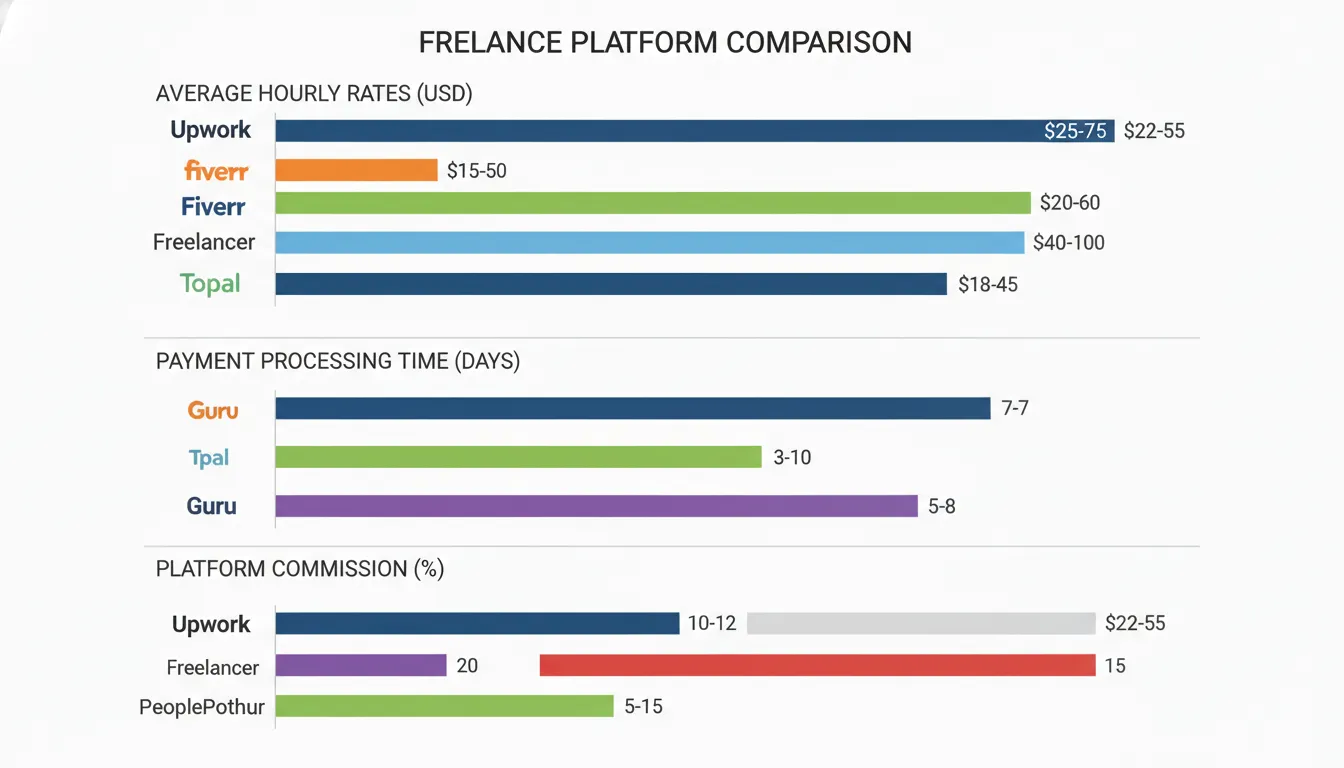
Earning Potential: Entry-level freelancers typically earn $10-25 per hour on Upwork. Established professionals with strong portfolios and ratings regularly command $50-150+ per hour. The platform takes 5-20% commission depending on your earnings history (5% after your first $500 earned).
Best For: Writing, design, development, virtual assistance, and social media management. Upwork’s diverse client base means there’s work for nearly every skill set.
Pro Strategies:
– Specialize heavily. Generic profiles get lost. “Content Writer” fails. “B2B SaaS Blog Writer for Fintech Startups” wins.
– Respond within the first 6 hours of a job posting. The algorithm heavily weights early responses.
– Ask clarifying questions in your proposal. Show you read their job posting and understood their needs.
– Avoid bidding on hundreds of low-quality jobs. It dilutes your profile’s quality rating.
Common Pitfall: Freelancers treat Upwork like a job board and just blast out generic proposals. This approach yields 1-2 hires per month at low rates. Successful Upwork freelancers treat it like a client relationship platform and focus on quality over quantity.
Fiverr: The Service-Based Selling Model
Fiverr flipped the traditional freelance marketplace upside down. Instead of clients posting jobs, you create service packages (called “Gigs”) and clients purchase them. This fundamentally changes your selling approach.
How It Works: You set your prices, create detailed service packages, and clients come to you. Fiverr takes 20% commission on every sale. The platform does the marketing; your job is to optimize your gigs for visibility and deliver excellent service.
Earning Potential: Fiverr has a quirky pricing tier system. Gigs start at $5 (hence the name), but you can charge $995+ for premium packages. Realistic earnings range from $200-2,000 per month for part-time freelancers who have 1-2 active gigs with good reviews. Full-time Fiverr sellers with multiple high-performing gigs earn $3,000-10,000+ monthly.
Best For: Design, writing, voiceover work, video editing, and any service that can be packaged into defined deliverables. Fiverr works best when you have a repeatable service.
Why Fiverr Works Differently: The barrier to entry is lower on Fiverr compared to Upwork. Clients aren’t evaluating dozens of proposals; they’re browsing services. If your gig is optimized for Fiverr’s algorithm (which heavily favors ratings, completion rate, and customer reviews), you’ll get consistent inquiries.
Pro Strategies:
– Start conservatively priced to build reviews quickly, then raise prices once you have 10+ five-star ratings.
– Create service tiers: Basic, Standard, and Premium. This increases average order value dramatically.
– Use video in your gig description. Fiverr prioritizes gigs with professional video introductions.
– Offer fast turnarounds (24-48 hours). Speed is rewarded heavily in Fiverr’s algorithm.
Common Pitfall: Underpricing at the start. Many freelancers feel obligated to stay at $5-15 because “that’s what Fiverr is.” Wrong. Successful Fiverr sellers price competitively (often $50-200 per gig) and let reputation do the selling.
Toptal: The Premium Tier for Top Talent
Toptal is the antithesis of high-volume platforms. They accept roughly 3% of applicants. If you get in, you’re competing in an elite pool where clients are paying premium rates specifically because they expect premium quality.
How It Works: You apply, pass a rigorous vetting process (skills tests, interview, work sample), and gain access to Toptal’s curated client base. Toptal matches you with clients based on your expertise and project requirements.
Earning Potential: Toptal freelancers average $60-150+ per hour. Some senior developers and architects earn $200+ per hour. The platform takes 10% commission after you complete jobs and build a relationship with clients.
Best For: Software developers, designers, project managers, and finance professionals. Toptal focuses on high-complexity, high-stakes projects where expertise genuinely commands a premium.
Why Toptal Commands Higher Rates: Clients using Toptal have vetted budgets. They’re not comparison shopping against five other freelancers at lower prices. They’ve already decided to invest in quality. This psychology is powerful.
Pro Strategies:
– Prepare intensively for the vetting interview. They’ll ask technical questions designed to separate true experts from self-taught hobbyists.
– Build relationships with account managers at Toptal. They match you to work, and relationships matter.
– Create a detailed case study of past work. Toptal clients want to see evidence of impact, not just deliverables.
Common Reality Check: Getting into Toptal is hard. The vetting process weeds out the majority of applicants. Only pursue this if you genuinely have 5+ years of professional experience and can pass a technical interview.
Guru: The Overlooked Middle Ground
Guru is positioned between Upwork and Toptal. It’s smaller than Upwork (around 3-4 million freelancers), which means less competition for quality projects. Guru attracts serious clients but doesn’t have the household name recognition of Upwork.
How It Works: Guru uses a similar model to Upwork—you propose on jobs, build client relationships, and get paid through the platform. Work Rooms provide collaboration tools, and Guru’s feedback system helps establish reputation.
Earning Potential: Guru freelancers typically earn $25-75 per hour across diverse skill categories. Commission rates are competitive: 8.95% for freelancers with good ratings, scaling down the more you earn.
Best For: Content writers, designers, developers, and customer service professionals. Guru has a strong community of serious freelancers who’ve learned not to underbid.
Why Guru Often Works Better Than Upwork: The smaller community of freelancers means less race-to-the-bottom pricing. Clients on Guru expect to pay fair rates and generally respect reasonable pricing. You’ll get fewer total inquiries than on Upwork, but the quality of each inquiry tends to be higher.
Pro Strategies:
– Niche yourself deeply. A specialist on Guru often wins over a generalist.
– Respond to invitations immediately. Guru’s platform often invites specific freelancers to apply for jobs matching their profile.
– Build long-term client relationships. Repeat clients bypass the bidding process and hire you directly at negotiated rates.
99designs: Specialized for Creative Services
99designs is the leading platform for design work specifically. If you’re a graphic designer, logo designer, or design generalist, this is your space.
How It Works: 99designs offers two models: the Contest Model (clients hold a design competition with multiple designers competing) and the One-on-One model (direct project matching). The platform handles all client communication and payment.
Earning Potential: Earnings vary wildly depending on competition and your experience level. A beginner designer might earn $300-500 per design project through contests. Established designers using the One-on-One model earn $1,000-5,000+ per project.
Best For: Logo design, website design, packaging design, branding, and any visual creative work.
Why 99designs Stands Out: Unlike Upwork where any freelancer can propose, 99designs vets designers. You need a portfolio to get accepted. Once approved, clients come to you based on your style and past work.
Pro Strategies:
– Build a strong portfolio before applying. Include 5-10 of your best design samples.
– Emphasize your design philosophy. Clients want designers with a point of view, not generalists.
– Use the One-on-One model once you have reviews. This bypasses the contest model and gets you direct client access.
Behance/Adobe Creative Cloud: Portfolio-First Approach
Behance (owned by Adobe) isn’t strictly a freelance platform, but it’s evolved into one of the most important places creative professionals showcase work. Many high-paying clients find designers through Behance.
How It Works: You upload your creative portfolio to Behance, optimize it for discovery, and clients reach out directly. No bidding, no contests—just your work speaking for itself.
Earning Potential: No direct earnings through Behance. Instead, it’s a pipeline for inbound client inquiries at premium rates. Designers with strong Behance portfolios report that 30-50% of their annual revenue comes from Behance leads.
Best For: Designers, art directors, photographers, and any creative professional serious about building personal brand and reputation.
Why This Matters: Behance attracts a different client entirely. These are clients who researched design work, found your portfolio, and decided they want to work with you specifically. That’s incomparably valuable compared to being one of 50 proposals on Upwork.
Pro Strategies:
– Treat Behance as your permanent portfolio, not just a platform.
– Write detailed case studies for each project. Explain your process, challenges, and results.
– Optimize project descriptions for search. Use keywords like “luxury branding,” “SaaS design,” “e-commerce,” etc.
– Include pricing information discretely. Serious clients expect to pay professional rates.
Freelancer.com: High Volume, Lower Rates
Freelancer.com is one of the oldest freelance platforms, with 60+ million registered users. It’s the volume play—lots of jobs, lots of bidders, competitive pricing.
How It Works: Similar to Upwork and Guru—post your profile, bid on jobs, deliver work, get paid. Freelancer.com offers both fixed-price and hourly projects.
Earning Potential: Entry to mid-level freelancers typically earn $15-40 per hour. The platform’s volume attracts a lot of low-budget projects, so earnings skew lower than Upwork or Guru.
Best For: Beginner freelancers building portfolios and experience. Developers, writers, and virtual assistants looking for volume work.
Common Reality: Freelancer.com is a stepping stone, not a destination. Most successful freelancers graduate to better platforms as their rates and reputation improve.
Arc.dev and Gun.io: Developer-Specific Premium Platforms
Arc.dev and Gun.io serve the same market as Toptal but with slightly different approaches. Both platforms focus exclusively on software developers and charge clients a premium for access to vetted talent.
How It Works: You apply, pass vetting, and gain access to a curated list of job opportunities. Gun.io matches you with clients; Arc.dev includes both matching and direct job postings.
Earning Potential: Developers on Arc.dev and Gun.io average $75-150+ per hour. Senior developers and those with specialized skills (blockchain, machine learning, etc.) command $150-250+ per hour.
Best For: Full-stack developers, backend developers, frontend developers, mobile developers—anyone with commercial development experience.
Why These Platforms Work: They’ve created a vetted, premium market specifically for developers. No low-ball projects. No beginner competition. Just serious clients with real budgets.
Pro Strategies:
– Have a strong GitHub profile. These platforms review your code.
– Specialize in a specific tech stack or industry.
– Build long-term relationships with account managers.
PeoplePerHour: UK-Based Alternative to Upwork
PeoplePerHour is a UK-founded platform with strong presence across Europe and growing global reach. It’s smaller than Upwork but attracts quality clients and freelancers.
How It Works: Similar to Upwork—bid on projects, build reputation, get hired. PeoplePerHour emphasizes quality over volume and has stricter vetting for freelancers.
Earning Potential: PeoplePerHour freelancers typically earn £20-60+ per hour ($25-75 USD equivalent). Commission structure is competitive: 20% for new freelancers, scaling down to 5% for top earners.
Best For: Writers, designers, developers, and virtual assistants. Particularly strong for UK-based work and European clients.

How to Choose the Right Platform(s) for Your Skills and Goals
Choosing platforms isn’t about joining every single one.
Key Takeaways

Advertisement
