

“`json
“`
The digital product market is booming. In 2024, the global digital content market was valued at over $1.3 trillion. By 2026, that number is projected to exceed $1.8 trillion. What does this mean for you? There’s never been a better time to create and sell digital products online. Whether you’re a complete beginner or an experienced creator, this market is open to everyone—no inventory needed, no shipping costs, no geographical limitations. The barrier to entry is lower than ever. You could launch your first digital product within weeks. Unlike traditional business models, digital products offer something magical: they sell while you sleep. Create once, sell infinitely. That’s the power of the digital product economy. Yet most people never start because they don’t know where to begin. They’re overwhelmed by choices: Should they build an ebook? Record an online course? Create printable templates? They worry about technical skills, marketing expertise, or finding customers. This guide eliminates that confusion. We’ll walk you through every step—from identifying your niche to scaling beyond your first $1,000 in sales. You’ll learn which platforms actually work in 2026, what products are most profitable, and how to avoid common mistakes that derail most creators. This isn’t theoretical. These are battle-tested strategies used by creators generating $300+ per day with digital products.
What Are Digital Products and Why They Matter
Digital products are intangible items delivered online—no physical manufacturing required. They live in files: PDFs, videos, audio, templates, software, or access to membership communities. The beauty is simple: create once, sell repeatedly. You don’t restock. You don’t manage inventory. You don’t wait for manufacturing timelines. A customer buys, downloads instantly, and you’ve made a sale with zero incremental cost.
The types of digital products span a wide range. Ebooks remain the most accessible entry point—straightforward to create, easy to market, and profitable for beginners. Online courses are the premium option, commanding higher prices because they deliver structured learning and transformation. Digital downloads include templates, spreadsheets, Notion workspaces, Canva designs, or graphics. Membership communities offer recurring revenue—customers pay monthly for exclusive content or community access. Software-as-a-service (SaaS) products automate tasks for businesses. Digital art, music, and stock photography serve specific niches. Pre-made email sequences, sales funnels, and marketing frameworks help entrepreneurs. The diversity means there’s an option for nearly every skill level and interest.
Why does this matter in 2026? Several factors converge. First, remote work normalized digital solutions. Businesses and individuals now expect digital products. Second, platforms made distribution frictionless. You don’t need technical skills—Gumroad, SendOwl, Teachable, and Thinkific handle payment processing, delivery, and customer management. Third, AI tools dramatically reduced creation time. You can draft an ebook in days, not months. You can create course videos faster than ever. Finally, passive income became a cultural priority. After the pandemic, people realized the fragility of relying on one income source. Digital products became the practical solution.
The real competitive advantage isn’t in having a unique idea. It’s in execution and audience building. Thousands of ebook templates exist. Hundreds of email marketing courses are sold. But the creators winning share one trait: they started, they published, and they marketed consistently. They didn’t wait for perfection.
Step 1: Identify Your Niche and Validate Demand
Your niche determines everything—profitability, competition, audience size, and whether you’ll stay motivated. A niche is simply a specific segment of people with a specific problem. “Business” is too broad. “Email marketing for e-commerce store owners” is a niche. “Productivity” is too broad. “Time management for parents working from home” is a niche.
Finding your niche requires three inputs: expertise, passion, and market demand. Start with what you know. What problems have you solved? If you’ve successfully grown an Instagram account to 50K followers, you have expertise in social media growth. If you’ve managed a household budget for years, you understand personal finance. If you’ve learned programming through self-study, you can teach coding to beginners. Don’t discount experience others might overlook. Your specific combination of skills and background creates unique perspective.
Next, identify what you’re willing to spend 6-12 months building around. You’ll be creating content, answering customer questions, and iterating on your product. Passion sustains you through the boring parts. If you hate the niche by month four, you’ll quit.
Finally, validate demand. This is crucial. A niche you love but nobody wants to pay for won’t work. Use these validation methods:
Reddit Research: Search relevant subreddits. Look for communities actively discussing your niche. Read what problems they mention repeatedly. If a subreddit has 100K+ members and daily activity, demand exists.
Google Trends: Type your niche keyword into Google Trends. Does it show stable or growing search volume? Declining trends suggest shrinking demand.
YouTube Analytics: Search your niche keyword on YouTube. How many views do related videos get? Are there channels with 100K+ subscribers? This proves an audience exists.
Amazon Book Sales: Search your niche on Amazon. If bestselling books in that category have thousands of reviews, a market exists.
Facebook Groups: Join groups serving your niche. Monitor activity. Successful groups with engaged members signal strong demand.
Competitor Research: Search your niche on Gumroad, SendOwl, and Teachable. Do competitors exist? Are they selling? How many reviews do they have? Lack of competitors might mean no demand. Too many competitors means you need a unique angle.
The validation step separates winners from people wasting time. Spend two weeks researching before you create a single product. This upfront work prevents months of wasted effort.

Step 2: Create Your Digital Product
Creation is where most people stumble. They overthink. They procrastinate. They aim for perfection. Stop. Digital products don’t need to be flawless. They need to be useful. Your first version is a starting point, not your legacy.
For Ebooks, the creation process is straightforward. You don’t need design software or coding knowledge. Use Google Docs, write your outline, then expand each section. A valuable ebook for beginners might be 40-60 pages. For intermediate audiences, 80-120 pages. Don’t write more just to pad the page count. Write what solves the problem. Once drafted, export to PDF. You can add basic design using Canva (templates make this simple) or hire a freelancer on Fiverr for $30-50.
For Online Courses, structure matters more than production quality. Outline your curriculum: How many modules? How many lessons per module? What’s the learning progression? Then record videos. You don’t need studio-quality equipment. Your phone’s camera works fine. Use free editing software like DaVinci Resolve or CapCut. Upload to your hosting platform. Add transcripts for accessibility. Professional courses have polish, but functional courses work just fine.
For Templates and Printables, create once in Canva, Google Sheets, or Notion. Save as PDF or appropriate file format. A collection of 10-20 templates constitutes a complete product. Think about what frustrates your audience. Solve that with templates.
For Membership Communities, you need clear content calendars. What will members access daily, weekly, or monthly? You might offer group coaching calls, exclusive resources, or community forums. Plan four months of content before launch.
For Email Sequences, map out the flow: How many emails? What’s the purpose of each? What calls-to-action do you include? A valuable sequence might be 7-15 emails delivered over two weeks.
The creation timeline depends on scope. A basic ebook: two weeks. A five-module course: 4-8 weeks. Templates: three weeks. Membership community: two weeks of planning, then ongoing content. Don’t aim for perfection. Aim for launch. You’ll improve based on customer feedback.
AI tools accelerated creation significantly in 2026. ChatGPT helps outline content, draft sections, and refine copy. Midjourney creates images. Opus Clip turns long videos into short clips. These tools don’t create your product; they accelerate your creation. You still provide the expertise, judgment, and direction.
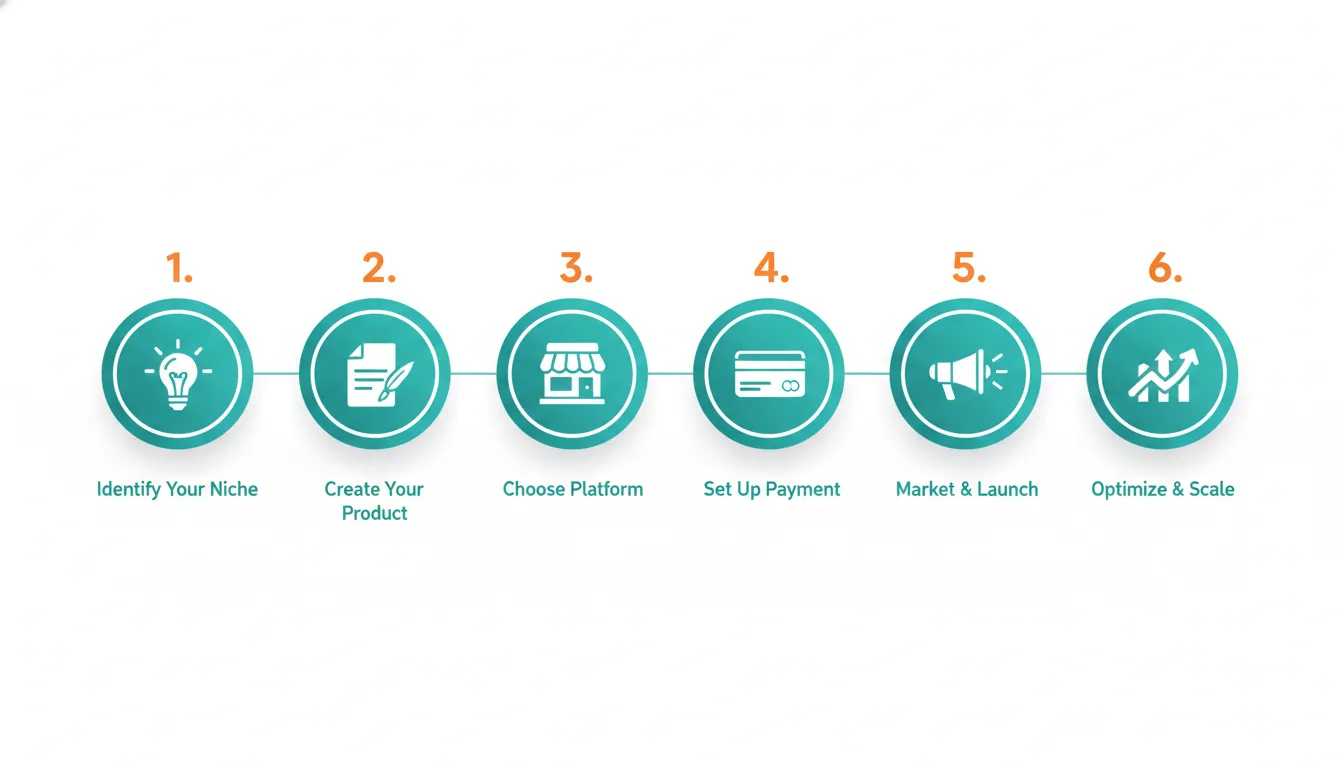
Key Takeaways
Step 3: Choose Your Platform and Set Up Your Store
Where you sell matters as much as what you sell. Different platforms serve different needs. Your choice depends on product type, technical comfort, and desired features.
Gumroad is the most beginner-friendly option. Upload your file, set a price, and you’re live. No coding required. They handle payment processing, file delivery, and customer management. Gumroad takes 10% of sales (lower than most competitors). It’s ideal for ebooks, templates, digital downloads, and courses. The audience is creative professionals, so it works well if you’re selling to creators.
Teachable specializes in online courses. It has built-in video hosting, student progress tracking, and community forums. More expensive than Gumroad ($39-399/month), but better for serious course creators. If your primary product is courses, Teachable is worth the investment.
SendOwl is a versatile platform supporting multiple product types. Pricing structure is flexible. Good for creators selling multiple products to the same audience.
Thinkific competes with Teachable, offering similar features at comparable prices. Both are solid for course creators.
Kajabi is the premium option ($119-399/month). It includes landing pages, email marketing, and community features. Use Kajabi if you’re building a full business ecosystem, not just launching one product.
Self-hosted options like WordPress plus WooCommerce or Easy Memberships give maximum control but require technical knowledge and ongoing maintenance. Most beginners should avoid this until they’re making substantial revenue.
Choosing your platform:
– First digital product, any type except courses: Gumroad
– Online courses primarily: Teachable or Thinkific
– Multiple product types to same audience: SendOwl
– Building a complete business ecosystem: Kajabi
– Maximum technical control, advanced skills required: Self-hosted WordPress
Once you’ve chosen, set up takes 1-2 hours. Connect a payment method (Stripe or PayPal). Upload your product files. Write product description and set pricing. Create a simple landing page if your platform provides one. That’s it.

Step 4: Price Your Product Strategically
Pricing trips up most creators. They either underprice (leaving money on the table) or overprice (pricing themselves out of the market). Here’s how to find the sweet spot.
Ebooks typically sell between $7-$47. A beginner guide might be $9-$17. An advanced, comprehensive ebook costs $27-$47. Consider your audience’s budget and problem severity. Are they solving an urgent, painful problem? Higher prices work. Are they learning casually? Lower prices work.
Online courses range from $37-$597. A short course (3-5 modules) costs $37-$97. A comprehensive course (10+ modules) costs $97-$297. Premium courses targeting business audiences can command $397-$997. Your price signals quality and attracts serious students.
Templates and digital downloads sell between $5-$29. A single template costs $5-$9. A bundle of 10-20 templates costs $17-$29.
Membership communities cost $9-$99/month. Entry-level communities with monthly resources cost $9-$29/month. Premium communities with group coaching or frequent live sessions cost $49-$99/month.
Pricing strategy considerations:
– Competitor pricing: What are successful competitors charging? Don’t undercut drastically unless you’re offering unique value.
– Time to create: More time invested justifies higher prices.
– Transformation offered: Does your product teach a skill worth thousands to the buyer? Price reflects ROI.
– Audience income level: Business owners pay more than students. High-income professionals pay more than hobbyists.
– Risk of underpricing: Low prices attract bargain hunters and reduce perceived value. Start higher; you can lower prices later.
– Perceived value over actual cost: You spent 60 hours creating the course, but that doesn’t determine its price. Perceived value determines price.
A proven strategy: Launch at a mid-range price. If you get minimal sales, you can lower prices. If demand exceeds supply, raise prices. Starting low makes raising prices difficult psychologically—existing customers resent it.
Step 5: Build an Audience Before (and During) Launch
This is where most digital product creators fail. They build a great product, launch to zero people, and wonder why nobody’s buying. Your product needs an audience before launch. Start building your audience months before your product exists.
Build audience through multiple channels:
Email List: This is your most valuable asset. Own the relationship. Use a tool like ConvertKit, Substack, or Mailchimp. Create a lead magnet—free resources people exchange their email for. A free ebook chapter, template sample, or email course works well. Promote your lead magnet consistently. Your goal: 500-1,000 email subscribers before launching.
Social Media: Choose one platform and go deep instead of spreading thin across many. If you’re visual, use Instagram or TikTok. If you’re written-word focused, use LinkedIn or Twitter/X. Post consistently—3-5 times per week. Share valuable, free content from your niche. Build genuine engagement. You’re not directly selling; you’re building trust and demonstrating expertise.
Content Marketing: Start a blog or YouTube channel. Create content around problems your product solves. Rank for SEO keywords. Direct readers to your email list. This is slow initially but pays dividends as search traffic accumulates.
Community Participation: Join Reddit communities, Facebook groups, and Discord servers in your niche. Help people authentically. Don’t spam links. When people ask questions you can help with, answer thoroughly. Over months, people recognize you as helpful. When you eventually mention your product, they’re interested.
Strategic Partnerships: Connect with creators serving the same audience. Offer to create free content together. Cross-promote. Share each other’s products. This accelerates audience building dramatically.
Pre-launch strategy: Two weeks before launch, tell your audience you’re creating something. Share your creation process. Ask for feedback. Build anticipation. Launch to excited, engaged people, not cold strangers.
Step 6: Market and Launch Your Product
Launch day is exciting but brief. Most sales come in the first 48 hours. Prepare accordingly.
Pre-launch (two weeks before):
– Email your list that something’s coming
– Tease on social media daily
– Ask audience what they want in your product
– Create urgency (limited-time launch price, limited spots for courses)
Launch day:
– Send launch email to your entire list
– Post multiple times on social media
– Reach out to strategic partners for cross-promotion
– Update all relevant landing pages
– Consider a launch discount (20-30% off first 48 hours)
Post-launch (weeks 2-4):
– Email sequences to cold audience (non-list followers)
– Consistent social media content
– Create launch bonuses (exclusive bonuses for early buyers)
– Gather testimonials from initial customers
– Ask for reviews on your platform
Launch mechanics:
– Create a simple landing page describing your product (most platforms provide this)
– Write benefit-focused copy (what will the buyer be able to do after consuming your product?)
– Include social proof if available (testimonials, reviews, results)
– Use urgency and scarcity (limited-time prices, limited spots)
– Clear call-to-action (large “Buy Now
Advertisement
