

“`json
“`
The freelance economy is exploding. By 2026, an estimated 2.1 billion people worldwide will engage in some form of freelance work, according to recent market research. That’s not just a side hustle anymore—it’s a legitimate career path. But with thousands of platforms claiming to offer the best opportunities, how do you know which ones actually pay and which ones waste your time?
The truth is simple: not all freelancing platforms are created equal. Some take 50% commission. Others demand upfront fees. Some platforms attract serious clients willing to pay premium rates. Others are flooded with budget-conscious shoppers looking for $5 gigs. The difference between choosing the right platform and the wrong one could mean the difference between making $500 a month and $5,000 a month.
In this guide, we’ve analyzed the top freelancing platforms operating in 2026. We’ve looked at commission structures, payment methods, user bases, and most importantly—what real freelancers are actually earning. Whether you’re a writer, designer, developer, marketer, or virtual assistant, you’ll find the platform that matches your skills and income goals.
What Are Freelancing Platforms? Understanding the Marketplace
Freelancing platforms are digital marketplaces that connect clients with independent professionals. Think of them as the middleman between you and people who need work done. Instead of knocking on doors or cold-emailing prospects, you create a profile, showcase your portfolio, and wait for clients to hire you.
These platforms handle the logistics. They process payments, provide dispute resolution, and in many cases, they keep a percentage of what you earn (typically 5-50% depending on the site). Some platforms are horizontal—meaning they accept all types of work. Others are vertical—focused on specific niches like design, writing, or programming.
The beauty of freelancing platforms is accessibility and speed. You can be earning money within days, not months. There’s no lengthy hiring process. No background checks (usually). Just a profile, some samples of your work, and client reviews that build your credibility over time.
However, there’s a trade-off: you’re competing with thousands of other freelancers globally. A client in the US might hire a developer in India for half the price. This is why choosing the right platform for your skill level matters enormously. High-end platforms like Toptal filter out 97% of applicants, meaning less competition but higher rates. Mainstream platforms like Upwork have lower barriers to entry but fiercer competition.
Upwork: The Most Popular Freelancing Marketplace
Upwork is the 800-pound gorilla of freelancing. With over 12 million freelancers and 5 million clients, it’s where most of the action happens. Whether you’re a complete beginner or a seasoned professional, you’ll find opportunities here.
How Upwork Works:
Upwork operates on a bidding system (for some job types) or fixed-price projects. Clients post jobs, and freelancers submit proposals. Once hired, you work through Upwork’s platform, and they automatically withhold their commission (10-20% depending on your earnings history with that client).
Best For:
Writers, developers, designers, virtual assistants, marketers, and project managers. Essentially any skill can find work here.
Commission Structure:
– First $500 earned: 20%
– Next $6,500: 10%
– All earnings after $7,000: 5%
This tiered system is actually generous. As you build earnings history, your commission drops significantly.
Payment:
Upwork processes payments weekly through various methods: direct deposit, PayPal, Wise transfers, and checks. Turnaround is 3-5 business days after project completion.
Earnings Potential:
Entry-level freelancers might earn $500-$2,000 monthly. Experienced professionals with strong reviews regularly earn $5,000-$15,000+ monthly. We’ve seen top-rated developers and writers hitting $20,000+ monthly on this platform.
Pros:
– Massive client base means consistent job opportunities
– Transparent payment system
– Favorable commission structure after initial earnings
– Built-in portfolio showcase
– Escrow protection (client funds held until you deliver)
Cons:
– Highly competitive, especially for beginners
– Requires “Connects” (paid currency) to bid on many jobs
– Platform takes transaction fees in addition to commission
– Time-tracking software required for hourly work (can feel intrusive)

Fiverr: The Quick-Start Platform for Beginners
If Upwork is the traditional marketplace, Fiverr is the modern gig economy platform. Instead of bidding on projects, you create “Gigs”—preset service offerings at fixed prices. Clients browse and buy your services like they’re shopping on Amazon.
How Fiverr Works:
You create a gig (e.g., “I will write 1000 words of SEO-optimized content for $50”). Clients discover your gig through search or recommendations and purchase directly. No bidding. No proposals. Just immediate work.
Best For:
Beginners, creative professionals, service-based work (writing, design, voiceover, social media management, graphic design, animation).
Commission Structure:
Fiverr takes 20% of every order. Unlike Upwork, this doesn’t decrease with earnings. It’s flat 20%, no matter how much you’ve earned.
Payment:
Payments are held for 14 days after order completion, then released to your account. Minimum payout is $10 via PayPal or direct bank transfer. Payment frequency is bi-weekly.
Earnings Potential:
Many sellers start with $20-30 gigs and earn $300-800 monthly. As you build reviews and upsell add-ons (called “Gig Extras”), income grows. Top-tier sellers regularly earn $3,000-$8,000+ monthly.
Pros:
– Zero barrier to entry (no application process)
– Predictable pricing model
– Algorithm rewards consistent sellers with visibility
– Large built-in audience (Fiverr has 350+ million monthly visitors)
– Upselling opportunities with Gig Extras
Cons:
– High competition (millions of gigs in most categories)
– Difficult to raise rates once established
– Fiverr’s algorithm can be unpredictable
– Client reviews heavily influence visibility
– Limited flexibility in what you can charge
Key Takeaways
Toptal: The Premium Platform for Elite Freelancers
Toptal is the opposite of democratic access. They accept only the top 3% of freelancers who apply. If you make it in, you’ll work with Fortune 500 companies, startups, and high-net-worth individuals who pay premium rates.
How Toptal Works:
You apply and go through a rigorous vetting process—technical assessments, portfolio review, and screening calls. If approved, you’re matched with clients through Toptal’s matching team. They handle all client relations and billing.
Best For:
Experienced software developers, designers, project managers, finance professionals, and product managers with proven track records.
Commission Structure:
Toptal takes 10% of billing for long-term contracts. However, they set your hourly rate (you don’t control pricing), and rates typically range from $60-$150+ per hour depending on your experience level.
Payment:
Direct deposit, typically within 2-4 weeks of invoice date. Toptal prefers longer-term contracts, so payments are more predictable.
Earnings Potential:
At $75/hour (average rate) working 30 hours weekly, that’s $9,000 monthly. Top-tier developers can earn $120-150/hour, reaching $15,000-$20,000+ monthly.
Pros:
– Premium clients paying premium rates
– Rigorous screening means less tire-kicker clients
– Dedicated account manager support
– Long-term project focus (not one-off gigs)
– Strong reputation means booked calendar
Cons:
– Extremely difficult to get approved (97% rejection rate)
– No flexibility on rates
– Requires long-term contract commitment
– Higher expectations and stricter deadlines
– May require specific tech stack or experience

Guru: The Underrated Alternative with Lower Fees
Guru is freelancing’s best-kept secret. While not as famous as Upwork, it serves 4.5 million users and has significantly lower commission rates, which means more money in your pocket.
How Guru Works:
Similar to Upwork—clients post jobs, freelancers bid on them. Work is delivered through the platform, and Guru takes a commission. The main difference is their fee structure is more favorable.
Best For:
Programmers, designers, writers, and data analysts. Strong user base in tech fields.
Commission Structure:
– Freelancers earning under $500: 9.5% commission
– Freelancers earning $500-$5,000: 8.95% commission
– Freelancers earning over $5,000: 7.95% commission
This is substantially lower than Upwork. A freelancer earning $3,000 monthly would pay roughly $270 in commissions on Guru versus $300+ on Upwork.
Payment:
Payment goes to your Guru wallet first. You can then withdraw via PayPal, bank transfer, or direct deposit. Processing takes 2-5 business days.
Earnings Potential:
Similar to Upwork—$1,000-$5,000+ monthly depending on specialization and experience. Less competition means potentially faster project acquisition for mid-level freelancers.
Pros:
– Lower commission rates save significant money long-term
– Less crowded than Upwork (less competition)
– Good platform stability and interface
– Flexible work types (hourly, fixed-price, retainer)
– Quick payouts
Cons:
– Smaller client base (fewer total job postings)
– Less brand recognition (fewer clients looking here first)
– Lower average project budgets than Upwork
– Requires more proactive bidding to find work
Freelancer.com: Volume Play for High-Output Professionals
Freelancer.com is where high-volume freelancers thrive. With 50+ million users, it’s massive. The commission is reasonable, and if you’re willing to bid aggressively, there’s consistent work.
How Freelancer Works:
Projects are posted, freelancers bid. Once hired, work happens on the platform. The interface is a bit dated compared to competitors, but the mechanics are solid.
Best For:
Designers, developers, writers, and virtual assistants who can handle multiple projects simultaneously.
Commission Structure:
– Projects under $250: 30% commission
– Projects $250-$1,000: 10% commission
– Projects over $1,000: 5% commission
The high commission on small projects is a drawback, but larger projects are reasonable.
Payment:
Payments process within 7 days. Available via bank transfer, PayPal, or Payoneer. Minimum payout is $5.
Earnings Potential:
Entry-level: $300-$800 monthly. Experienced: $2,000-$7,000 monthly. Some power-users exceed $10,000 monthly by handling many simultaneous projects.
Pros:
– Huge project volume (tons of opportunities)
– Very low barrier to entry
– Flexible work types
– Fast payouts for larger projects
– Community features and verified payment system
Cons:
– High commission on smaller projects (30%)
– Very competitive (millions of freelancers bidding)
– Quality control issues (not all clients are professional)
– Dated user interface
– Requires aggressive bidding to win projects
99designs: For Designers Who Want Clarity
99designs is specifically built for designers—graphic designers, web designers, logo designers, and brand designers. It’s the most specialized platform we’re reviewing.
How It Works:
You create a portfolio, set your pricing, and clients browse and hire you. They also run “Design Contests” where multiple designers compete on a single brief, but this model is declining as the platform emphasizes direct hire.
Best For:
Graphic designers, UX/UI designers, brand designers, logo designers, website designers.
Commission Structure:
99designs takes 30% commission from design contests and 20% from direct hire projects.
Payment:
Bi-weekly payments via PayPal, bank transfer, or Payoneer.
Earnings Potential:
Varies enormously. Entry-level designers: $500-$2,000 monthly. Established designers: $3,000-$10,000+ monthly.
Pros:
– Niche platform means fewer irrelevant listings
– Direct hire model (not contest-based) is becoming standard
– Supportive community
– Portfolio-focused
– Higher average project budgets than general platforms
Cons:
– 20-30% commission is on the high side
– Designer-only (not useful if you have multiple skills)
– Less volume than general platforms
– Building initial reviews takes time
PeoplePerHour: The European-Friendly Platform
PeoplePerHour is strongest in the UK and Europe but serves freelancers globally. It’s smaller than Upwork but growing steadily.
How It Works:
Hourly and fixed-price projects. Freelancers bid or are invited by clients. Similar marketplace model to Upwork.
Best For:
Developers, writers, designers, marketing professionals. Strong for European freelancers.
Commission Structure:
– PeoplePerHour takes 20% on the first £500 earned
– 10% on earnings between £500-£5,000
– 5% on earnings over £5,000
Payment:
Weekly payouts via PayPal, bank transfer, or Payoneer.
Earnings Potential:
Comparable to Upwork—$800-$4,000+ monthly depending on specialization.
Pros:
– European-friendly (more UK/EU clients)
– Transparent fee structure
– Good platform stability
– Weekly payments
– Supportive community
Cons:
– Smaller community than Upwork
– Fewer job postings overall
– Less US client base
– Requires EU bank for certain features
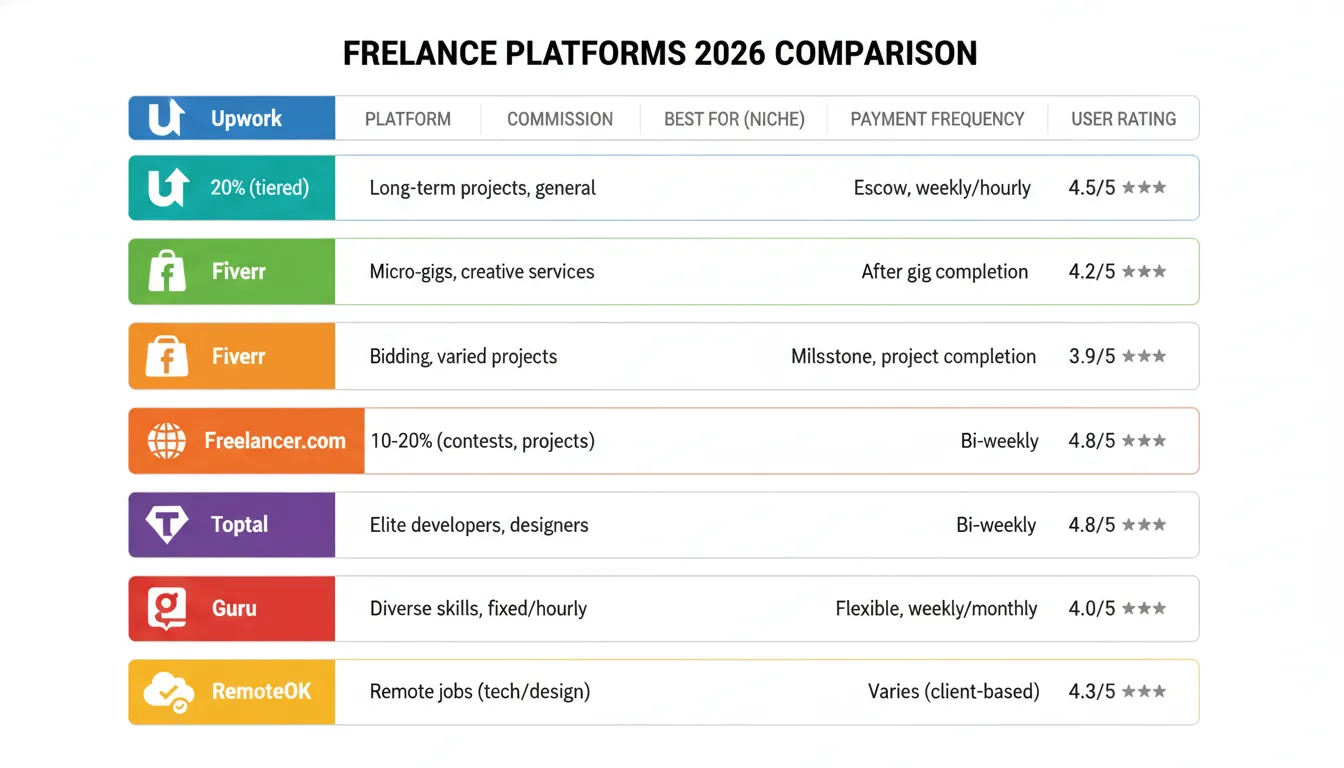
Comparison Table: Platform at a Glance
| Platform | Commission | Best For | Entry Difficulty | Payment Speed | Best Earning Potential |
|—|—|—|—|—|—|
| Upwork | 5-20% | All skills | Moderate | 3-5 days | $5K-20K+/month |
| Fiverr | 20% flat | Gig-based work | Very Easy | 14 days | $1K-8K+/month |
| Toptal | 10% | Elite developers | Very Hard | 2-4 weeks | $10K-20K+/month |
| Guru | 7.95-9.5% | Tech/creative | Easy | 2-5 days | $2K-8K+/month |
| Freelancer.com | 5-30% | High volume | Very Easy | 7 days | $1K-10K+/month |
| 99designs | 20-30% | Designers | Easy | Bi-weekly | $500-10K+/month |
| PeoplePerHour | 5-20% | Developers/writers | Easy | Weekly | $800-4K+/month |
Tools, Resources, and Cost Breakdown
Getting started on freelancing platforms requires minimal investment, but smart choices can accelerate your earnings.
Essential Tools:
– Portfolio website ($10-50
Advertisement
