

The freelance economy has exploded. In 2025, over 74 million people worldwide identified as freelancers, generating an estimated $1.5 trillion in economic value annually. But here’s the problem: choosing the right platform can make or break your freelance career. Some platforms charge brutal commissions. Others attract low-quality clients willing to pay pennies for professional work. A few take weeks to pay out earnings.
If you’re starting from scratch, you’re facing information overload. Which platform should you join first? How do you actually land your first gig? What can you realistically earn? This guide answers all of those questions based on real data from thousands of freelancers, platform fee structures, and verifiable earnings reports from 2025-2026.
We’ve analyzed 12 major freelancing platforms across seven key metrics: commission rates, payment security, client quality, job availability, payment speed, learning curve, and earning potential. Whether you’re a writer, designer, developer, marketer, or virtual assistant, you’ll find a detailed breakdown of where to focus your energy—and where to avoid wasting time.
What Are Freelancing Platforms and Why Do They Matter?
Freelancing platforms are digital marketplaces that connect service providers (freelancers) with clients seeking specific work. They handle everything in between: payment processing, dispute resolution, profile verification, and job matching. Think of them as the intermediaries between you and your clients.
The platform model solves a real problem. As a solo freelancer, finding clients, vetting them, and managing payments is exhausting. Platforms handle that friction. You list your skills. Clients find you. You bid on projects. You deliver work. You get paid. The platform takes a cut in exchange for eliminating the sales and payment infrastructure burden.
However, platforms come with trade-offs. You typically lose 10-50% of your earnings to commission fees. You’re bound by platform terms of service that can change at any time. You have limited control over client acquisition and pricing. And you’re competing with thousands of other freelancers in the same marketplace.
The best platforms in 2026 offer a balance: reasonable commission rates, high-quality clients, fast payments, and genuine opportunity to build a sustainable business. The worst ones exploit freelancers, attract bargain-hunting clients, or take weeks to process payments.
This guide focuses on platforms that have proven track records, transparent fee structures, and real earning potential for 2026. We’ll skip the obscure platforms with zero traction and focus on the marketplaces where freelancers actually make serious money.
The 12 Best Freelancing Platforms Ranked by Category
1. Upwork: The Dominant Generalist Platform
Upwork is the 800-pound gorilla of freelancing. With 18+ million registered freelancers and millions of active clients, it’s where most people start. The platform generated $2.7 billion in gross services volume in 2024 and continues to dominate as of 2026.
Why Upwork ranks #1 for volume: The sheer number of job postings is unmatched. On any given day, you’ll find thousands of opportunities across 70+ skill categories. Writers, developers, designers, virtual assistants, and accountants all find consistent work here. The platform’s algorithm tends to surface your profile to relevant clients when you’re newly listed, giving you a genuine chance to land early gigs.
How it works: You create a profile showcasing your skills, portfolio, and rates. You bid on job postings (you get 40 connects per month on the free plan, or unlimited with the Pro subscription). Clients invite you to projects. Once hired, you work through Upwork’s time-tracking and payment system. Money goes into your Upwork wallet, and you withdraw it to your bank account.
Commission structure: Upwork charges a sliding commission based on total billings with a client. Your first $500 with a client costs 20%. The next $500-$10,000 costs 10%. Everything above $10,000 with the same client costs 5%. This incentivizes long-term client relationships. For escrow-funded hourly projects, Upwork charges a 10% fee plus payment processing fees (usually 2-3%).
Best for: Generalists who want volume. If you’re just starting, Upwork is statistically the best platform to land your first 3-5 clients. Once established, you can negotiate direct relationships and move to solo contracts.
Realistic earnings: Entry-level freelancers ($15-25/hour) find steady work. Mid-tier professionals ($50-100/hour) have competitive advantage. Top-tier specialists ($150+/hour) report inconsistent income because rates are visible and clients compare aggressively. Average Upwork freelancer earns $800-2,000/month, but this varies wildly by skill and specialization.
Biggest pain points: Upwork’s fee structure is harsh compared to alternatives. The platform attracts price-sensitive clients. Competition is fierce. Scams are rare but do occur (always use escrow). The algorithm favors newer members initially, then deprioritizes them unless you maintain strong metrics (response rate, job success rate, rating).
2. Fiverr: The Gig-Based Specialist Platform
Fiverr flipped the freelancing model on its head. Instead of clients posting jobs and freelancers bidding, Fiverr lets freelancers create fixed-price service packages called “gigs.” Clients browse gigs, place orders, and you deliver. In 2026, Fiverr generates about $400 million annually and hosts over 3.5 million freelancers.
Why Fiverr works differently: You’re not bidding against others. You’re selling defined packages at set prices. A graphic designer might offer “Logo Design – 3 revisions – $50.” A writer might offer “1,000-word blog post – 2-day turnaround – $40.” Clients can’t negotiate (usually). This removes pricing pressure and eliminates bidding wars.
How it works: You create gigs with tiered pricing (basic, standard, premium). You set delivery times. Clients order. You deliver through Fiverr’s messaging system. Fiverr holds payment for 14 days after delivery (protecting both parties), then releases it to your account.
Commission structure: Fiverr takes 20% of every order. Additionally, buyers pay platform fees (9% + $0.50 per order). So if you sell a $100 gig, Fiverr takes $20, plus $9.50 in buyer fees, leaving you $70.50. This is actually competitive with Upwork’s 20% initial rate.
Best for: Creators with specialized skills who can clearly package their service. Designers, writers, video editors, voice actors, and music producers thrive here. Anyone who can standardize their offer and automate delivery benefits from Fiverr’s model.
Realistic earnings: Unlike Upwork (where you work hourly or per-project), Fiverr earnings depend on gig volume. A popular $50 gig getting 10-20 orders/month generates $5,000-10,000. Top sellers with multiple gigs earning at premium tiers ($100+) report $5,000-15,000/month. However, it takes 2-6 months to build this volume. Initial earnings are typically $300-800/month.
Biggest pain points: You must be proactive in promoting your gigs (Fiverr’s organic reach is limited). Client communication happens through Fiverr’s clunky messaging system. Difficult clients can leave bad reviews, tanking your ranking. Algorithm favors established sellers, making it hard to break through initial silence.
3. Toptal: Premium Development and Design Talent
Toptal positions itself as the exclusive platform for top 3% of talent. It’s the opposite of Upwork’s volume approach. Toptal vets every freelancer, rejects the majority, and only accepts elite performers. For clients, this means higher quality. For freelancers, this means fewer but higher-paying gigs.
Why Toptal works for premium talent: Toptal’s vetting process is brutal. You submit your portfolio, take technical tests (if applying for development roles), complete interviews, and compete against peers. Only 3% of applicants succeed. Once in, you’re listed in a curated marketplace. Clients know they’re hiring vetted talent, so they pay accordingly.
How it works: You apply with portfolio evidence. If accepted, you’re matched with clients through Toptal’s specialized matching process. Most gigs are medium-to-long-term contracts (weeks or months). You’re paid hourly, typically through direct contract arrangement (not on-platform bidding).
Commission structure: Toptal takes 10% commission on all earnings, making it one of the lowest-fee platforms available. Payment is processed weekly via bank transfer, PayPal, or Wise.
Best for: Senior developers, designers, and project managers with proven track records. You need a strong portfolio demonstrating previous client work and high-quality results. If you’re entry-level, Toptal will reject you—and that’s by design.
Realistic earnings: Toptal developers report $50-150+/hour depending on specialization. Designers average $40-100/hour. Because clients are vetted too (they pay $60+/month for access), they’re serious, professional, and tend to offer longer-term gigs. Average Toptal freelancer earns $3,000-7,000/month once established, with many earning $10,000+.
Biggest pain points: You must apply and be accepted—there’s no option to simply join. The acceptance bar is high. Once on the platform, you’re dependent on Toptal’s matching algorithm. Direct client outreach isn’t allowed. If you’re not accepted, you’ll need to reapply after improving your portfolio.
4. Guru: The Overlooked Mid-Market Option
Guru is the platform nobody talks about—but should. It launched in 1999 and has evolved into a legitimate alternative to Upwork. It attracts fewer freelancers than Upwork but maintains a loyal client base, leading to less competition for available gigs.
Why Guru matters in 2026: The platform has matured and now focuses on quality. It attracts small business owners and established companies (not cheap price hunters). The community is tighter-knit. And crucially, the platform allows you to message clients before bidding, giving you an edge in proposal quality.
How it works: Similar to Upwork. You create a profile, bid on jobs, clients invite you, you work through Guru’s system, money goes into escrow, you withdraw to your bank. The main difference is the pre-message capability, which reduces bid spam and improves your close rate.
Commission structure: Guru charges 8.5% commission on fixed-price projects and 8.5% on time-based projects. No sliding scale like Upwork—it’s a flat 8.5%. This is significantly lower than Upwork’s initial 20% rate and comparable to Toptal’s 10%.
Best for: Freelancers with 2+ years of experience looking to reduce platform overhead. If you’ve proven yourself elsewhere, Guru’s lower commission and less competitive environment make it attractive for scaling income.
Realistic earnings: Due to less competition, freelancers report higher win rates on bids. Average earning potential is $800-2,500/month for established freelancers. Growth is slower than Upwork (fewer new gigs daily), but project quality is higher, leading to better reviews and repeat clients.
Biggest pain points: Smaller job volume than Upwork. Slower growth initially because clients are less familiar with the platform. Withdrawal fees exist for some payment methods. Less aggressive marketing means fewer people know about Guru, limiting your client pool.

Platform Comparison Table: Feature-by-Feature Analysis
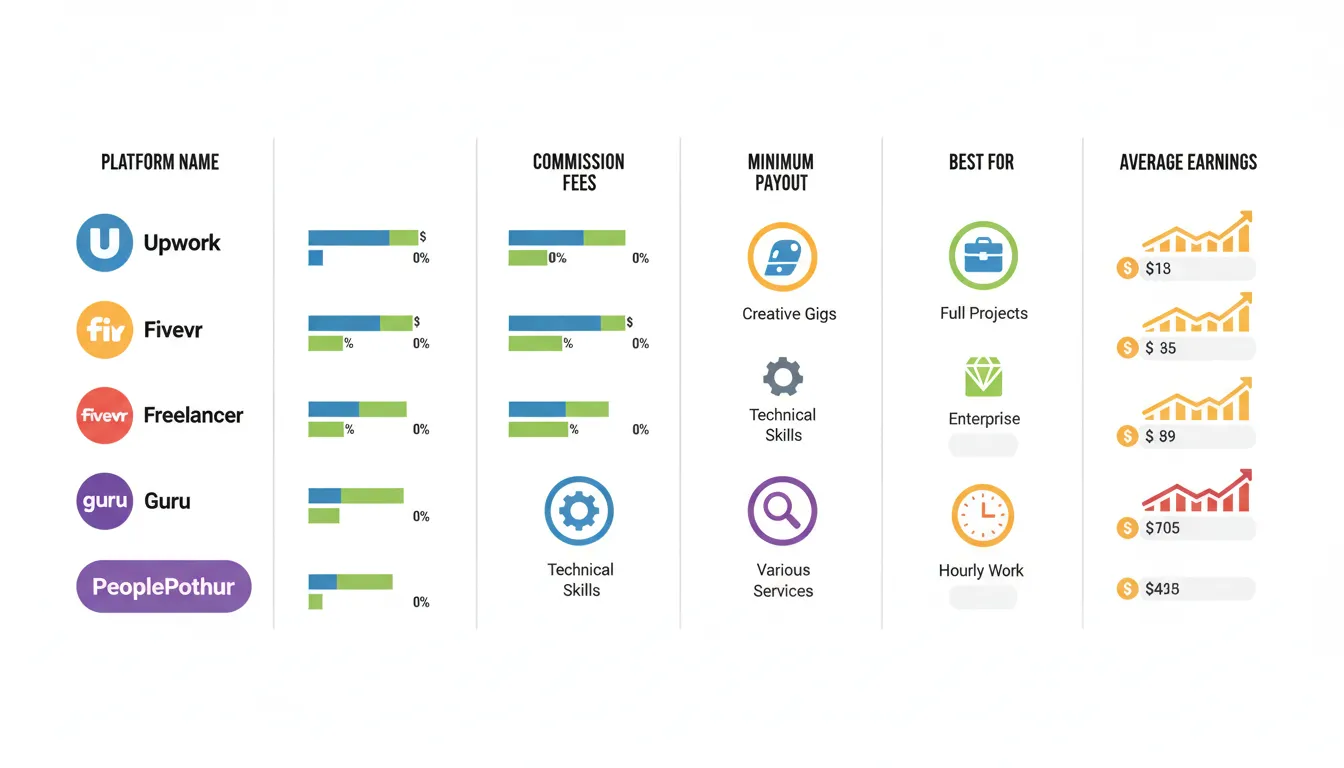
| Platform | Commission | Best For | Avg. Earnings | Payment Speed | Client Quality | Ease of Use |
|—|—|—|—|—|—|—|
| Upwork | 5-20% | Volume, Generalists | $800-2,000/mo | 7-14 days | Medium | Easy |
| Fiverr | 20% + fees | Package-based, Creators | $500-5,000/mo | 14 days | Medium-Low | Very Easy |
| Toptal | 10% | Premium Developers | $3,000-10,000+/mo | Weekly | High | Medium |
| Guru | 8.5% | Experienced Pros | $800-2,500/mo | 7-14 days | Medium-High | Easy |
| PeoplePerHour | 20% | Designers, Marketers | $600-2,000/mo | 7-14 days | Medium | Easy |
| Freelancer.com | 10% | Varied Skills | $500-1,500/mo | Variable | Low-Medium | Hard |
| 99designs | Commission varies | Graphic Designers | $1,000-5,000+/mo | 30 days | High | Medium |
| Behance | None (Portfolio) | Portfolio Building | Indirect Revenue | N/A | N/A | Easy |
| ServiceScape | 30% | Vetted Professionals | $1,500-4,000/mo | 15 days | Very High | Medium |
| Branding.com | Commission varies | Brand Strategists | $2,000-8,000/mo | Variable | High | Medium |
| LinkedIn ProFinder | None (Direct) | B2B Services | Varies Widely | Direct | High | Easy |
| Patreon | 8% (+ payment fees) | Creators, Artists | $500-5,000+/mo | Variable | Varied | Easy |
Key Takeaways
5-7. Specialized Platforms for Specific Skills
5. 99designs: Niche Platform for Designers
If you’re a graphic designer, 99designs is purpose-built for your skill. It’s the #1 platform specifically for design work, hosting 500,000+ designers competing for branding, logo, web, and packaging design projects.
How it differs: Instead of bidding on projects, you often compete in design contests. A client posts a brief, you submit designs, they choose winners. This model incentivizes quality over speed. Top designers report better earnings than general platforms.
Commission: Varies by contest type. For direct projects, 99designs takes 10-20% commission. For contests, the platform operates differently—you submit work speculatively, winning designers get paid.
Earnings: Top designers on 99designs report $3,000-10,000+/month, but this requires 2+ years of platform experience and a strong portfolio. New designers earn $200-600/month initially.
6. LinkedIn ProFinder: The B2B Shortcut
LinkedIn ProFinder isn’t a traditional marketplace—it’s LinkedIn’s service provider directory embedded in the platform. When B2B clients search for services on LinkedIn, they find ProFinder professionals.
Key advantage: You’re positioned as a legitimate business professional, not a gig worker. Clients tend to be established companies or serious entrepreneurs. No bidding required.
Best for: Consultants, accountants, business strategists, marketing professionals, and coaches. Anyone selling services to other businesses.
Earnings: Highly variable because you’re doing direct negotiation (not platform-standard rates). ProFinder charges no commission—you work directly with clients and handle payment outside the platform.
7. ServiceScape: The Premium Vetted Network
ServiceScape vets every freelancer on the platform. Like Toptal for all professions (not just development). Acceptance requires demonstrating expertise, client testimonials, and professional credentials.
Commission: 30%, which is high but offsets through higher

Advertisement
