

You’re stuck. Your 9-to-5 job pays the bills, but it doesn’t fund your dreams. You’ve heard the success stories—someone making five figures from a side hustle while keeping their day job. But you don’t know where to start, and honestly, you’re skeptical about how realistic those claims are.
Here’s the truth: 63% of working professionals now have a side hustle, and the average income is between $500 and $5,000 monthly. That’s not lottery-ticket money, but it’s enough to pay off debt, fund a vacation, or build an emergency fund. The difference between those who succeed and those who fail isn’t talent or luck—it’s choosing the right opportunity and taking consistent action.
The challenge? Too many side hustles are saturated, require upfront capital you don’t have, or demand skills you haven’t built yet. You need something achievable for beginners that doesn’t require quitting your day job or investing thousands of dollars.
This guide breaks down 13 legitimate side hustles specifically for working professionals. Each one includes real income data, the actual time commitment, startup costs, and a step-by-step roadmap to get started TODAY. Whether you have five hours a week or fifteen, there’s something here for you.
What Exactly Is a Side Hustle? (And Why It Matters in 2024)
A side hustle is a business or income-generating activity you run alongside your primary job. It’s different from a hobby because it’s intentional, structured, and designed to generate real income. It’s also different from a career change—you’re not betting your financial stability on it.
For working professionals in 2024, side hustles serve three critical purposes:
Income Diversification: Your job could disappear tomorrow. Recessions happen. Companies downsize. A side hustle creates a safety net. It’s not insurance—it’s multiple income streams.
Skill Development: The skills you build in your side hustle often become valuable in your primary career. Freelance writing builds communication skills. Tutoring builds teaching expertise. Content creation builds marketing knowledge. These compound.
Optionality: When your side hustle reaches a certain income level, you get choices. Do you scale it into a full-time business? Do you keep it as passive income while staying in your job? Do you use it to negotiate a raise at work because you’re less dependent on their paycheck? You create leverage.
The data backs this up: professionals with side hustles report 32% higher job satisfaction, likely because they feel less trapped and more in control of their financial future.
However, not all side hustles are created equal. Some require significant startup capital ($500-$2,000). Others demand 20+ hours weekly. Still others are so saturated that competition makes it nearly impossible for beginners to earn meaningful income.
The best side hustles for beginners in 2024 share three characteristics:
– Low barrier to entry: You can start with $0-$100
– Flexible timing: They fit around your 9-to-5
– Legitimate income potential: Not $10/month pyramid schemes, but real $500+ monthly potential
Side Hustle #1: Content Creation (Blog, YouTube, TikTok)
Monthly Income Potential: $500-$3,000+ (takes 3-6 months to see meaningful income)
Time Commitment: 8-15 hours/week
Startup Cost: $0-$50 (domain optional)
Content creation is the side hustle that keeps paying long after you publish. A blog post written today can generate income for years through search traffic, affiliate commissions, and ad revenue.
How It Actually Works
You create content (written, video, or short-form) in a niche where people are already searching for answers or spending entertainment time. You build an audience. Once that audience reaches a threshold (usually 1,000-10,000 people), you monetize through:
Ad Networks: Google AdSense, Mediavine, AdThrive. You get paid per thousand impressions (CPM). CPM varies wildly—entertainment niches pay $2-$5 CPM, while high-RPM niches like finance, tech, and healthcare pay $15-$50 CPM or more.
Here’s critical data: high-RPM niches consistently outperform entertainment content by 10-15x. A finance blog earning $50 CPM will generate significantly more income than an entertainment channel earning $3 CPM, even with identical traffic.
Affiliate Marketing: You recommend products your audience actually uses and get a commission (usually 5-50% per sale). Amazon Associates pays 1-10%. SaaS affiliate programs can pay 20-40%. This is more reliable than ads because it converts real purchases.
Sponsorships: Brands pay to reach your audience. This requires 10,000+ followers typically, but payments can be substantial ($500-$5,000 per sponsored post).
Your Own Products: Once you have an audience and trust, you can sell courses, templates, or services. This is the highest-income tier but also the most work.
Step-by-Step: Start Your Content Side Hustle
Step 1: Choose Your Niche
This is everything. Pick something where:
– You have some existing knowledge or passion
– People actively search for solutions (look at Google Trends)
– It’s a high-RPM niche (finance, tech, health, career, productivity, business)
Examples that work: “Career transitions for mid-level professionals,” “Passive income for software engineers,” “Tax optimization for freelancers.” NOT “random life thoughts” or “just for fun vlogs.”
Step 2: Pick Your Platform
– Blog: Highest earning potential long-term. SEO traffic is valuable. Takes 3-6 months to see income.
– YouTube: More immediate feedback. Videos are highly shareable. Takes 1,000 subscribers + 4,000 watch hours before monetization.
– TikTok/Reels: Fastest growth if you’re good at short-form content. Monetization is lower per view, but rapid audience building possible.
For most working professionals, a blog + TikTok combination works best. Blog for high-value, long-tail traffic. TikTok for quick audience growth and referral traffic.
Step 3: Create Your First Content
Start with SEO research. Tools like Ubersuggest (free tier) or Semrush show what people search for monthly. Pick keywords with 1,000-10,000 monthly searches and low competition. Write 10 articles before worrying about monetization.
Step 4: Monetize When Ready
Join Google AdSense (minimum 6 months old content + 10,000 pageviews). Sign up for affiliate programs in your niche. Build your email list from day one—this becomes your most valuable asset.
Real Timeline
– Months 1-2: Setup, create 10-15 pieces of content, build basic audience
– Months 3-4: Publish consistently (2-3x/week), grow email list to 500+
– Months 5-6: First $100-$300 from ads/affiliate commissions
– Months 7-12: Reach $500-$1,500/month as content compounds
– Year 2+: $1,500-$5,000+/month as older content continues driving traffic

Side Hustle #2: Freelance Writing & Copywriting
Monthly Income Potential: $800-$3,000+
Time Commitment: 5-15 hours/week
Startup Cost: $0-$50
Freelance writing is the fastest money-making side hustle if you can write clearly. There’s constant demand, rates are relatively high, and you get paid quickly.
The Three Types of Freelance Writing
Content Writing: Blog posts, articles, web copy. You research a topic and write 1,500-3,000 words. Pay: $75-$300 per article. Time: 3-5 hours per article.
Copywriting: Sales pages, emails, landing pages. Shorter, highly targeted writing designed to convert. Pay: $150-$500 per project. Time: 2-4 hours per project.
Technical Writing: Documentation, manuals, guides. Requires domain expertise. Pay: $200-$500+ per project. Time: varies.
Most beginners start with content writing because the barrier to entry is lowest. You don’t need a portfolio—you can build one as you go.
Step-by-Step: Launch Your Freelance Writing Business
Step 1: Build a Minimal Portfolio
You need 3-5 writing samples. Write these for free initially. Options:
– Start a Medium publication and publish 3-4 articles
– Guest post on industry blogs (traffic in exchange for portfolio piece)
– Create sample articles on topics you’ll pitch to clients
– Volunteer to write for nonprofits (they’re always looking for free content)
This takes 1-2 weeks of effort.
Step 2: Create Your Pitch Template
Write a short, benefit-focused email explaining what you do. Don’t send generic pitches. Mention the company by name. Show that you understand their content needs.
Example framework:
“Hi [Editor Name], I noticed your blog covers [specific topic]. I’ve written extensively about [related topic] for [publication]. I’d love to contribute a piece on [specific angle]. Here’s my portfolio: [link].”
Step 3: Find Clients
Job boards to check:
– Upwork: High volume, lots of lowball offers, but easy to get started
– Contently: Better-paying gigs, requires portfolio
– Mediavine Jobs Board: If you’re interested in content marketing
– LinkedIn: Pitch companies directly
– Cold outreach: Email blog editors, content marketing managers, marketing agencies directly
Step 4: Price Your Work
Beginners often underprice. Don’t charge per word. Charge per project.
– First 5-10 clients: $75-$150 per article (1,500 words)
– Established: $200-$400 per article
– Experienced/specialized: $400-$1,000+ per article
As you build testimonials and a portfolio, raise your rates. After 20 successful projects, you should be charging $200+ minimum per article.
Step 5: Deliver Exceptional Work
Meet deadlines. Follow guidelines precisely. Do one revision even if it’s not in the contract. Ask for testimonials. Become someone editors want to hire repeatedly.
Income Progression
– Month 1: 2-3 articles, $200-$400
– Month 2: 4-5 articles, $400-$750
– Month 3+: 6-8 articles monthly, $1,000-$2,000+
This is completely realistic. Many working professionals reach $1,000+/month within 2-3 months of consistent pitching and writing.
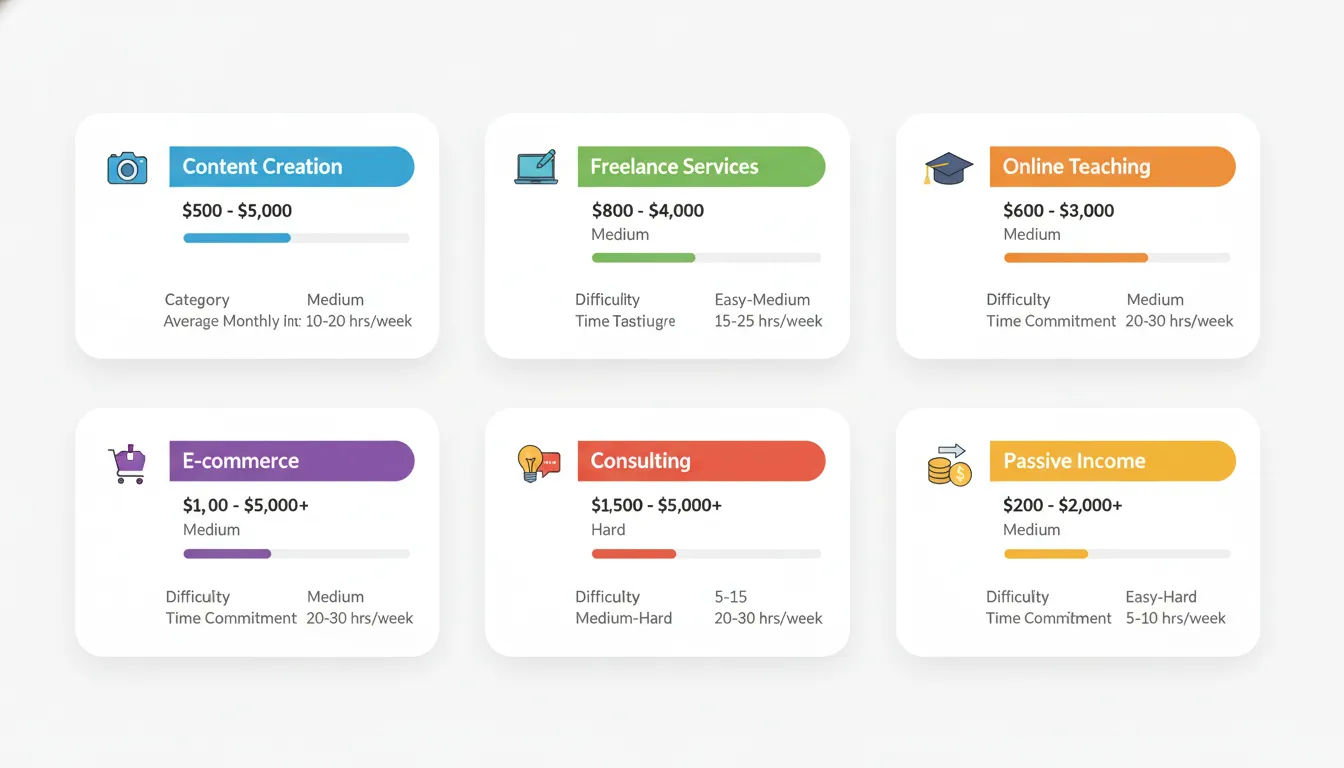
Key Takeaways
Side Hustle #3: Freelance Services (VA, Social Media Management, Consulting)
Monthly Income Potential: $600-$2,500+
Time Commitment: 5-15 hours/week
Startup Cost: $0-$100
If you have professional skills (project management, social media, bookkeeping, customer service), you can immediately freelance these services. Companies need help. Solopreneurs and small businesses especially will pay for your expertise.
The Most Profitable Beginner-Friendly Services
Virtual Assistant (VA): Email management, scheduling, research, administrative tasks. Pay: $15-$25/hour starting, can reach $30-$50/hour as you specialize.
Social Media Management: Creating content calendars, posting, engaging, basic analytics. Pay: $400-$1,500/month per client (retainer-based). Time: 5-10 hours/week per client.
Bookkeeping/Accounting Admin: Data entry, invoice processing, bank reconciliation. Pay: $20-$40/hour. High demand from small business owners.
Project Coordination: Keeping remote teams organized, managing timelines, communication. Pay: $25-$50/hour.
Sales Support: Lead qualification, CRM management, outreach follow-up. Pay: $18-$35/hour.
The key difference from content creation: you’re getting paid immediately for your time. No 3-month ramp-up. You get paid as soon as you deliver.
Step-by-Step: Sell Your Professional Services
Step 1: Identify Your Strength
What did you do in your day job? What do people always ask you to help with? Start there. You already have credibility and experience.
Step 2: Create a Simple Service Page
You don’t need a fancy website. A simple one-page site (Webflow, Wix, or even a nice Google Doc) stating:
– What you do
– Who you help (target client)
– What problems you solve
– Your rates/packages
– How to contact you
Keep it under 500 words.
Step 3: Find Your First Clients
Options:
– Upwork/Fiverr: Fastest initial clients. Rates are lower, but cash flow starts immediately.
– LinkedIn: Search “solopreneur” or “small business owner” in your industry. Message them. Offer a 5-hour trial project at a reduced rate ($200-$300). Once they see value, they’ll want ongoing support.
– Facebook Groups: Join groups for entrepreneurs in your niche. Offer to help solve a problem someone posts about.
– Referrals: One good client leads to three more through referrals. Incentivize referrals ($100 referral bonus).
– Agency partnerships: Contact small marketing/design agencies. They often resell VA/admin services to their clients.
Step 4: Package Your Service
Don’t sell hourly. Sell retainers (monthly packages) or project-based pricing.
Example: Social Media Management retainer
– Starter: $400/month (4 hours/week) – Content calendar, posting, basic engagement
– Growth: $800/month (8 hours/week) – Everything above + copywriting, hashtag research, analytics reporting
– Premium: $1,500/month (15 hours/week) – Everything + strategy sessions, competitor analysis, audience growth plan
Retainers are the goal because:
– Predictable income
– Recurring revenue
– Client locked in (less feast-and-famine)
– Higher hourly rate than project work
Step 5: Systematize and Scale
After your first client, document your process. Create templates. Use tools like Asana, Notion, or Monday.com to manage workflows. This lets you take on more clients without working exponentially more hours.
Income Progression
– Month 1: One client, 5 hours/week, $250-$400
– Month 2-3: Two clients, 12 hours/week, $800-$1,200
– Month 4+: Three clients at $400-$800 each, $1,200-$2,400+
Most professionals reach $1,500+/month within 3-4 months. This is more reliable than content creation because you’re selling your existing expertise, not building an audience from scratch.

Side Hustle #4: Online Teaching & Tutoring
Monthly Income Potential: $500-$2,000+
Time Commitment: 5-15
Advertisement
