

The Spanish digital advertising market is booming. In 2026, YouTube creators targeting Spanish audiences face an unprecedented opportunity—but only if they understand how CPM (Cost Per Mille) rates work and which niches command premium prices. Here’s the reality: a tech tutorial creator in Spain could earn 3 to 5 times more per thousand views than an entertainment vlogger covering the same content length. This isn’t speculation. It’s driven by advertiser demand, audience purchasing power, and the growing sophistication of Spain’s digital economy. If you’re creating content for Spanish viewers or targeting Spanish diaspora communities worldwide, you need to understand the mechanics of CPM, the current rates, and how to position yourself in the highest-paying categories. This guide breaks down everything you need to know to turn your YouTube channel into a sustainable income stream in 2026.
Understanding YouTube CPM: The Foundation
YouTube CPM (Cost Per Mille) represents the amount advertisers pay for every 1,000 ad impressions on your videos. It’s critical to distinguish this from RPM (Revenue Per Mille), which is what you actually earn after YouTube takes its 45% cut. If a video generates a $6 CPM, your RPM will be approximately $3.30. This distinction matters enormously when planning your content strategy and revenue projections.
CPM rates vary dramatically based on several interconnected factors. Geographic location of your audience is paramount—viewers in Spain, the United States, United Kingdom, Canada, and Australia generate significantly higher CPM rates than creators targeting viewers in developing nations. This reflects advertiser budgets and the purchasing power of audiences in those regions. Within Spain specifically, CPM rates have remained relatively stable compared to other European markets, typically ranging from €1.50 to €4.50 depending on the content niche. However, 2026 data shows premium niches commanding rates up to €6.00 or higher during peak advertising seasons (October through December, and March through May).
Content category dramatically influences your CPM. Financial services, insurance, software-as-a-service (SaaS), professional development, and technology content attract premium advertisers willing to pay substantial rates. Entertainment, lifestyle, and general vlogging content attracts mass-market advertisers with smaller budgets. The difference isn’t marginal—it’s the difference between a €1.50 CPM and a €5.00 CPM on the same video length and viewership. Seasonality also impacts rates significantly. Q4 (October-December) sees CPM increases of 40-60% compared to Q1 and Q2 as advertisers spend their year-end budgets. Even within months, CPM can fluctuate by 15-20% based on advertising demand cycles.
Your audience demographics matter tremendously. Channels attracting older, professional audiences (35-65 year-old demographics) command higher CPM rates than channels with predominantly younger viewers (13-24). This reflects the spending patterns advertisers target. If your audience skews toward business professionals, financial decision-makers, and high-income individuals, you’ll see substantially better CPM rates even with lower overall subscriber counts.
Spain’s YouTube CPM Landscape in 2026
Spain’s digital advertising market continues its expansion trajectory into 2026, with YouTube advertising spending growing at approximately 18-22% year-over-year. The Spanish economy’s recovery post-pandemic, combined with increased digital transformation across businesses, has created an environment where quality content targeting professional audiences becomes increasingly valuable to advertisers.
Current CPM rates in Spain for 2026 break down as follows:
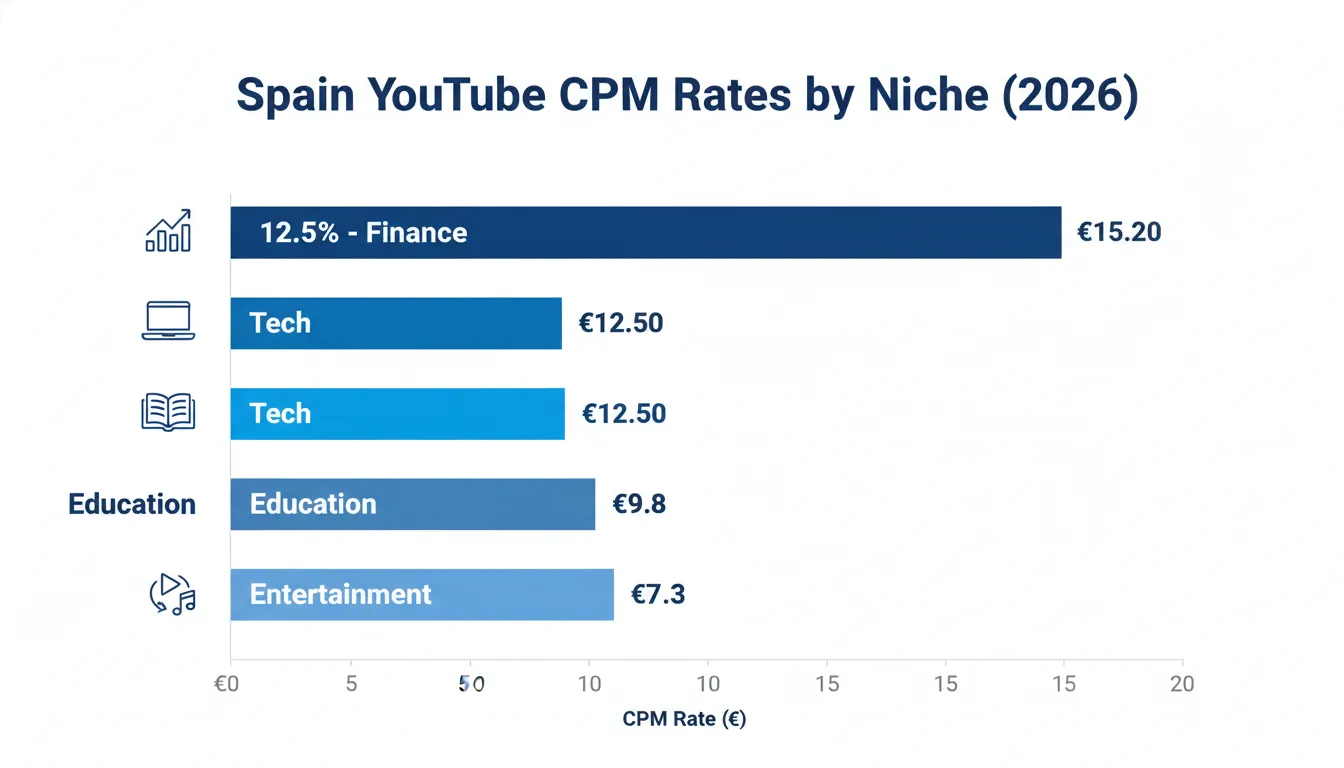
Premium Niches (Finance, Tech, B2B Software): €4.50 – €8.00 CPM. These categories command the highest rates because advertisers in financial services, enterprise software, and professional services have substantial marketing budgets and focus on high-intent, qualified viewers.
Mid-Tier Niches (Education, Business, Personal Development, Health): €2.50 – €4.50 CPM. Educational content, career development, and business tutorials attract advertisers willing to pay solid rates for engaged, motivated audiences.
Standard Entertainment (Lifestyle, Gaming, Entertainment): €1.00 – €2.50 CPM. Mass-market entertainment content attracts lower CPM rates because advertisers are often smaller businesses or agencies with limited budgets per impression.
Underperforming Categories (General vlogging, music content): €0.50 – €1.50 CPM. These categories struggle because advertiser demand is limited relative to content supply.
It’s important to note that these rates represent typical CPM ranges. Individual channels within each category will experience variation based on audience quality, engagement rates, video length, and viewer location concentration. A channel with 80% of viewers based in Madrid will see higher CPM than a channel with viewers distributed across 20 countries.
RPM (what you actually earn) in Spain typically ranges from 45-60% of the CPM rate. A €4.00 CPM translates to approximately €1.80-€2.40 RPM. This difference represents YouTube’s platform fee, payment processing, and network costs. Understanding this gap prevents the disappointment creators often experience when their first earnings reports don’t match calculated CPM figures.

Step-by-Step Strategy to Maximize Your CPM in Spain
1. Select High-CPM Niches Aligned with Your Expertise
Your first decision is niche selection, and this is non-negotiable for CPM optimization. You cannot build a sustainable channel by creating content purely for CPM rates without authentic expertise or passion—audience authenticity drives engagement, which indirectly improves CPM performance. However, if you have flexibility in your content direction, prioritize these high-CPM categories: financial planning and investment advice, software development and technical tutorials, digital marketing and business growth, professional certifications and career development, enterprise software reviews and comparisons, and insurance and banking education.
Within these categories, specificity matters. A channel about “investing in Spain” will outperform a generic “investing” channel because it attracts local advertisers and higher-intent viewers. A channel teaching “how to build SaaS products for Spanish markets” outperforms “general programming tutorials.” The narrower your focus within a premium niche, the better your CPM becomes because your audience becomes increasingly valuable to specific advertisers.
Conduct competitive analysis within your chosen niche. Search for YouTube channels creating similar content and analyze their subscriber counts, view counts, and estimated revenue based on publicly available tools like Social Blade or VidIQ. Don’t copy their strategy, but understand what topics, video lengths, and publishing schedules work within your niche.
2. Build and Optimize for Your Core Spanish Audience First
Your immediate audience determines your CPM more than any other factor. A channel with 10,000 Spanish subscribers will generate higher CPM rates than a channel with 50,000 subscribers distributed across 30 countries. This is because Spanish viewers in Spain and Spanish-speaking professionals abroad represent a high-value demographic to European and Latin American advertisers.
Optimize your channel metadata for Spanish search queries. Your channel name, description, and video titles should incorporate Spanish keywords that professionals and potential customers actually search for. Use YouTube’s search analytics to identify exact phrases your target audience uses. If you’re creating finance content, discover whether Spanish audiences search for “inversión en bolsa,” “fondos indexados,” or “asesor financiero” and incorporate these phrases naturally.
Create content specifically addressing Spanish market conditions, regulations, or opportunities. A video titled “Cómo invertir en bolsa en España 2026: Guía completa para principiantes” will attract Spanish viewers with higher CPM potential than “Stock Market Investing 101.” Geographic specificity acts as a CPM multiplier because it increases audience relevance to local and regional advertisers.
3. Optimize Video Length for Your Niche
Video length directly correlates with CPM potential because longer videos accommodate more ad placements. YouTube’s monetization system allows mid-roll ads (ads in the middle of videos) on videos longer than 8 minutes. However, length must serve your content—artificial padding damages engagement and viewer retention, which ultimately hurts CPM through reduced watch time and higher abandonment rates.
Professional and educational content performs well at 12-18 minute lengths. This duration allows for introductory context, detailed explanation, examples, and calls-to-action without losing viewer attention. Technical tutorials benefit from 15-25 minute formats when you’re demonstrating processes step-by-step. Business and finance content thrives at 10-15 minutes, which allows sufficient depth while respecting professional viewers’ time constraints.
Shorter content (5-8 minutes) still generates revenue but limits ad placements to pre-roll and post-roll, reducing overall CPM potential. Very long content (30+ minutes) sometimes experiences watch-time drops that reduce CPM because viewers abandon before completing the video. Test different lengths within your niche and monitor performance using YouTube Analytics. Your analytics dashboard shows average view duration and audience retention—longer retention on longer videos suggests your audience prefers comprehensive content.
4. Strategically Schedule Content for Peak CPM Periods
Seasonal patterns significantly impact CPM rates. Plan your content calendar around high-CPM periods:
Q4 (October-December): CPM rates increase 40-60% due to holiday advertising budgets. Schedule your best-performing content series during these months. If you have flexibility, frontload your most valuable content during this period.
Q1 (January-March): New Year resolutions and budget allocations create solid demand for finance, fitness, and professional development content. This represents your second-best CPM period.
Q2-Q3: Rates typically decline 20-30%. Use these periods for experimentation, audience building, and evergreen content that generates consistent long-term revenue.
Peak Days: Tuesday through Thursday typically see higher CPM rates than weekends. Monday performance is mixed. Schedule releases during weekday mornings (8am-10am Spain time) when professionals check content during work hours.
5. Develop Audience Engagement Strategies
Engagement metrics—likes, comments, click-through rates on cards and end screens—influence your channel’s algorithmic performance and advertiser appeal. High engagement signals quality content to both YouTube’s algorithm and potential advertisers. Create content that naturally encourages professional interaction: ask specific questions in your content that viewers want to answer, create controversial (but not divisive) takes on industry topics, and respond to comments thoughtfully to encourage community building.
Professional and educational content communities are smaller but more engaged than entertainment communities. A finance channel with 50,000 subscribers and 8% engagement rate outperforms a music channel with 500,000 subscribers and 0.5% engagement rate in terms of CPM and advertiser appeal. Prioritize engagement rate over subscriber count.
Key Takeaways
Tools and Resources for CPM Optimization
YouTube Studio Analytics remains your primary tool for monitoring CPM performance. Access your Analytics dashboard and navigate to the “Revenue” section. This displays your estimated CPM, RPM, and total revenue metrics. Review this data weekly to identify which content types and topics command the highest rates. YouTube Studio’s “Earnings” report shows revenue breakdown by geography, allowing you to quantify your Spanish audience’s contribution to total earnings.
Third-party analytics tools provide deeper insights:
TubeBuddy: Offers keyword research specific to CPM rates. Their “Keyword Explorer” shows estimated CPM for different search terms, allowing you to identify which topics command premium rates before creating content.
VidIQ: Provides competitor analysis and CPM benchmarking. Compare your channel’s CPM against competitors in your niche and identify performance gaps.
Social Blade: Tracks estimated daily, monthly, and yearly revenue based on publicly available data. While estimates aren’t precise, they indicate whether your channel’s earnings trajectory is improving.
Ahrefs YouTube Tool: Excellent for identifying high-performing videos in your niche and understanding what topics generate optimal engagement and CPM performance.
Google AdSense Dashboard: Your official earnings platform where actual payments are calculated. Review this regularly to understand the gap between estimated YouTube Studio figures and actual earnings.
Cost considerations for CPM optimization are primarily time-focused rather than monetary. High-quality microphone equipment (€100-300), basic lighting setup (€50-150), and screen recording software (free to €100) represent typical startup costs for professional-quality content. Most premium tools like TubeBuddy offer free versions with limited features—start free, upgrade only when data-driven analysis proves ROI.
High-CPM Niches Detailed Breakdown
Finance & Investment Content: Spain’s financial market has matured significantly. Content teaching investment strategies, tax optimization, retirement planning, and investment product comparisons attracts premium advertisers. CPM rates: €5.00-€8.00. Advertiser types: Investment platforms (Degiro, Broker Financiero), financial advisory services, insurance companies, investment course creators.
Technology & Software Development: Spanish tech sector growth creates demand for programming tutorials, SaaS reviews, and technical education. CPM rates: €4.50-€7.50. Advertiser types: Cloud platforms, development tools, coding bootcamps, enterprise software providers.
Digital Marketing & Business Growth: Spanish small and medium businesses increasingly invest in digital marketing education. CPM rates: €3.50-€6.00. Advertiser types: Marketing agencies, CRM platforms, email marketing tools, advertising platforms.
Professional Certifications: Career advancement content (project management certifications, data analysis, digital marketing certifications) attracts professionals willing to pay for education. CPM rates: €3.00-€5.50. Advertiser types: Training platforms, certification bodies, corporate learning platforms.
Health & Wellness (Professional): Medical professionals, fitness professionals, and nutritionists creating credentialed health content attract premium advertisers. CPM rates: €2.50-€4.50. Advertiser types: Healthcare providers, supplement companies, fitness equipment, wellness apps.
Entertainment (Comparative Weakness): Gaming, music, general vlogging, comedy. CPM rates: €0.80-€2.50. These categories attract mass-market advertisers with smaller budgets and serve as baseline for comparison.
Pros and Cons of CPM-Focused Strategy
Advantages:
– Predictable Revenue Model: CPM provides clear earnings formulas based on views, allowing accurate revenue projections.
– Scalability: Once your content system is established, revenue scales with views without proportional effort increases.
– Passive Income Potential: Evergreen content continues generating revenue months or years after publication.
– Professional Credibility: Building authority in high-CPM niches positions you as expert, opening sponsorship and consulting opportunities.
– Geographic Arbitrage: Spanish content attracts both Spanish-based viewers and diaspora communities, expanding audience potential.
– Algorithm Alignment: YouTube actively promotes engaging, long-form content that accommodates multiple ad placements.
Disadvantages:
– Income Volatility: Seasonal fluctuations (40-60% variance Q4 vs Q1) make income unpredictable.
– Monetization Threshold: YouTube requires 1,000 subscribers and 4,000 watch hours before monetization eligibility—6+ months of work typically required.
– Niche Saturation: High-CPM niches attract more creators, increasing competition and slowing growth.
– Audience Burnout Risk: Some creators experience audience fatigue when optimizing excessively for CPM over authentic interest.
– Algorithm Dependency: YouTube algorithm changes can dramatically impact reach and earnings.
– Income Inequality: Channels require 100,000+ subscribers to generate €2,000+/month—substantial commitment required.
– Geographic Limitations: Channels targeting only Spanish viewers limit audience size compared to English-language channels.
Real-World Examples and Case Studies
Case Study 1: Spanish Finance YouTuber “La Verdad Sobre el Dinero”
This fictional but representative example illustrates typical CPM performance. A finance education channel launched January 2024, targeting Spanish young professionals (25-40) interested in investment and financial independence. Initial content covered index fund investing, retirement account optimization, and tax-efficient investing strategies.
Growth trajectory: Started with 0 subscribers, reached 10,000 subscribers by month 6 (insufficient for monetization). By month 12, achieved
Advertisement
