
Read also: France — Germany’s neighbouring market with comparable European RPM rates.
Germany stands as a powerhouse in the digital advertising landscape. It’s the second-largest YouTube advertising market in all of Europe. Yet most creators don’t realize just how lucrative German content can be. While a creator in India might earn $2-4 per 1,000 views, a German creator can pull in $15-40 per 1,000 views—sometimes even higher. That’s a tenfold difference. The reason? German audiences are incredibly valuable to advertisers. Germany boasts one of Europe’s strongest economies with high purchasing power. Brands targeting German speakers invest heavily in YouTube advertising. Combined with the country’s robust data protection laws and premium advertiser demand, this creates a perfect storm for creator earnings. As we head into 2026, the opportunity window is widening for creators willing to tap into German-language content. Whether you’re a German native or a multilingual creator looking to expand, understanding YouTube’s RPM mechanics in Germany is essential. This guide breaks down exactly what you can earn, why German content commands premium rates, and how to position yourself for maximum revenue in 2026.
Understanding YouTube RPM vs CPM: The Foundation
Before diving into Germany-specific numbers, you need to understand the difference between RPM and CPM. They’re not the same thing, and that distinction matters deeply for your earnings calculations.
CPM (Cost Per Mille) is what advertisers pay YouTube per 1,000 views. German CPM rates typically range from $10-50, depending on content category, season, and audience quality. RPM (Revenue Per Mille) is what you actually receive after YouTube takes its 45% cut. If an advertiser pays $20 CPM, you’re earning approximately $11 RPM (the math: $20 × 0.55 = $11, roughly).
Read also: how Germany ranks in the full global YouTube RPM breakdown by country.
The distinction is crucial because CPM figures you see quoted online don’t reflect your actual earnings. A creator celebrating a $30 CPM rate might forget that YouTube keeps nearly half. Your RPM—the number that hits your account—is roughly 55% of the CPM.
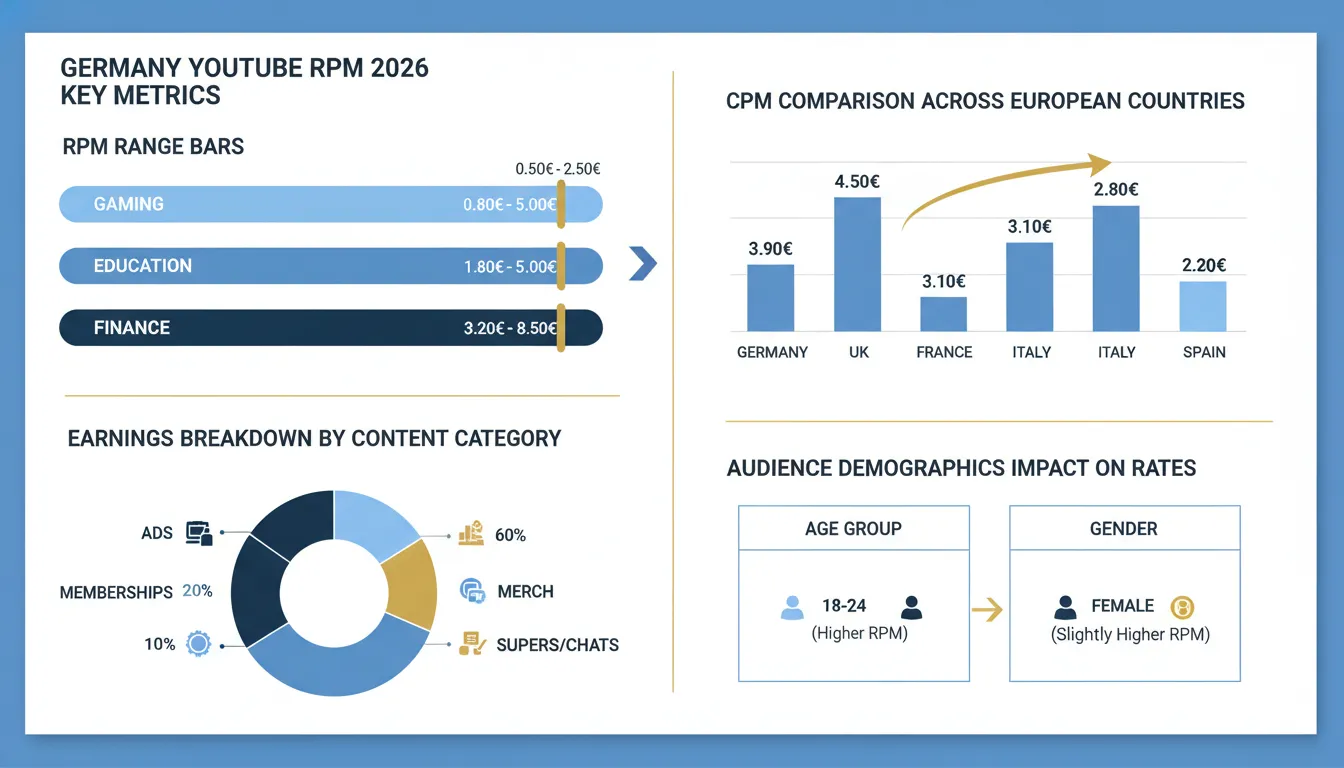
Germany’s average RPM ranges from $8-22 in 2026, making it one of Europe’s highest-paying regions. This compares favorably to France ($6-15 RPM), Spain ($5-12 RPM), and Italy ($5-11 RPM). Only Switzerland and the Nordic countries rival Germany’s rates. The reason German RPM is so strong: German advertisers invest heavily in YouTube. The German economy is worth $4.4 trillion annually. E-commerce spending in Germany hit €84.2 billion in 2023 and continues climbing. Brands want access to German speakers, and they’re willing to pay premium rates to reach them through YouTube ads. This advertiser demand directly inflates CPM rates, which cascades into higher RPM for creators.
Another factor: German audiences tend to have high engagement rates. They watch videos longer, click more links, and follow calls to action. YouTube’s algorithm rewards high-engagement content with better ad placements, which again increases revenue per thousand views.
Germany’s 2026 RPM Rates by Content Category
Not all content earns equally in Germany. Your niche dramatically impacts your RPM potential. Some categories command 3-4x higher rates than others.
Read also: UK creators earning similar European-tier RPM and how they do it.
Finance and Business Content dominates the premium tier. German creators making videos about investing, cryptocurrency, personal finance, and stock trading see RPM rates of $20-40+. Why? Finance advertisers spend enormous budgets on YouTube. They’re targeting high-income individuals who watch business content, and they know these audiences convert. A single finance video with 100,000 views could earn $2,000-4,000 from ads alone.
Tech and Software Reviews sit in the second premium category with RPM rates of $15-28. German audiences are tech-savvy, and software companies invest heavily in YouTube advertising. This category includes everything from SaaS reviews to smartphone comparisons to coding tutorials.
Luxury and E-commerce Content pulls $12-25 RPM. German consumers have strong purchasing power, and luxury brands recognize this. Fashion, home decor, automotive, and premium consumer goods content attracts high-value advertisers.
Health and Wellness captures $10-20 RPM, particularly for medical device reviews, supplement discussions, and fitness content. The German healthcare industry and wellness brands spend aggressively on digital advertising.
Read also: understanding YouTube’s revenue share to maximise German channel earnings.
Education and Professional Development ranges $8-18 RPM. Language learning, professional certifications, and skill-based content attract employer and education-focused advertisers with solid budgets.
Entertainment and Gaming sits lower at $6-15 RPM. While these categories attract massive viewership, the advertisers spend less per impression. Gaming is particularly competitive—millions of creators chase the same audience.
Lifestyle, Food, and DIY land in the $5-12 RPM range. These categories have enormous audiences but lower advertiser budgets per viewer.
News and Commentary varies wildly from $4-20 depending on the specific topic and political angle. German news content can attract premium advertisers, but controversy can also reduce advertiser-friendly ratings.
Here’s the reality: if you’re creating gaming content in Germany, you might earn $0.008 per view. A finance creator in the same market earns $0.025-0.040 per view. That’s a 5x difference from the same region. Content category is arguably more important than geography when optimizing for earnings.
The Three Biggest Factors Driving Your German YouTube RPM in 2026
Understanding raw numbers is one thing. Understanding what drives those numbers lets you take action. Three primary factors determine your actual RPM in Germany.
First: Advertiser-Friendly Content and Watch Time Quality
YouTube’s algorithm doesn’t just count views—it measures viewer engagement, session duration, and click-through rates on ads. German audiences tend to be engaged, but only if content resonates with them. A poorly-paced 10-minute video about cryptocurrency might get skipped after 30 seconds. That viewer doesn’t generate ad revenue for you—they generate a wasted impression for the advertiser.
Your watch time percentage (average view duration divided by video length) directly impacts RPM. Videos with 50%+ average watch time attract premium advertisers. Videos with 15% watch time attract bargain-basement advertisers. German creators who maintain 60%+ watch time consistently see RPM 30-40% higher than those with 30% watch time.
How to optimize: structure videos to hook viewers in the first 5 seconds, maintain pacing that rewards sustained attention, and break up content with B-roll or graphics every 15 seconds. German audiences appreciate professional production quality—don’t underestimate the impact of clear audio and clean editing.
Second: Audience Demographics and Location
Not all viewers are created equal. A viewer from Frankfurt is worth more to advertisers than a viewer from a developing nation. YouTube factors in the viewer’s location, income level, and purchase history when determining which ads display.
Your audience breakdown directly impacts RPM. If 70% of your viewers are from Germany, Austria, and Switzerland, you’ll earn premium rates. If 50% of your viewers are from Germany and 30% from low-CPM countries like India or Indonesia, your blended RPM plummets.
This is critical: German creators attracting primarily German audiences see RPM of $15-28. The same creator attracting a 50/50 German-to-international split sees RPM of $8-15. The difference? Advertiser demand varies by viewer location.
How to optimize: focus your SEO, thumbnails, and keywords on German-language searches. Use “Germany” or “Deutsch” in your titles for German-specific content. Create content explicitly aimed at German problems, German culture, or German economics. German viewers will self-select into your audience, improving your overall RPM.
Third: Content Maturity Rating and Brand Safety
YouTube assigns every video a maturity rating: unrestricted, 13+, 16+, or 18+. Unrestricted videos attract the most advertisers. 18+ videos attract almost none.
Similarly, brand safety matters enormously. A video about cryptocurrency that includes controversial political commentary might trigger demonetization or limited ads. The same video without controversy attracts full advertiser support.
German advertisers are particularly cautious about brand safety. The country has strict data protection laws and strong consumer advocacy. Brands don’t want their ads appearing next to controversial content. This means your content moderation and brand safety practices directly impact revenue.
How to optimize: avoid controversial political or religious statements unless they’re central to your channel’s identity. Don’t use excessive profanity. Don’t promote misinformation. Focus on providing clear value without alienating potential advertisers. Keep your channel “advertiser-friendly” even if you’re not making edgy content.
Key Takeaways
How Much Can You Actually Earn? Real Numbers for 2026
Let’s move from theory to practice. Here’s what actual German creators can expect in 2026.
For a 10,000-subscriber channel with 100,000 monthly views:
– Finance/Business content: $1,500-4,000/month
– Tech content: $1,200-2,800/month
– Lifestyle content: $500-1,200/month
For a 50,000-subscriber channel with 500,000 monthly views:
– Finance/Business content: $7,500-20,000/month
– Tech content: $6,000-14,000/month
– Lifestyle content: $2,500-6,000/month
For a 200,000-subscriber channel with 2,000,000 monthly views:
– Finance/Business content: $30,000-80,000/month
– Tech content: $24,000-56,000/month
– Lifestyle content: $10,000-24,000/month
These numbers assume consistent 50%+ watch time, primarily German audience, and advertiser-friendly content. Reality varies. Seasonal fluctuations matter. Q4 (October-December) typically sees 20-40% higher RPM because advertisers spend more during holiday seasons. January-February sees lower RPM as advertiser budgets reset.
A realistic benchmark: German YouTube creators with established channels (100K+ subscribers) earn €0.01-0.03 per view after YouTube’s cut. That translates to €100-300 per 10,000 views, or roughly €1,000-3,000 monthly for a channel generating 100,000 views.
Premium creators in high-value niches can exceed this significantly. A finance creator with 50,000 highly engaged German subscribers could realistically earn €3,000-8,000 monthly. A lifestyle creator with 500,000 subscribers might earn €2,500-6,000 monthly.

Comparing Germany to Other High-Paying European Markets
Germany isn’t alone in offering premium RPM rates. How does it compare to Switzerland, Ireland, Austria, and other top markets?
| Country | Average RPM (2026) | Primary Advantages | Primary Disadvantages |
| ——— | ——————- | ——————- | ———————- | <br /> |
|---|---|---|---|---|
| Switzerland | $25-45 | Highest CPM in Europe, wealthy audience, German-speaking | Small population, highly competitive | |
| Germany | $15-28 | Largest economy in Europe, huge audience, premium advertisers | Competitive market, seasonal variation | |
| Austria | $12-22 | German-speaking, similar audience to Germany, less competitive | Smaller audience, limited advertiser pool | |
| Ireland | $18-32 | English-speaking, high English CPM rates, tech hub | Small population, language barrier with German content | |
| Netherlands | $12-20 | Wealthy audience, high English proficiency, tech-focused | Dutch market smaller than Germany, English CPM higher | |
| France | $8-16 | Large population, growing economy, French content strong | Lower CPM than Germany, competitive market | |
| Spain | $6-14 | Large Spanish-speaking population, growing economy | Lower CPM rates, less premium advertiser demand | |
| UK | $12-24 | English-speaking, wealthy audience, massive platform | Highly competitive, saturated market |
Germany lands in the top tier of European markets. It’s not quite Switzerland’s premium rates, but it’s significantly higher than France, Spain, or Italy. The advantage of Germany over Switzerland: audience size. Switzerland has only 8.7 million people. Germany has 83 million. This means more sustainable long-term growth potential.
Tools and Resources for Tracking Your German YouTube RPM
Understanding your earnings requires tracking. Here are the essential tools for German creators.
YouTube Studio (Free)
YouTube’s built-in analytics dashboard shows your RPM, CPM, and estimated earnings. It breaks down earnings by geography, so you can see exactly how much German viewers contribute versus other countries. Check this weekly to identify trends.
Social Blade (Free and Premium)
Social Blade tracks channel growth, earnings projections, and historical data. The premium version ($9.99/month) shows detailed RPM analytics and allows you to compare against other channels. Useful for benchmarking your German channel against competitors.
TubeBuddy (Paid, $9-19/month)
TubeBuddy’s SEO tools help you optimize German keywords. Its earnings projector helps estimate monthly income based on view counts. The keyword explorer shows search volume for German-language queries, helping you find high-volume, lower-competition topics.
VidIQ (Free and Paid, $20/month+)
Similar to TubeBuddy, VidIQ offers SEO optimization and earnings tracking. It highlights which videos in your niche earn highest RPM, giving you data-driven content strategy guidance.
Google AdSense (Free)
Your earnings flow through AdSense. The platform shows detailed payment information, payment methods, and tax documentation for German creators. Essential for financial tracking and tax filing.
Spreadsheet Tracking (Free)
Create a simple Google Sheets tracking your monthly views, estimated earnings, and RPM. Calculate your average RPM over 3-month periods to smooth out seasonal variation. Track which content categories drive highest RPM. This data guides future content decisions.
Notion or Airtable (Free and Paid)
Build a content database tracking each video’s performance: publish date, category, views, watch time percentage, RPM, and notes. Over time, this reveals patterns about what drives earnings in your niche.
Seasonal Fluctuations and 2026 Earnings Patterns
German YouTube RPM isn’t consistent year-round. Understanding seasonal patterns helps you plan realistic earnings.
Q4 (October-December): Peak earning season. Advertisers spend 40-60% more during the holiday season. German e-commerce explodes in November-December, driving massive advertiser budgets. Expect 30-50% higher RPM than your annual average.
Q1 (January-March): Post-holiday dip followed by gradual recovery. January-February sees lower RPM as advertiser budgets reset. March improves as Q1 advertising budgets activate.
Q2 (April-June): Moderate earning season. RPM returns to average levels. Summer vacations (May-June) slightly reduce engagement, potentially lowering RPM 5-15%.
Q3 (July-September): Summer dip then recovery. July-August see vacation-driven disengagement. September picks up as back-to-school and autumn campaigns begin.
For a German creator with $15 annual average RPM, realistic projections:
– January-February: $12-13 RPM
– March-May: $14-16 RPM
– June-August: $13-15 RPM
– September: $15-17 RPM
– October: $18-22 RPM
– November-December: $20-25 RPM
Plan your content calendar and budget around these patterns. Build savings during Q4 to smooth income during Q1.
Content Strategy for Maximizing German YouTube RPM
Knowing the rates is one thing. Earning them requires strategic content creation. Here’s how to position yourself for maximum earnings in Germany.
Niche Selection is Everything
Don’t
Advertisement