

If you’re a legal professional considering YouTube, the timing has never been better. The legal niche stands as one of the highest-paying categories on the platform, with creators consistently earning $15–$30 RPM (Revenue Per Mille, or per 1,000 views) in 2026. Some specialized areas like personal injury and business law push rates to $45+ RPM. This isn’t speculation—it’s driven by hard economics. Legal advertisers pay premium rates because their audience is wealthy, intent-driven, and ready to convert. A personal injury lawyer searching for case strategy information is far more valuable to advertisers than a casual viewer watching entertainment content. The legal niche attracts financial services, software companies, practice management tools, and other high-CPM advertisers desperate to reach qualified professionals. For attorneys, law students, and legal entrepreneurs, YouTube represents a genuine income stream that complements traditional practice. The barrier to entry is low—a smartphone and credibility—but the earning potential is substantial. This guide breaks down exactly how much you can realistically earn, which practice areas pay the most, and the exact steps to launch a profitable legal YouTube channel in 2026.
What Is YouTube RPM and Why Does the Legal Niche Pay So Much?
YouTube RPM differs from CPM (Cost Per Mille) in a crucial way. CPM is what advertisers pay YouTube for ad impressions. RPM is what you, the creator, actually take home after YouTube’s 45% cut and other factors. If a video has $20 CPM, your RPM might be $10–$12 depending on geography, watch time, and viewer quality.
The legal niche commands exceptional rates for three core reasons:
1. High-Intent Audiences. Someone watching a YouTube video titled “How to Fight an Unfair Dismissal” or “How to Form an LLC in 2026” is actively seeking legal guidance. They’re problem-solving. They have money at stake. Advertisers know this viewer is qualitatively different from someone passively scrolling entertainment content. Financial services companies, law practice management software, and business formation services will pay $50–$100+ CPM to reach these audiences.
2. Affluent Viewer Demographics. Legal content attracts professionals with disposable income. These aren’t teenagers. They’re business owners, high-earners, and people willing to invest in professional services. Advertisers targeting professionals (accounting software, consulting firms, business solutions) pay significantly more per impression than mass-market ads.
3. Regulatory and Financial Advertiser Participation. The legal industry itself needs visibility. Law firms run YouTube ads. Legal tech companies run ads. Financial institutions run ads targeting people with legal concerns. This creates a dense advertiser marketplace competing for the same qualified audience, which drives CPM up.
Compare this to other niches. Gaming might average $2–$5 RPM. Entertainment averages $3–$7 RPM. Even finance, a generally high-paying niche, averages $8–$15 RPM. Legal consistently outpaces them. The data from 2025 into 2026 shows legal content holding strong at $15–$30 RPM, with specialist subcategories (personal injury, immigration, business formation) regularly hitting $25–$45 RPM.
The barrier isn’t complexity—it’s credibility. You need to establish authority. But if you’re a licensed attorney or legal professional, you already have what most creators spend years building.
Which Legal Practice Areas Pay the Highest RPM in 2026?
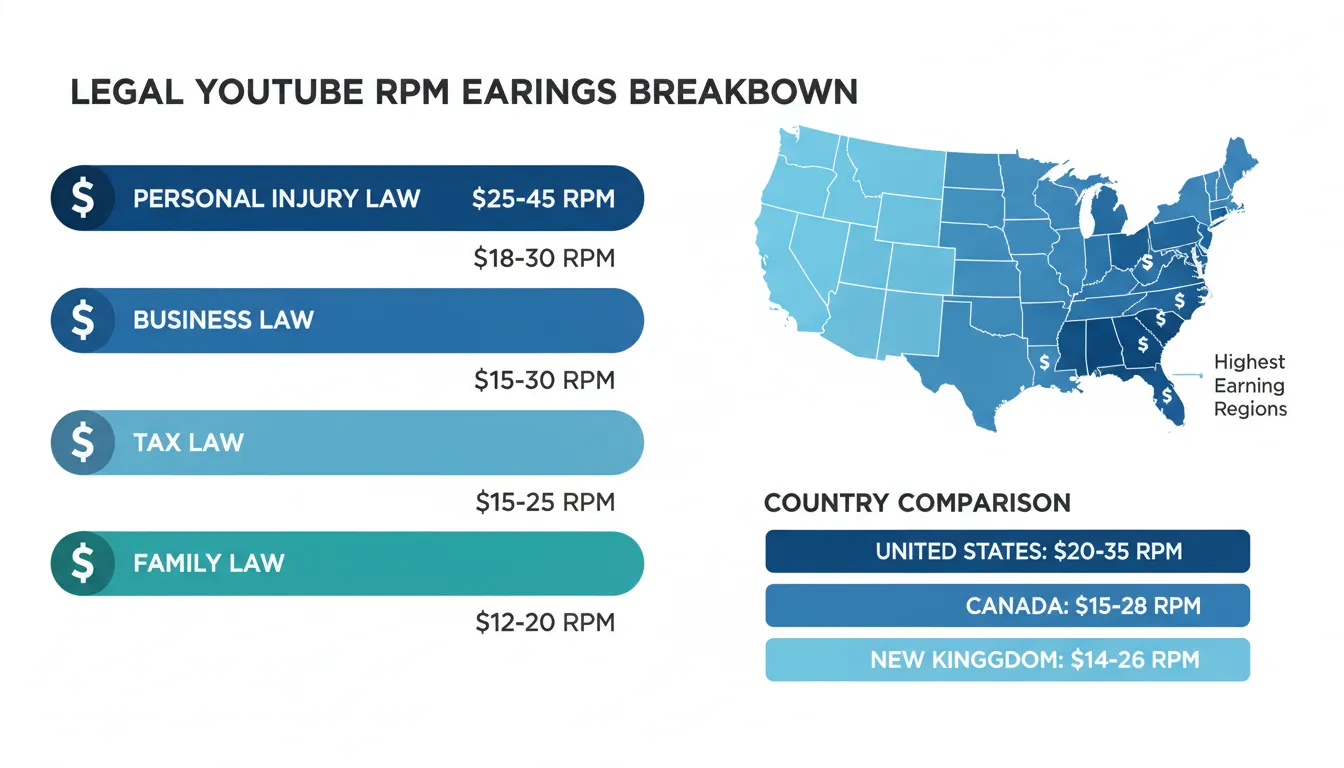
Not all legal content earns equally. Earnings vary dramatically based on practice area, audience geography, and content specificity. Here’s the 2026 breakdown based on advertiser demand and CPM data:
Personal Injury Law: $25–$45 RPM
Personal injury attracts the highest CPM rates because the downstream value is enormous. A single personal injury case can be worth $50,000–$500,000+. Advertisers know that someone researching personal injury claims has massive financial stakes. Medical malpractice, wrongful death, car accident litigation, and workplace injury content consistently hit $30–$45 RPM. The audience is specific: injured people actively seeking representation or information. This hyper-targeted intent drives advertiser bids sky-high. Law firms themselves aggressively advertise to these audiences, creating competition that pushes CPM rates up.
Business Law & Formation: $18–$30 RPM
Starting a business, forming an LLC, understanding partnership agreements, navigating contracts—these topics attract entrepreneurs and business owners. Again, the financial stakes are high. An LLC formation decision affects business structure for years. Contract disputes can cost six figures. Advertisers selling business formation services (like Stripe, LegalZoom, Rocket Lawyer), accounting software, and business banking solutions pay premium rates. Content around S-corps vs. LLCs, operating agreements, and business structure optimization hits $20–$30 RPM regularly. Slightly lower than personal injury because the immediate revenue stakes are sometimes lower, but still excellent.
Employment & Labor Law: $15–$25 RPM
Wrongful termination, discrimination, wage disputes, non-compete agreements. These topics matter deeply to workers and employers. Viewers are often in active employment disputes, making them valuable to employment law firms, HR software, and legal tech companies. The CPM is solid but slightly lower than injury law because the financial stakes per case, on average, are lower. Still, $15–$25 RPM is well above YouTube average.
Tax Law & IRS Issues: $15–$25 RPM
Tax professionals know this niche well. Content around IRS audits, back taxes, tax relief, and business tax strategy attracts affluent viewers with serious tax problems. Financial firms, tax software companies, and CPA services advertise heavily. The audience is intent-driven (they have a tax problem) and affluent (they need professional help). CPM stays solid at $15–$25 RPM.
Family Law & Divorce: $12–$20 RPM
Divorce, custody battles, alimony, child support modifications. The emotional intensity is high, but the immediate financial stakes are somewhat lower than business or injury law. Still, family law channels earn above YouTube average. Viewers are in active life disputes and searching for guidance. The content helps attorneys build authority before conversion to paid consultations.
Immigration Law: $12–$20 RPM
Immigration content attracts specific, motivated audiences. Visa applications, green cards, citizenship, asylum—viewers are actively navigating these processes. Immigration-focused advertisers and law firms pay decent CPM, but advertiser competition is slightly lower than in other areas, keeping rates more modest. Still solid earnings territory.
General Legal Education & Bar Prep: $10–$18 RPM
Bar exam prep, law school guidance, legal career content. The audience is students with limited income compared to practicing attorneys. CPM drops accordingly. However, bar prep companies and law school services advertise heavily, keeping rates respectable. This category is excellent for building audience size first, then pivoting to higher-RPM practice-specific content.
Comparison Table: Legal Niche RPM by Practice Area (2026 Data)
| Practice Area | Low-End RPM | High-End RPM | Key Advertisers | Audience Intent Level |
| — | — | — | — | — | <br /> |
|---|---|---|---|---|---|
| Personal Injury | $25 | $45 | PI Law Firms, Medical Services, Insurance | Extremely High | |
| Business Law | $18 | $30 | LegalZoom, Stripe, Accounting Software | Very High | |
| Employment Law | $15 | $25 | HR Software, Labor Law Firms | Very High | |
| Tax Law | $15 | $25 | Tax Relief Services, CPA Firms | Very High | |
| Family Law | $12 | $20 | Family Law Firms, Mediation Services | High | |
| Immigration | $12 | $20 | Immigration Law Firms, Visa Services | High | |
| General Legal | $10 | $18 | Bar Prep Companies, Legal Education | Medium-High |
The takeaway: specialize as much as possible. A channel about “general law topics” will earn less than a channel focused exclusively on LLC formation or personal injury claims. Advertisers pay for specificity because it ensures their target audience.

Geographic Factors: Where Legal YouTube Viewers Make You the Most Money
YouTube RPM isn’t just about niche—it’s dramatically about geography. The same video earning $20 CPM from US viewers might earn $3 CPM from Southeast Asian viewers. The legal niche is no exception, but geography matters even more because legal content is jurisdiction-specific.
United States: The Premium Market ($15–$45 RPM)
The US dominates legal YouTube earnings because (a) US viewers are affluent, (b) US advertisers pay the highest rates globally, and (c) US legal content has the largest addressable market. A video about US LLC formation, federal employment law, or IRS audits attracts millions of potential viewers, all with high purchasing power. Personal injury law videos targeting US audiences regularly hit $30–$45 RPM because both the viewers and advertisers are US-based with premium budgets.
Canada: Secondary English Market ($12–$25 RPM)
Canadian legal content performs well because Canadian viewers are affluent and English-speaking. CPM is slightly lower than the US because advertiser budgets are proportionally smaller, but still excellent. Canadian business law and tax content hits $15–$25 RPM. The barrier is smaller audience size compared to US content.
United Kingdom & Australia: Moderate-to-Strong ($10–$20 RPM)
English-speaking legal markets outside North America perform solidly. UK employment law, Australian property law, and other Commonwealth legal content attracts quality advertisers at $10–$20 RPM. Again, smaller audience size than the US, but excellent rates.
European Markets: Varying by Country
Switzerland and the Nordic countries (Denmark, Norway) have premium CPM rates that extend to legal content. However, smaller populations limit overall earning potential. A Swiss tax law channel might hit $25–$35 RPM, but with a much smaller total addressable audience than US content.
Emerging Markets: Low CPM ($1–$5 RPM)
India, Southeast Asia, and other emerging markets have large audiences but extremely low CPM rates. Even legal content, which outperforms other niches in these regions, rarely exceeds $5 RPM. Unless your goal is pure subscriber growth (to later monetize with US audiences), focus content on English-speaking, developed-market audiences.
Strategic Implication: If you’re a US-based attorney, create content targeting US law. If you’re creating legal content internationally, prioritize the US, Canada, UK, and Australia as your primary audiences (even if you’re based elsewhere). Language matters—English-language legal content dominates earnings. A video about US personal injury law will earn exponentially more than content about obscure jurisdictions with small audiences.
Key Takeaways
Step-by-Step: How to Launch a Profitable Legal YouTube Channel in 2026
Building a legal YouTube channel that hits $15–$30 RPM isn’t complicated, but it requires strategy. Here’s the exact framework:
Step 1: Choose Your Hyper-Specific Niche
Don’t create a generic “legal advice” channel. Pick a specific practice area and target audience. Examples:
– Personal injury lawyers helping accident victims understand claim value
– Business formation specialists teaching entrepreneurs how to structure companies
– Tax professionals helping small business owners reduce IRS liability
– Employment lawyers teaching workers how to recognize wrongful termination
– Immigration lawyers guiding visa applicants through the process
Specificity drives RPM. A channel titled “Personal Injury Law Explained” will outperform “General Legal Advice” by 2–3x in RPM, even with the same subscriber count.
Within your niche, narrow further. Instead of “business law,” choose “LLC formation” or “S-corp vs. LLC.” Instead of “tax law,” choose “small business tax deductions” or “IRS audit defense.”
Why? Because narrow niches attract narrow, high-intent audiences. Someone searching “how to form an LLC in California” is far more valuable to advertisers than someone searching “what is business law?”
Step 2: Establish Credibility & Legal Compliance
You must disclose that you’re providing educational content, not legal advice. Every video should include a disclaimer in the description: “This is educational content, not legal advice. Consult a licensed attorney in your jurisdiction before making decisions.”
Your channel bio should clearly state your credentials:
– “Licensed Attorney in [State]”
– “15+ years of personal injury litigation”
– “MBA, CPA, and tax specialist”
This credibility is your actual competitive advantage. It justifies higher CPM rates and builds audience trust. Advertisers prefer channels run by actual professionals because the content is authoritative and the audience is genuinely qualified.
You don’t need to be practicing law currently, but you need legitimate credentials. Even law professors, legal consultants, and retired attorneys can build successful channels because they have the knowledge foundation.
Step 3: Create a Content Strategy Around High-CPM Keywords
Not all legal keywords perform equally. Some keywords attract high-CPM searchers; others don’t. Research legal keywords using Google Trends, YouTube’s search suggestions, and keyword tools like Ahrefs or SEMrush.
High-CPM legal keywords include:
– “How to sue [X]” (attracts personal injury viewers)
– “How much is my case worth?”
– “Business formation [state]”
– “IRS audit help”
– “Wrongful termination lawsuit”
– “How to start an LLC”
– “Non-compete agreement”
Low-CPM legal keywords include:
– “What is a contract?” (educational, low intent)
– “Explain legal terms” (entertainment-focused)
– “Law school advice” (student audience, low budget)
Your content calendar should prioritize high-intent, jurisdiction-specific keywords. A video titled “How to Form an LLC in Texas in 2026” will outperform “What Is an LLC?” by significant RPM margins.
Step 4: Develop a Sustainable Content Calendar
Consistency builds YouTube’s algorithm favor. Aim for weekly uploads initially, then adjust based on your production capacity.
Sample content calendar for a personal injury law channel:
– Week 1: “How Insurance Companies Value Personal Injury Claims”
– Week 2: “Statute of Limitations by State: Personal Injury Edition”
– Week 3: “When to Reject a Settlement Offer (And Why)”
– Week 4: “Medical Records: Why They Make or Break Your Case”
Each video should be 8–15 minutes long (long enough for multiple ad placements, short enough to maintain engagement). Long-form content dramatically improves RPM because YouTube can insert more ads.
Step 5: Optimize for YouTube’s Algorithm & Monetization Features
– Title Optimization: Include the keyword naturally. “How to Calculate Personal Injury Settlement Value in 2026” beats “Settlement Math Explained.”
– Thumbnail Design: Use contrasting colors, your face or clear imagery, and text that creates curiosity without misleading (“The #1 Mistake in Settlement Negotiations”).
– Description: Include a full transcript (improves SEO and accessibility). Link to your website or practice. Include timestamps for longer videos.
– Tags: Use relevant tags like “personal injury law,” “settlement negotiation,” “legal advice” (with your disclaimer).
– Playlists: Organize videos by topic. Playlists increase watch time, which improves monetization.
– End Screens: Direct viewers to your next video, your website, or a playlist. Keep them in your content ecosystem.
– Cards: Use YouTube cards to promote relevant videos within your content.
Step 6

Advertisement
