

The average American household now relies on multiple income streams. It’s no longer unusual—it’s essential. If you’re working a 9-to-5 job and feeling financially squeezed, a high-paying side hustle could be your ticket to financial breathing room. According to recent data, the gig economy is growing 15% annually, with 59 million Americans now engaged in freelance work. The best part? Many of these opportunities require minimal startup costs and can generate serious income within months, not years.
Here’s the reality: the highest-paying side hustles in 2026 aren’t get-rich-quick schemes. They’re legitimate, scalable income opportunities that reward skill, consistency, and strategy. We’re talking $500–$5,000 per month—income that can eliminate debt, fund a vacation, or accelerate your retirement timeline. This guide walks you through 15 proven side hustles with realistic earnings expectations, startup requirements, and actionable first steps you can take this week.
What Counts as a “Highest-Paying” Side Hustle in 2026?
To make this list, a side hustle had to meet strict criteria. First, it must generate an average monthly income between $500 and $5,000. Lower-paying gigs (like food delivery or task-based work) didn’t make the cut—we focused on opportunities that reward expertise, time management, and strategic thinking. Second, the opportunity must be scalable or repeatable, meaning you can increase earnings without proportionally increasing time spent (or you can systematize the work).
Third, startup costs must be reasonable for working adults (under $500 in most cases). Finally, the side hustle must have proven demand in 2026 based on actual market data, not speculation. The global gig economy is valued at $455 billion and is projected to reach $1.4 trillion by 2030. This isn’t a temporary trend—these are legitimate income channels with real sustainability.
Side hustles fall into five main categories:
– Freelance services (writing, design, consulting)
– Content creation (YouTube, blogging, podcasting)
– Digital products (courses, templates, software)
– E-commerce (dropshipping, print-on-demand, reselling)
– Professional services (tutoring, coaching, bookkeeping)
Each category has different entry barriers, earning potential, and time requirements. Some side hustles require upfront investment in tools or training. Others require audience-building. Understanding which category suits your skills, schedule, and risk tolerance is crucial before diving in.
Side Hustle #1–5: Freelance Services (Writing, Design, Coding)
Freelancing dominates the side hustle landscape for a reason. Platforms like Upwork, Fiverr, Toptal, and Guru have made it possible to find clients globally without leaving your home. Freelance professionals with specialized skills command premium rates—often $50–$150+ per hour for writing, design, and coding work. The earnings potential here is genuinely substantial.
Freelance Writing: This is the most accessible freelance skill to monetize. Content writers, copywriters, and technical writers earn $25–$100+ per hour depending on experience and niche. A freelance writer billing 20 hours per week at an average rate of $60/hour generates $4,800/month—well within the upper range of our target. The barrier to entry is minimal; you need a portfolio, a platform (Medium, Substack, or your own website), and samples.
To start: Build a portfolio with 3–5 sample pieces relevant to your target niche (financial writing, health, tech, marketing, etc.). Apply to 10–15 job postings weekly on Upwork and other platforms. Join communities like r/freelancewriters and Freelance Writers Den to network and find clients. Most writers report landing their first client within 2–4 weeks with consistent outreach.
Graphic Design: Designers on Fiverr and Upwork earn $40–$150+ per project, with experienced designers commanding significantly higher rates. A designer completing 5–10 projects monthly can easily reach $2,000–$5,000. However, this requires proficiency in design tools like Adobe Creative Suite or Canva Pro (which is more accessible). The barrier to entry is skill-based; you need either formal training, self-taught expertise, or a natural design eye. The good news: YouTube and Skillshare offer affordable design training courses.
To start: Choose a specialty (logo design, social media graphics, book covers, web design). Create 3–5 portfolio pieces. Start on Fiverr with competitive pricing ($50–$100 per project) to build reviews and reputation. After 10–15 projects, increase prices. Fiverr takes 20% commission, but the client acquisition is handled for you.
Web Development & Coding: This is the highest-paying freelance category. Developers earn $50–$200+ per hour, and specialized skills (React, Python, full-stack development) command premium rates. Building a website or web application can generate $2,000–$10,000+ per project. The barrier to entry is technical knowledge. However, coding bootcamps and online courses (Codecademy, Udemy, General Assembly) make learning accessible in 3–6 months.
To start: If you don’t know how to code, commit to learning a marketable skill (JavaScript, React, Python). Platforms like freeCodeCamp and The Odin Project offer free, comprehensive training. Build 3 portfolio projects. Apply to junior developer roles on Toptal, Gun.io, or traditional freelance platforms. Alternatively, specialize in a high-demand skill like WordPress customization—less competitive, still lucrative ($50–$100/hour).
Virtual Assistance & Administrative Support: This is less glamorous but highly profitable. Virtual assistants (VAs) earn $15–$50+ per hour managing emails, scheduling, bookkeeping, social media, and customer service for small business owners and entrepreneurs. A VA working 25 hours per week at $25/hour generates $2,500/month. The demand is enormous; many entrepreneurs are desperate for reliable administrative support.
To start: Create a simple website or Upwork profile highlighting your skills (organization, communication, specific software like Asana, HubSpot, Slack). Target service-based businesses, coaches, and e-commerce owners. Many successful VAs specialize in a niche (e-commerce VA, executive assistant, bookkeeper) which commands higher rates. Start with 3–5 clients at $20–$30/hour, then raise rates as you build reputation.
Consulting & Specialized Services: If you have expertise in a specific field (marketing, HR, finance, business strategy), consulting is extremely lucrative. Consultants earn $75–$300+ per hour. A consultant working 20 billable hours per week at $100/hour generates $8,000/month. However, this requires established expertise and professional credibility—often a track record in your field.
To start: Build authority in your niche through a blog, LinkedIn content, or podcast. Position yourself as an expert. Target ideal clients directly via email or LinkedIn. Offer a free initial consultation (30 minutes) to qualify prospects. Once prospects see your value, they’re willing to pay premium rates. Many consultants charge $150–$250/hour after building reputation.

Side Hustle #6–10: Content Creation (YouTube, Blogging, Podcasting)
Content creation has transformed from a hobby into a legitimate income stream. Unlike freelancing, content creation is highly scalable—you create content once, and it generates income passively for months or years. However, it requires patience; most content creators don’t see substantial earnings until 6–12 months in.
YouTube Channel (Monetized): YouTube creators earn primarily through AdSense, sponsorships, and affiliate marketing. According to YouTube RPM data, creators earn $0.25–$4+ per 1,000 views depending on niche and audience location. [As explored in our detailed guide on YouTube RPM by niche](https://mykitchenincome.com/youtube-rpm-2026-niches-ranked/), certain niches outperform others significantly. A channel with 100,000 subscribers earning an average CPM of $5 generates roughly $5,000 per 1,000 views—meaning 1 million monthly views equals $5,000 in AdSense income alone.
Reaching this scale takes time, but it’s achievable. Personal finance, business, tech, and educational content typically earn the highest RPM. [According to our research on personal finance niches](https://mykitchenincome.com/youtube-rpm-personal-finance-niche-2026-what-money-creators-really-earn/), finance creators earn significantly above average, with top creators reporting $3,000–$10,000+ monthly from channels with 50,000+ subscribers.
To start: Choose a niche you’re knowledgeable and passionate about. Create a content calendar with 10 video ideas. Invest in basic equipment (a decent smartphone or $300 camera, USB microphone, simple ring light). Upload consistently (1–2 videos weekly). Optimize titles and descriptions for SEO. Aim for YouTube Partner Program eligibility (4,000 watch hours, 1,000 subscribers) within 12–18 months, then monetize aggressively with sponsors and affiliate links.
Blogging with Monetization: Blog income comes from AdSense, affiliate marketing, and sponsored content. Unlike YouTube, blogging is often faster to monetize (AdSense approval requires only 6+ months of content and traffic). A blog receiving 50,000 monthly pageviews can generate $500–$1,500 via AdSense alone, plus additional income from affiliate links (Amazon Associates, industry-specific affiliate programs).
To start: Choose a niche with commercial intent (personal finance, online business, health, tech). Create pillar content (10–15 evergreen, SEO-optimized articles) before launching. Use SEO tools (Ubersuggest, Ahrefs free tier, or Semrush) to identify low-competition keywords. Focus on ranking for long-tail keywords first. Publish consistently (2–4 articles weekly). Monetize with AdSense once eligible, then layer in affiliate links and sponsorships.
Podcast Sponsorships: Podcasting is less saturated than YouTube and blogging. Podcast sponsorships range from $200–$2,000+ per episode depending on audience size and niche. A podcast with 10,000+ monthly listeners can attract sponsorship deals worth $500–$2,000/month from relevant companies. Additionally, podcasts can drive affiliate sales, digital product sales, and coaching business leads.
To start: Choose a niche with passionate audiences (entrepreneur, health, personal development, niche hobbies). Invest in basic equipment ($150–$300). Record 10 pilot episodes. Launch on Spotify, Apple Podcasts, and YouTube. Reach out to relevant brands for sponsorship once you hit 5,000+ downloads monthly. Alternatively, guest on established podcasts to build authority and audience (this can lead to coaching and consulting clients).
Substack & Newsletter Monetization: Email newsletters are experiencing a resurgence. Substack creators earn through paid subscriptions, sponsored content, and affiliate marketing. A newsletter with 5,000 subscribers and a 5% conversion to paid ($120/year subscription) generates $3,000 annually—approximately $250/month. Top creators (with 10,000+ subscribers and higher conversion rates) earn $2,000–$5,000+ monthly.
To start: Build an email list on your existing platform (YouTube, blog, social media). Launch a newsletter focused on your expertise or passion. Provide genuine value in free content. After 6+ months with a loyal audience (2,000+), introduce a paid tier with exclusive content. Alternatively, pitch to brands for sponsored newsletter editions ($500–$2,000 per sponsorship).
TikTok Creator Fund & Brand Deals: While TikTok Creator Fund payouts are modest ($200–$1,000/month for larger creators), the real money comes from brand partnerships. Creators with 100,000+ followers can earn $500–$5,000+ per brand deal. The platform’s algorithm is favorable to new creators; videos can go viral without a huge existing audience, making TikTok appealing for fast growth.
To start: Create content in your niche consistently (5–7 videos weekly). Focus on entertainment and value, not selling. Use trending sounds and hashtags. Once you hit 10,000 followers, enable monetization. Reach out to brands directly for sponsorship deals—many are eager to work with micro-influencers (10,000–100,000 followers) at reasonable rates.
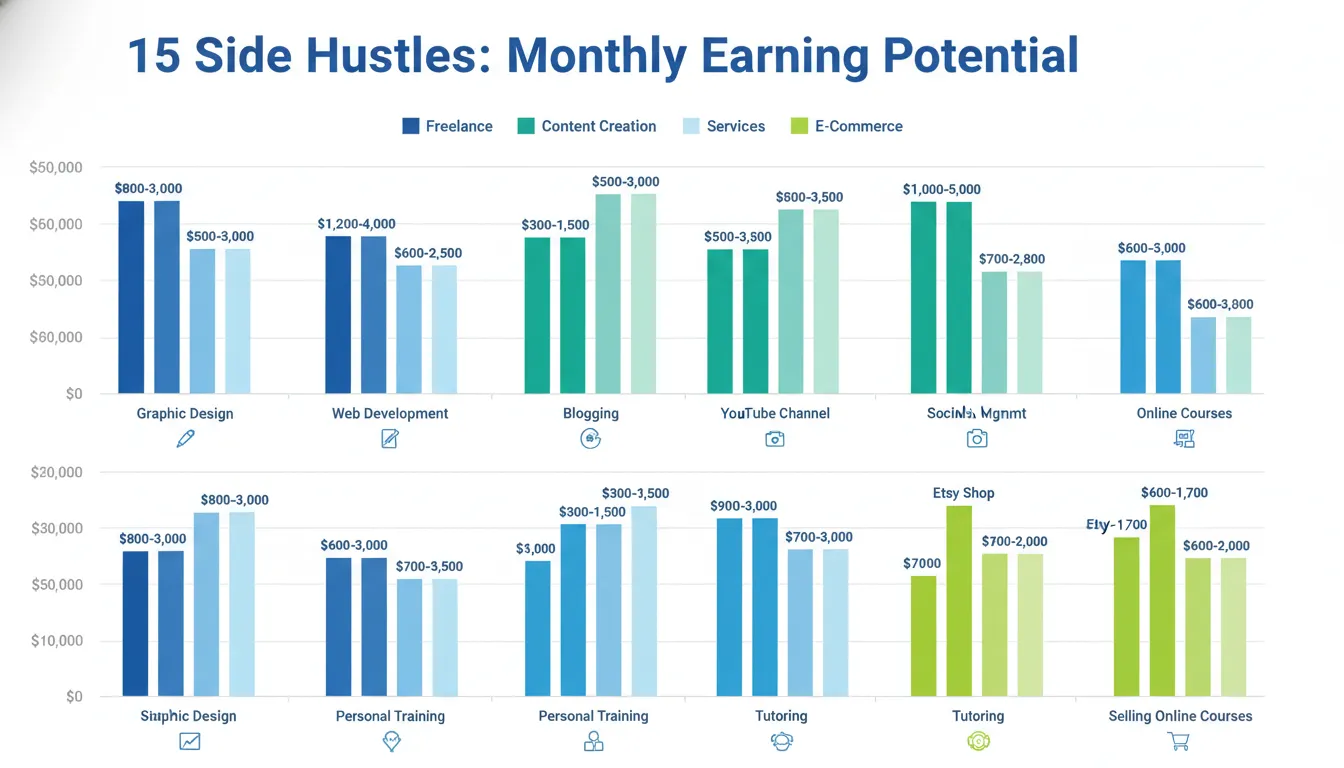
Key Takeaways
Side Hustle #11–13: Digital Products & E-Commerce
Digital products require upfront effort but generate passive income once created. E-commerce business models vary widely in complexity and startup cost.
Online Courses: Course creators earn $500–$5,000+ monthly by selling $27–$297 courses to their audiences. A course that sells 50 copies at $47 generates $2,350/month. The barrier is creating quality course content, but platforms like Teachable, Kajabi, and Podia handle the technical side.
To start: Identify a skill you can teach (freelance writing, graphic design, online business, fitness, cooking). Create a course outline (8–15 modules, each with 2–5 lessons). Record video lessons using Screenflow or OBS (free). Build a sales page with testimonials and a video walkthrough. Drive traffic through YouTube, blogs, email lists, or paid ads. Most course creators earn their first sale within 30–90 days with active promotion.
Digital Templates & Printables: Creators sell Notion templates, Canva templates, spreadsheets, and printables on Etsy, Gumroad, and their own sites. A creator with 10 templates selling at $15–$30 each can generate $500–$2,000/month if they drive consistent traffic (social media, Pinterest, email lists).
To start: Identify templates solving a specific problem (budget spreadsheet, social media planner, course template, resume template). Create 5–10 templates using Canva Pro ($120/year) or Google Sheets. List them on Etsy (minimal fees, built-in traffic) or Gumroad (higher profit margin, requires traffic driving). Drive traffic via Pinterest, TikTok, and relevant communities. Scale by creating complementary templates addressing the same audience’s needs.
Dropshipping or Print-on-Demand: These e-commerce models require minimal inventory investment. Dropshipping involves partnering with suppliers who ship directly to customers; you handle marketing and customer service. Print-on-demand is similar—you design products (t-shirts, mugs, hoodies), and a partner company prints and ships them. Profit margins are typically 30–50%.
To start: For dropshipping, use Shopify ($29–$299/month) with suppliers like Printful, Oberlo, or AliExpress integration. For print-on-demand, use Printful, Merch by Amazon, or Teespring. Design 10–20 products targeting a specific niche or audience. Drive traffic via TikTok, Instagram, or paid ads. Expect to reinvest initial profits into marketing; realistic timeline to $500/month revenue is 3–6 months with consistent marketing.

Side Hustle #14–15: Professional Services & Coaching
These categories leverage your professional expertise for premium income.
Online Tutoring & Educational Services: Tutors earn $25–$100+ per hour depending on subject and credentials. A tutor working 20 hours weekly at
Advertisement
