

YouTube RPM—revenue per thousand impressions—has become the holy grail metric for creators trying to monetize their channels. But here’s the problem: most creators treat RPM as a one-size-fits-all number. They don’t realize that your RPM in 2026 could vary by 300%, 400%, or even more depending on where your audience lives. A creator in Switzerland earning $15 RPM operates in an entirely different ecosystem than one in India earning $2 RPM. This isn’t a coincidence. It’s the direct result of three powerful, interconnected factors that shape the YouTube monetization landscape globally. Understanding these factors isn’t just helpful—it’s essential if you want to build a sustainable, profitable YouTube channel. According to recent creator surveys, over 60% of YouTubers don’t fully understand why their RPM fluctuates, and fewer than 25% optimize their channels around the geographic composition of their audience. That’s a massive missed opportunity. In this comprehensive guide, we’re breaking down the three biggest factors driving YouTube RPM by country in 2026, showing you exactly which countries pay the most, and most importantly, how you can leverage this data to maximize your own earnings.
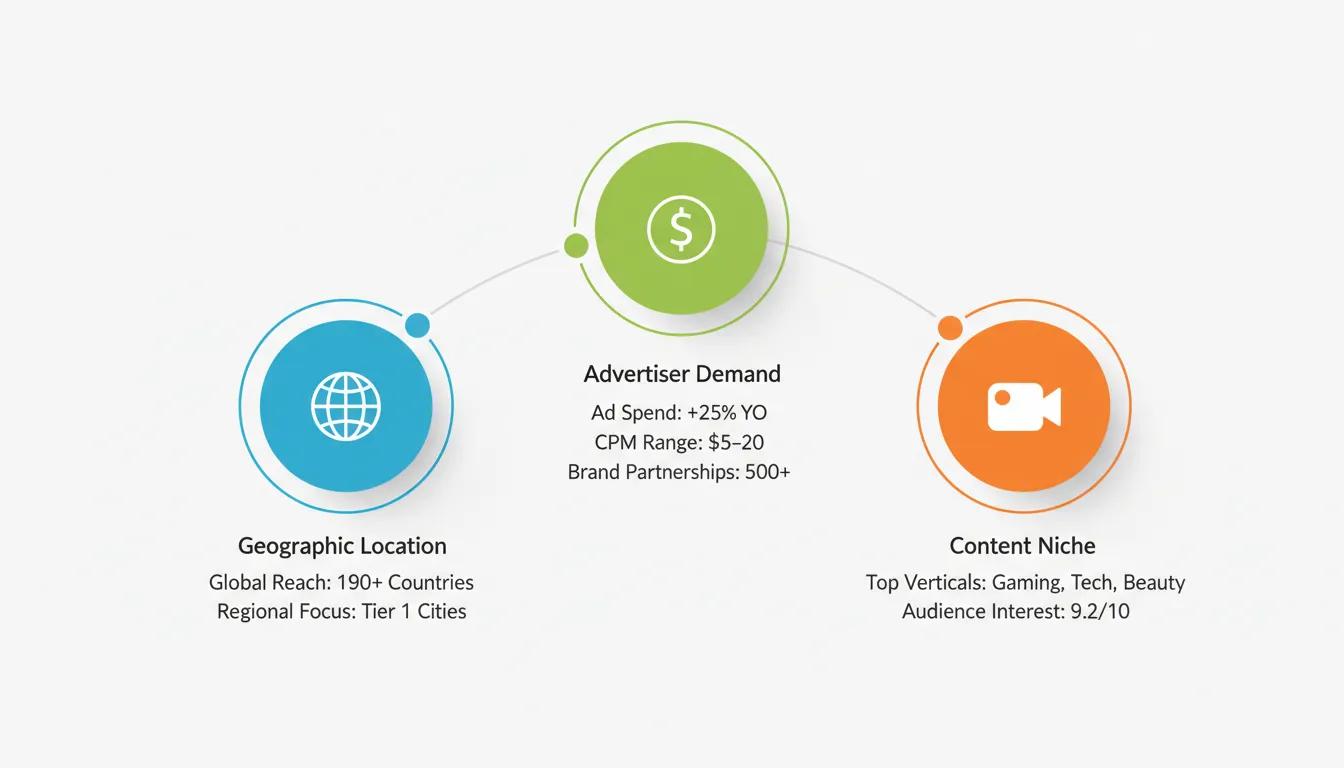
Factor #1: Geographic Location and Advertiser Demand
Geographic location is the heavyweight champion of RPM determination. It’s not just that certain countries have wealthier viewers—it’s that advertisers themselves are willing to pay significantly more to reach audiences in wealthy nations. This creates a cascading effect throughout the entire YouTube ecosystem.
The United States, United Kingdom, Canada, and Australia remain the top tier of RPM-paying countries in 2026. These nations have multiple things in common: high cost of living, strong purchasing power, mature digital advertising markets, and advertisers competing fiercely for audience attention. When a viewer from the US watches a video, YouTube advertisers know that person has disposable income and is likely to make purchases. Therefore, they bid higher for ad placements. A typical CPM (cost per thousand impressions) in the US ranges from $8-15, which translates to RPM of $4-8 after YouTube takes its 45% cut.
Compare this to emerging markets. India, the Philippines, and parts of Southeast Asia have exploding creator communities, but RPM rates there hover between $0.50-$2.50. This isn’t because viewers in these countries matter less—it’s because advertisers have smaller budgets allocated to these regions, and the cost of goods is lower, reducing the value proposition for ads. A product that costs $100 in the US costs $20 in India, so advertisers adjust their bids accordingly.
The practical implication here is crucial: your audience geography directly determines your income potential. If you have 100,000 views from US-based viewers, you might earn $400-$800. Those exact same 100,000 views from India might generate $50-$250. This isn’t conjecture—it’s driven by hard economic data and advertising budgets.
In 2026, we’re seeing interesting shifts. Switzerland, Norway, and Denmark have emerged as premium markets, often matching or exceeding US RPM rates. These Nordic countries have the highest disposable income per capita globally and strong e-commerce sectors, making them incredibly attractive to advertisers. Meanwhile, secondary markets like Ireland and Singapore are climbing the ranks as their digital economies expand.
The tier system breaks down like this:
Tier 1 (Highest RPM): United States, Australia, Canada, United Kingdom, Switzerland, Norway, Denmark, Sweden, Netherlands
Tier 2 (High RPM): Germany, France, Japan, South Korea, New Zealand, Ireland, Austria
Tier 3 (Medium RPM): Italy, Spain, Portugal, Czech Republic, Poland, Brazil, Mexico
Tier 4 (Lower RPM): India, Philippines, Indonesia, Vietnam, Pakistan, Nigeria, Bangladesh
Understanding this hierarchy helps you make strategic decisions. If you’re targeting a niche audience that skews toward Tier 1 countries, you’re positioned to earn substantially more. If your audience is primarily Tier 4, you need different monetization strategies.
Factor #2: Content Niche and Advertiser Vertical Competition
The second major factor is your content niche. Not all niches attract the same advertiser interest or advertiser budgets. This creates dramatic RPM variations even within the same country.
Certain niches are “advertiser magnets.” Finance, business, technology, health, and personal development content attracts premium advertisers willing to pay top dollar. A finance channel teaching stock investing might have a CPM of $40-80 (RPM of $20-40), while a general entertainment channel in the same country might see only $5-10 CPM (RPM of $2.50-5).
Why the difference? Advertisers selling financial products know they need to reach people interested in finance. They have large budgets and are competing intensely for that specific audience. The lifetime value of a customer gained through a finance ad might be thousands of dollars, so a $50 CPM feels cheap. By contrast, entertainment advertisers have smaller budgets spread across more channels, creating less bidding competition.
Here’s the niche breakdown for 2026:
Premium Niches (Highest Advertiser Demand):
– Finance and investing
– Business and entrepreneurship
– Health and fitness (especially weight loss, supplements)
– Technology and gadgets
– Real estate and property
– Insurance and legal services
– Cryptocurrency and trading
High-Paying Niches:
– Self-improvement and productivity
– Career development
– Home improvement and DIY
– Automotive
– Education and courses
– Gaming (specific sub-niches)
Medium-Paying Niches:
– General vlogging
– Travel
– Cooking and food
– Fashion and beauty
– Lifestyle
– Entertainment and comedy
– Sports commentary
Lower-Paying Niches:
– General entertainment
– Music (depends heavily on composition)
– ASMR
– Shorts-focused content
– Compilation videos
The interesting dynamic in 2026 is the rise of “hybrid niches”—channels that blend high-paying content with lifestyle elements. For example, a channel teaching “how to build wealth through side hustles” combines finance (premium) with entrepreneurship (premium), creating multiplicative advertiser interest.
Your content format also matters within the niche. Long-form educational content (15+ minutes) typically commands higher CPM/RPM than short-form content because it allows for mid-roll ads, which advertisers value more highly. Educational content also tends to keep viewers engaged longer, allowing for more ad placements.

Factor #3: Audience Composition and Viewer Demographics
The third critical factor is the specific demographic composition of your audience—their age, interests, purchase history, and engagement patterns. Two channels in the same country with the same niche can have vastly different RPM due to who’s watching.
YouTube’s algorithm assigns value to viewers based on historical data. A 35-year-old professional in the US with a history of purchasing luxury goods is worth significantly more to advertisers than a 16-year-old student watching for free. The algorithms that power YouTube’s ad system learn from millions of data points about which viewers actually convert—meaning which viewers click ads and make purchases.
Age demographics dramatically impact RPM. Channels with audiences skewing 25-54 years old typically see 2-3x higher RPM than channels with audiences skewed younger (13-24) or older (55+). This is the “sweet spot” where purchasing power meets digital comfort and active engagement.
Gender composition also plays a role. Content attracting female audiences aged 25-45 (who control household purchasing in many Western countries) tends to see premium CPM rates, particularly for beauty, wellness, and home products. Content attracting male audiences 30-50 sees premium rates for finance, tech, and automotive advertising.
Geographic distribution within your audience matters enormously. If your channel attracts viewers globally, your RPM is the weighted average of all those countries’ rates. A channel with 50% US audience, 30% UK, and 20% Indian audience will have a healthy RPM. A channel with 80% Indian and 20% US has lower average RPM despite having some high-value viewers.
Here’s a practical example: Two cooking channels, both with 1 million subscribers, both in English, both posting weekly. Channel A attracts affluent home cooks aged 35-55 from the US, Canada, and UK, focused on gourmet cooking. Channel B attracts budget-conscious home cooks aged 18-35 globally, focused on cheap meal prep. Channel A might see $6-8 RPM. Channel B might see $2-3 RPM. Same niche (cooking). Same platform. Completely different economics.
In 2026, we’re seeing advertisers increasingly use audience intelligence tools to identify high-value viewers. Channels that attract viewers with specific interests (like people interested in investing, home purchasing, or premium goods) command higher rates even if total subscriber counts are lower.
Key Takeaways
YouTube RPM Rates by Country in 2026: The Data
Understanding the raw numbers helps contextualize these factors. Here’s what actual RPM rates look like across major markets in 2026:
| Country | Average RPM (USD) | Range | Primary Advertiser Demand |
|———|——————-|——-|————————–|
| Switzerland | $12-18 | $8-25 | Finance, luxury goods, tourism |
| Australia | $10-16 | $7-22 | Real estate, finance, e-commerce |
| United States | $9-15 | $6-25 | All verticals, heavy competition |
| Canada | $8-14 | $5-20 | Finance, tech, e-commerce |
| United Kingdom | $8-13 | $5-18 | Finance, beauty, e-commerce |
| Denmark | $9-14 | $6-20 | Tech, sustainability, design |
| Norway | $10-15 | $7-22 | Luxury goods, technology |
| Netherlands | $8-12 | $5-18 | Tech, e-commerce, design |
| Germany | $7-11 | $4-16 | Manufacturing, tech, automotive |
| New Zealand | $8-12 | $5-17 | Real estate, finance, tourism |
| Ireland | $7-11 | $4-15 | Tech, finance, SaaS |
| Japan | $6-10 | $4-14 | Electronics, gaming, automotive |
| South Korea | $6-10 | $3-15 | Gaming, tech, entertainment |
| Brazil | $4-8 | $2-12 | E-commerce, education, finance |
| Mexico | $3-7 | $1.50-10 | E-commerce, education |
| India | $1-2.50 | $0.50-4 | E-commerce, education, apps |
| Philippines | $1.50-3 | $0.75-5 | E-commerce, education |
| Indonesia | $1.50-3 | $0.75-5 | E-commerce, apps |
| Vietnam | $1.50-3 | $0.75-5 | E-commerce, apps |
These rates reflect a channel with balanced, engaged audiences and consistent upload schedules. Actual RPM can vary based on the three factors we discussed.

How to Leverage These Factors for Maximum RPM
Now that you understand the three factors, the strategic question becomes: how do you optimize your channel to capitalize on them?
Strategy #1: Target High-RPM Countries Through Niche Selection
Choose a content niche that naturally attracts audiences from Tier 1 countries. A channel about “investment strategies for software engineers” will attract viewers primarily from the US, Canada, UK, and Australia. A channel about “budget travel vlogs” will attract viewers from everywhere, including low-RPM countries. If revenue is your primary goal, niche selection is your first lever.
Strategy #2: Optimize Audience Demographics
Create content that appeals to the 25-54 age group, particularly in Tier 1 countries. This might mean adjusting your thumbnail style, title language, pacing, and content depth. Content that appeals to professionals with disposable income will naturally attract higher-value viewers. For example, teaching “how to start a consulting business” appeals to professionals; teaching “how to get free stuff online” appeals to budget-conscious teens.
Strategy #3: Use Geographic Expansion Strategically
Don’t expand to every market equally. If you’re starting out, focus on one Tier 1 country. Build a community there. Understand the cultural nuances. As you grow, gradually expand. If you’re already established in a Tier 1 country with strong RPM, you can afford to expand to Tier 3 or Tier 4 countries because your base revenue is already solid.
Strategy #4: Combine Niche Expertise with Premium Content
The channels earning the highest RPM tend to combine expertise in a premium niche with production quality that signals authority. A $50 RPM finance channel likely has professional audio, consistent branding, data-driven content, and clear educational value. Compare this to a finance channel with poor audio and rambling videos, which might only achieve $20 RPM.
Tools, Resources, and RPM Calculators
Several tools can help you forecast and track RPM potential based on these factors.
YouTube Studio Analytics (Free)
Your primary tool. Check the geography report to see where your viewers come from. Calculate your current RPM by dividing total revenue by impressions and multiplying by 1,000. Track this monthly to identify trends.
TubeRanker ($15-50/month)
Provides RPM data broken down by channel, niche, and geography. Useful for competitive analysis and benchmarking against similar channels.
Social Blade (Free with premium options)
Tracks earnings over time, estimates annual revenue based on current RPM, and shows growth trends.
VidIQ ($20-100/month)
Offers RPM forecasting based on channel metrics and niche data. Their premium tier includes competitor RPM analysis.
SEMrush and Ahrefs ($100-400/month)
Primarily SEO tools, but increasingly useful for understanding advertiser demand in different niches and geographic markets. Can inform content strategy.
YouTube RPM Calculator by My Kitchen Income (Free)
A dedicated calculator that lets you input your expected views, niche, primary audience country, and other factors to estimate potential RPM. This is the most practical tool for planning content strategy.
The cost-benefit analysis is straightforward: if you’re serious about YouTube revenue, a $30/month analytics tool pays for itself through better decision-making that might increase your RPM by just 5-10%.
Pros and Cons of Optimizing for High-RPM Factors
Pros:
– Significantly higher income potential. Optimizing for high-RPM factors can double, triple, or quadruple your earnings from the same view count.
– More sustainable business model. Channels with higher RPM need fewer views to hit income goals, making growth more achievable.
– Better long-term positioning. Building an audience in premium niches positions you for diversification (sponsorships, courses, consulting) later.
– Increased professionalism. Targeting high-RPM audiences often forces you to improve content quality, which benefits your channel long-term.
– Less algorithm dependency. Channels with engaged, high-value audiences tend to have more stable viewership and monetization.
– Scalability. Once you’ve built an audience in a high-RPM niche and country, scaling to other platforms or monetization methods is easier.
Cons:
– Higher competition. Premium niches have more established creators and higher barriers to entry. Breaking through requires quality and patience.
– Narrower audience. Targeting finance professionals limits your total address
Advertisement
