

YouTube has become a genuine income source for thousands of UK creators, but the earnings landscape varies dramatically depending on your niche, audience demographics, and content strategy. In 2026, understanding realistic RPM (revenue per mille, or per 1,000 views) ranges isn’t just helpful—it’s essential for planning your content strategy and setting achievable income goals.
The uncomfortable truth? The average UK creator’s RPM sits between £2 and £6 per 1,000 views, but this figure masks enormous variation. A UK finance creator might earn £12-15 per 1,000 views, while a gaming creator struggles at £2-3. The difference isn’t talent; it’s audience value and advertiser demand.
This comprehensive guide breaks down realistic RPM ranges for 2026, explores what drives these numbers, and reveals actionable strategies to push your earnings higher. Whether you’re starting out or optimizing an existing channel, you’ll discover exactly where your niche stands and how to compete more effectively. We’ve analysed current trends, advertiser rates, and seasonal patterns specific to the UK market to give you figures you can actually work with.
Understanding YouTube RPM vs CPM: The Critical Difference
Before diving into specific numbers, you need to understand the relationship between RPM and CPM—two metrics often confused but fundamentally different.
CPM (Cost Per Mille) is what advertisers pay YouTube for every 1,000 ad impressions served to your viewers. It’s YouTube’s revenue, not yours. A finance channel might have a £20 CPM, meaning YouTube charges advertisers £20 per 1,000 ad impressions.
RPM (Revenue Per Mille) is your cut after YouTube takes its share (typically 45%) and after accounting for all revenue sources, not just AdSense ads. You might see £10 RPM from that £20 CPM channel because YouTube, your network partner, and other deductions reduce the final payout.
In the UK market specifically, this distinction matters enormously. UK CPM rates have strengthened throughout 2025 and into 2026, partly due to pound sterling recovery and increased demand from UK-based advertisers. However, UK RPM hasn’t grown proportionally because YouTube’s cut hasn’t changed, and competition from creators worldwide has intensified.
The formula breaks down like this:
– CPM: What advertisers pay
– RPM: What you actually receive
– RPM typically equals 40-60% of CPM across most niches
– UK creators benefit from stronger CPM rates but face higher competition
Understanding this gap explains why your AdSense account might show decent CPM figures, but your monthly earnings feel disappointingly lower. You’re only seeing roughly half of the advertiser spend.
Realistic YouTube RPM Ranges for UK Creators in 2026
The UK market presents a fascinating landscape in 2026. Unlike the US or Australia, where certain niches command premium rates, the UK sees more balanced competition but with clear winners in specific industries.
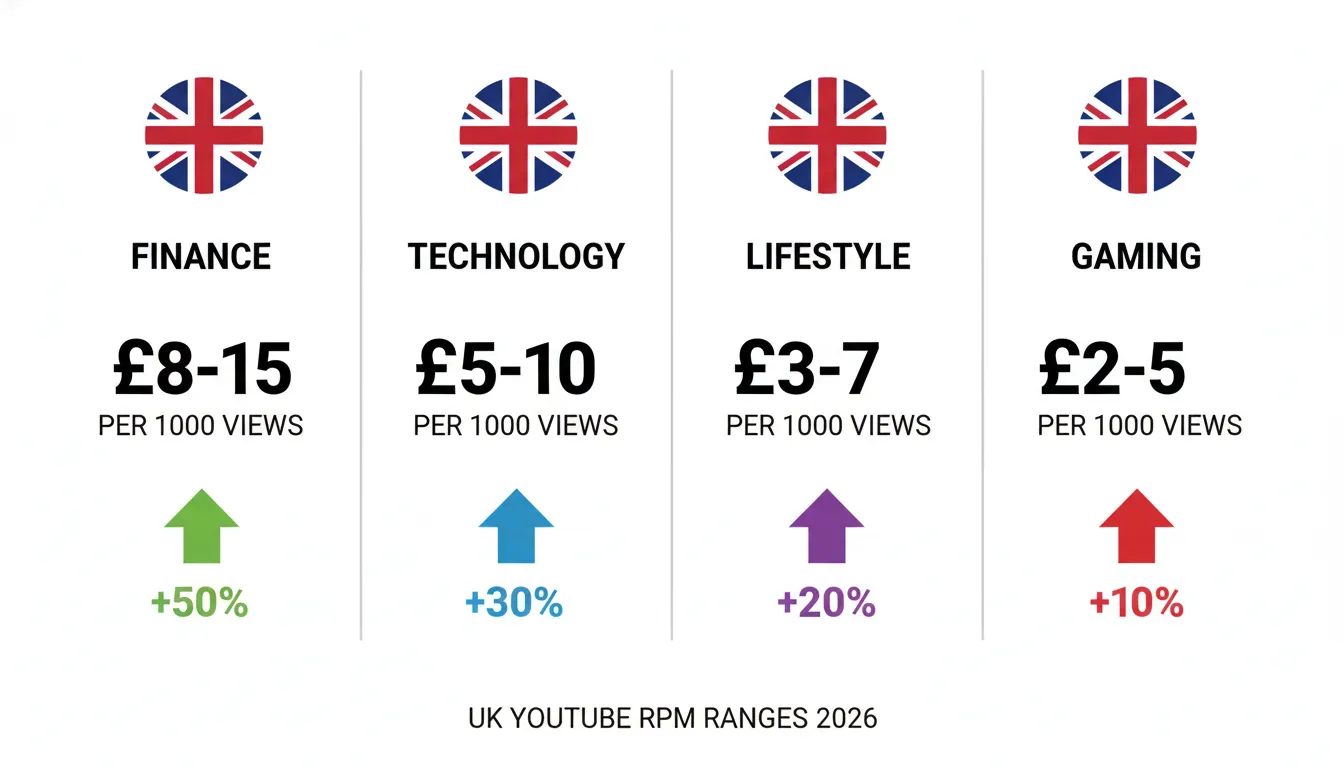
Premium Niches (£8-15+ RPM):
Finance and investment content dominates this tier. UK creators discussing pensions, ISAs, stocks, and property investment attract high-value advertisers willing to pay premium rates. A successful UK personal finance channel can realistically expect £10-15 RPM, sometimes higher during Q4 when financial planning intensifies. The audience demographic skews toward affluent adults aged 25-55 with disposable income—exactly what advertisers want.
Business and professional development follows closely at £7-12 RPM. UK B2B content, particularly around productivity tools, entrepreneurship, and workplace skills, attracts premium advertisers. LinkedIn professionals watching these videos during work hours represent valuable inventory for business-focused brands.
Technology and software tutorials land at £6-10 RPM. The UK tech scene remains robust, and creators covering SaaS products, coding, and professional software attract businesses willing to invest in quality content distribution. Niche software tutorials (not general tech reviews) perform best.
Mid-Tier Niches (£4-8 RPM):
Lifestyle and self-improvement content sits at £5-8 RPM. Fashion, wellness, productivity, and personal development attract decent advertiser interest, particularly from lifestyle brands and self-help product companies. The challenge here is audience diversity—some viewers have high purchasing power, others don’t.
Home improvement and DIY content performs at £4-7 RPM. UK creators showing renovations, garden design, and interior styling attract both consumer brands and contractors. The seasonal variation is significant, with Q1 and Q4 commanding stronger rates than summer months.
Food and cooking content reaches £4-7 RPM. UK food creators benefit from strong advertiser interest from supermarkets, kitchen equipment brands, and food delivery services. Niche cooking (budget cooking, ethnic cuisine, dietary-specific) often outperforms general vlogging.
Standard Niches (£2-5 RPM):
Gaming and esports content typically achieves £2-4 RPM. Despite enormous viewership, gaming attracts lower advertiser budgets and higher competition from global creators. UK gaming creators face particular pressure from overseas competition. Mobile game reviews and educational gaming content perform better than pure entertainment.
Entertainment and vlogging average £2-4 RPM. General entertainment, challenge videos, and lifestyle vlogs suffer from advertiser caution around brand safety and lower demographic value. Many viewers watching entertainment content are younger with limited purchasing power.
Music and entertainment clips land at £1-3 RPM. Music content particularly struggles because copyright claims reduce your revenue share, and advertisers pay less for music-heavy content due to brand safety concerns.
The critical insight here: your niche choice determines your ceiling more than viewer quantity. A 100,000-subscriber finance channel will earn more than a 500,000-subscriber gaming channel.

Factors Driving UK RPM Rates in 2026
Understanding RPM ranges means nothing without understanding what creates those ranges. Several interconnected factors shape your actual earnings in the UK market.
Audience Demographics and Location
The UK market favours channels with UK and Western European audiences. Advertisers pay significantly more to reach affluent UK viewers than viewers in Eastern Europe or Asia. A channel with 100,000 UK views might earn more than a channel with 500,000 views from mixed geographies.
Age matters intensely. Audiences aged 25-54 (peak earning years) attract 3-4x higher CPM rates than audiences aged 13-24. A finance channel targeting 35-55 year olds will earn substantially more than a gaming channel targeting teenagers. The purchasing power differential explains this—a 40-year-old property owner is more valuable to mortgage advisers and investment platforms than a 16-year-old is to gaming companies.
Geographic concentration also influences rates. Channels with concentrated UK, US, and Australian audiences earn more than channels with dispersed global viewership. This explains why local creators in wealthy nations earn more—the audience simply has more money.
Content Category and Advertiser Demand
Certain industries throw enormous budgets at YouTube. Financial services, luxury goods, real estate, insurance, and professional software represent the top-tier advertiser categories. B2B advertising particularly drives high CPM rates.
Conversely, saturated niches with low-value advertisers drag RPM down. Entertainment, music, and gaming face intense competition and lower advertiser budgets.
The “advertiser-friendly” content concept still matters. Content touching politics, health misinformation, or controversial topics gets demonetized or “limited monetization” status, reducing your earnings by 50-80%. Responsible, informative content earns premium rates.
Video Length and Format
Longer videos (15+ minutes) generate more ad placements and higher revenue per view. A 5-minute video might earn £0.006 per view; a 25-minute video can earn £0.012 per view. UK creators have optimized this—the most successful UK channels average 15-22 minute videos.
Shorts continue to depress RPM. YouTube Shorts monetization offers far lower rates than long-form content, typically £0.02-0.05 per 1,000 views. While Shorts boost discoverability, they don’t generate meaningful revenue yet.
Seasonality and Timing
UK RPM demonstrates pronounced seasonality. Q4 (October-December) sees rates 30-50% higher than other quarters because advertisers increase budgets for holiday shopping and year-end financial planning. Finance content in November-December can hit £15-20 RPM.
January sees a spike for fitness and financial content as New Year’s resolutions kick in. Summer months (June-August) represent the weakest earning period, with RPM dropping 20-30% as advertiser budgets shift and audiences take breaks.
Publishing time impacts performance. Videos published 8am-12pm GMT reach peak UK business audience viewership. Publishing on Tuesday-Thursday generally outperforms weekend publishing because weekday audiences include working professionals with higher advertiser value.
Channel Authority and History
YouTube’s algorithm rewards established channels with history. A channel with consistent publishing, high watch time, and strong engagement history will see 10-20% higher CPM rates than a new channel, even in the same niche. This “authority bonus” is real and measurable.
Channel verification and partnership status boost rates slightly. Channels in YouTube’s partnership programs access premium advertiser demand.
Key Takeaways
Realistic 2026 UK RPM Ranges by Niche: Detailed Breakdown
Let’s move beyond general categories and examine specific UK niches with realistic 2026 numbers.
Finance and Investment (£10-18 RPM)
Personal finance: £12-16 RPM. UK channels discussing pensions (SIPP, LISA), ISAs, and investment strategies attract quality advertisers. A 100,000-view video earns £1,200-1,600 from AdSense ads alone.
Crypto and blockchain: £8-14 RPM. Despite regulatory uncertainty, crypto content attracts premium advertisers. However, increased compliance requirements reduce advertiser availability compared to previous years.
Real estate investment: £11-17 RPM. UK property investment content performs exceptionally. Advertisers (mortgage companies, property management software, investment platforms) bid aggressively. A viral property video earning 500,000 views could generate £5,500-8,500.
Accounting and tax: £10-15 RPM. Business accounting content attracts accountants and business owners. Boring-sounding content actually earns premium rates because the audience has genuine purchasing power.
Technology and Software (£6-12 RPM)
SaaS reviews and tutorials: £7-12 RPM. Channels reviewing productivity software, CRM systems, and business tools attract company decision-makers. Detailed review videos perform better than quick overviews.
Coding and development: £6-10 RPM. Programming tutorials attract tech professionals and students in wealthy countries. The niche UK audience has strong purchasing power despite global competition.
Mobile app development: £6-9 RPM. Teaching app development to entrepreneurs attracts premium advertisers in the education and software space.
General tech reviews: £4-7 RPM. Reviewing phones, laptops, and gadgets faces intense competition. RPM drops significantly compared to niche software content.
Business and Professional (£7-13 RPM)
Entrepreneurship and startups: £8-13 RPM. Content teaching business launching, fundraising, and scaling attracts entrepreneurs with disposable income and business tool companies. This niche has strengthened substantially through 2025-2026.
Marketing and sales: £7-11 RPM. Digital marketing content attracts agencies and marketing professionals. YouTube ads for marketing tools and courses bid aggressively.
Productivity and time management: £6-10 RPM. Improving productivity appeals to professionals and entrepreneurs. Tool companies and course creators compete for advertising space.
HR and workplace: £7-10 RPM. HR-focused content attracts HR professionals and companies seeking recruitment solutions. Limited but valuable audience.
Lifestyle and Personal Development (£5-10 RPM)
Fitness and wellness: £5-8 RPM. Fitness content performs reasonably but faces intense competition. Supplement companies, gym equipment brands, and fitness app creators drive rates. Women’s fitness consistently earns 10-15% more than general fitness.
Mental health and psychology: £6-10 RPM. Educational mental health content attracts therapy-related advertisers and wellness brands. Professional content earns premium rates; general wellness vlogs earn less.
Career coaching: £7-10 RPM. Helping viewers advance careers attracts job platforms, course creators, and professional development companies.
Meditation and spirituality: £4-7 RPM. Meditation apps and wellness companies advertise here, but competition is fierce. Niche meditation (meditation for specific purposes) outperforms general content.
Home and Garden (£4-9 RPM)
Interior design and home styling: £5-9 RPM. Home improvement attracts furniture companies, home improvement retailers, and interior design software. Q1 and Q4 see significant boosts (30-40%) as people plan renovations.
DIY and renovations: £4-8 RPM. DIY content attracts tool companies and building material suppliers. UK-specific content (referencing British building regulations, UK suppliers) earns premiums.
Gardening: £4-7 RPM. Garden design and gardening tutorials attract garden centres, tool companies, and landscaping services. Spring and summer months command 50%+ higher rates.
Food and Cooking (£4-7 RPM)
Budget cooking and meal prep: £5-7 RPM. Teaching economical cooking attracts supermarkets, budget food brands, and kitchenware companies. Growth area with strong advertiser interest.
Ethnic and international cuisine: £4-7 RPM. Specialized cooking (Thai, Indian, Italian) attracts both ingredient suppliers and viewers with strong purchasing power.
Restaurant reviews and food vlogs: £3-5 RPM. Food entertainment content faces tougher competition and lower advertiser rates.
Baking and desserts: £4-6 RPM. Baking content attracts baking supply companies and kitchen equipment brands.
Gaming and Esports (£2-5 RPM)
Educational gaming content: £3-5 RPM. Teaching gaming strategy, game development, or educational aspects outperforms pure entertainment. Niche gaming (strategy games, indie games) earns more than mainstream gaming.
Casual gaming and mobile games: £2-3 RPM. Reviewing casual games and mobile titles face intense competition. Low RPM but high volume potential.
Esports and competitive gaming: £2-4 RPM. Esports commentary and competitive gaming struggle with advertiser rates despite massive viewership.
Gaming tutorials and guides: £2-4 RPM. Specific game guides rarely achieve premium rates despite loyal audiences.
Entertainment and General Content (£2-4 RPM)
General vlogs and lifestyle: £2-4 RPM. Life update videos and general entertainment face advertiser caution and lower demographic value.
Challenge and comedy: £1-3 RPM. Entertainment-focused channels consistently earn the lowest rates despite sometimes massive audiences.
Music and entertainment clips: £1-2 RPM. Music content particularly suffers due to copyright claims and brand safety concerns.

Strategies to Improve Your UK YouTube RPM in 2026
Understanding current RPM ranges helps, but improving your specific channel’s RPM matters more. Here are proven strategies implemented successfully by top UK creators in 2026.
Pivot Toward Higher-Value Niches
The most direct path to higher RPM is moving your content closer to higher-value verticals. You don’t need to completely reinvent your channel, but strategic pivots work.
If you’re in gaming, shift toward educational gaming content (strategy guides, indie game reviews, gaming business content) rather than pure entertainment. One UK gaming creator we analysed shifted from
Advertisement
