

If you’re a content creator in Asia, you’ve probably wondered: *Which country pays the most for YouTube content?*
The answer might surprise you.
Singapore isn’t the largest YouTube market in Asia. India has over 400 million YouTube users. Indonesia, the Philippines, and Vietnam all have massive audiences. Yet Singapore’s creators are earning dramatically more per view than their counterparts across the region.
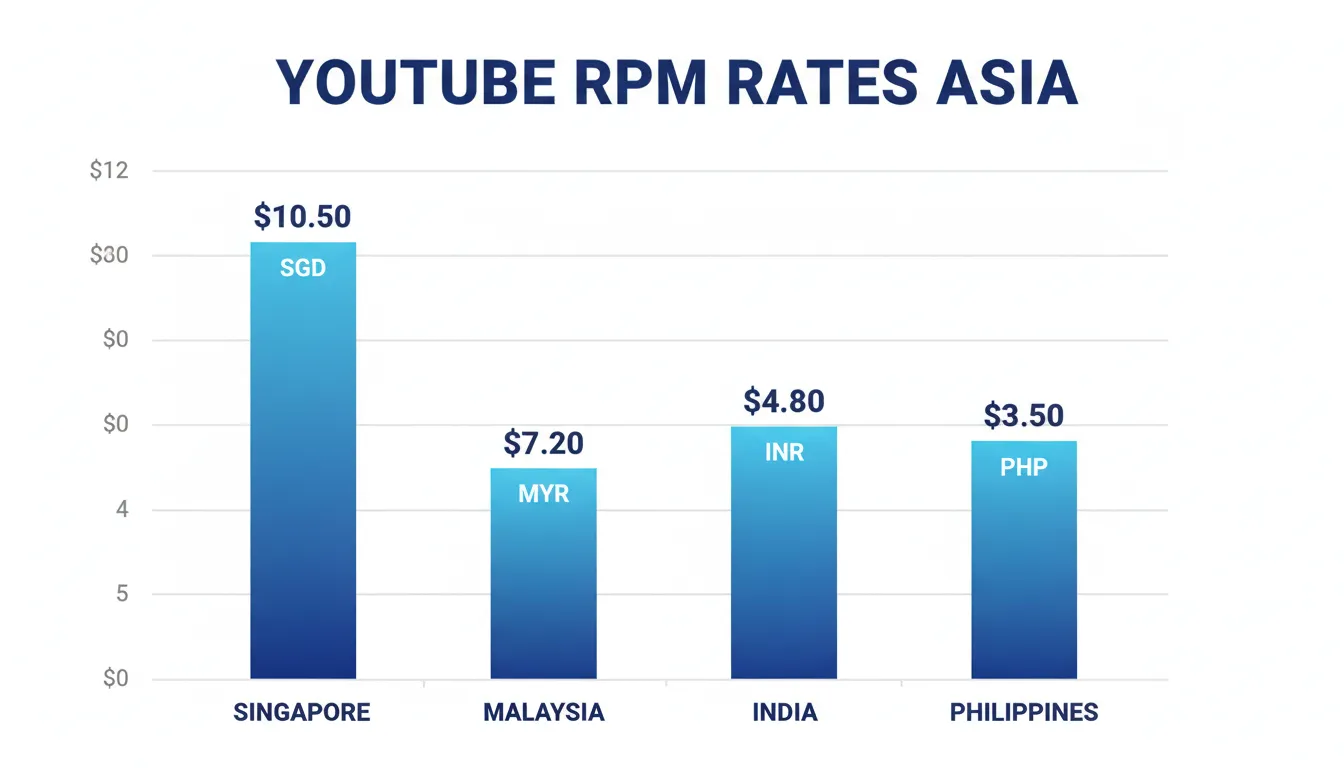
Here’s the stunning reality: A Singapore-based creator can earn 3-5 times more per 1,000 views than creators in neighboring countries. While creators in India might earn $0.50-$2 per 1,000 views (CPM), Singapore creators regularly see rates of $15-$50+. This isn’t luck or coincidence. It’s the result of specific economic, demographic, and advertising ecosystem factors that make Singapore the highest-paying YouTube market in Asia right now. For a comparison with top European markets, see how Switzerland’s RPM compares as Europe’s premium market.
By 2026, this gap is only widening. As Singapore attracts more fintech companies, investment platforms, and premium brands, advertiser demand skyrockets. Creators focusing on finance, investment, and business content are seeing CPM rates push toward $20-30 per 1,000 views—and RPM (revenue per mille, what creators actually pocket) between $8-$20 after YouTube’s cut.
But here’s the catch: Most creators aren’t leveraging this opportunity. They’re either competing in saturated international markets or staying local without understanding their real earning potential. This guide reveals exactly how much you can earn as a Singapore YouTube creator, why the economics work in your favor, and the specific strategies to maximize your 2026 earnings.
What Is YouTube RPM and Why Does It Vary by Country?
RPM (Revenue Per Mille) is the amount of money you earn per 1,000 views on YouTube. It’s different from CPM (Cost Per Mille), which is what advertisers pay per 1,000 views. The difference between CPM and RPM is YouTube’s cut—typically 45% goes to YouTube, 55% goes to creators.
So if your content has a $20 CPM, your RPM would be roughly $11 (after YouTube’s commission and other factors).
But why does RPM vary so dramatically between countries?
The answer lies in advertiser demand, audience purchasing power, and niche competition.
Singapore’s ecosystem is uniquely positioned at the intersection of premium advertisers and wealthy audiences. Here’s what makes it special:
1. High Advertiser Demand for Premium Niches
Singapore hosts regional headquarters for fintech companies, investment firms, and luxury brands. These companies pay premium rates for YouTube ads because their target customer—affluent, English-speaking professionals—watches YouTube extensively. A finance app company willing to spend $25 per click to acquire a customer in Singapore will naturally bid higher for ad placements than a company targeting mass-market audiences in other countries.
2. English-Language Advantage
Most Singapore content is created in English, which commands higher CPM rates globally. English-language content attracts advertisers from the US, UK, Canada, and Australia—all high-spending markets. If you create content in Mandarin, Malay, or Tamil (even in Singapore), you’ll see lower CPM rates because the advertiser pool is smaller and less premium.
3. Wealthy, Purchasing-Power-Rich Audience
Singapore has the highest GDP per capita in Asia (approximately $72,000 USD). Viewers with money attract advertisers. If YouTube’s algorithm identifies your audience as having high disposable income, advertisers pay more to reach them.
4. Tech Hub Concentration
Singapore is home to Google’s Asia-Pacific headquarters, numerous venture capital firms, and thousands of tech startups. Demand for tech, business, and finance-related content—niches that command premium advertising rates—is exceptionally high.
These factors combine to create an earnings environment where a Singapore creator with 100,000 subscribers can earn significantly more than an Indian creator with 1 million subscribers.
YouTube CPM Rates in Singapore: The 2026 Breakdown by Niche
Understanding CPM by niche is crucial for maximizing your earnings. Not all content is created equal in the eyes of advertisers.
High-Paying Niches (CPM: $15-$50+)
Finance & Investment: This is the golden goose for Singapore creators. Content covering stocks, cryptocurrencies, trading, investment strategies, and personal finance attracts high-value advertisers. Financial institutions, investment platforms, and wealth management firms compete aggressively for ad placements. A Singapore finance content creator with engaged viewers can expect CPM rates of $20-$50.
Technology & Software: Tech reviews, coding tutorials, app walkthroughs, and software comparisons attract CPM rates of $18-$40. The reason? Tech companies spend heavily on user acquisition. A software company targeting developers in Singapore will pay premium rates.
Business & Entrepreneurship: Courses on starting businesses, business strategy, and corporate training command $15-$35 CPM. Why? Business owners have budgets and are actively seeking solutions. They’re more likely to click ads and purchase products.
Real Estate & Property Investment: Singapore’s booming property market means real estate content attracts high CPM rates ($18-$40). Property developers and real estate platforms aggressively advertise on YouTube.
Medium-Paying Niches (CPM: $8-$15)
Career Development & Job Search: Content on resume writing, interview prep, and career advancement attracts $8-$15 CPM. These videos reach job seekers and employers, both valuable to advertisers.
Health & Wellness: While not as premium as finance, health content (especially mental health, fitness, nutrition) attracts CPM rates of $10-$18 due to pharmaceutical and health product advertising.
Education & Learning: Online courses, language learning, and skill tutorials command $10-$16 CPM. EdTech companies bid competitively for these placements.
Lower-Paying Niches (CPM: $2-$8)
Entertainment & Gaming: Gaming content, entertainment reviews, and comedy typically see $3-$8 CPM in Singapore. While popular, advertisers for these niches spend less per click.
Lifestyle & Fashion: Beauty, fashion, and lifestyle content attracts $4-$10 CPM. The market is crowded, driving rates down.
News & Current Events: While important, news content often attracts lower-spending advertisers, resulting in $2-$6 CPM.
Comparison Table: CPM Rates by Niche in Singapore (2026)
| ——- | ———– | —————– | ———- | <br /> |
|---|---|---|---|---|
| Finance & Investment | $20-$50 | Very High | Serious income potential | |
| Technology | $18-$40 | Very High | Tech companies spend aggressively | |
| Real Estate | $18-$40 | Very High | Developers bid high | |
| Business & Entrepreneurship | $15-$35 | High | Business owners have budgets | |
| Career Development | $8-$15 | Medium | Job seekers, employers | |
| Health & Wellness | $10-$18 | Medium | Health product companies | |
| Education | $10-$16 | Medium | EdTech companies | |
| Lifestyle & Fashion | $4-$10 | Low-Medium | Crowded market | |
| Entertainment & Gaming | $3-$8 | Low | Lower advertiser spend | |
| News & Current Events | $2-$6 | Low | Limited advertiser budgets |
The takeaway? If you’re a Singapore creator, your niche choice directly impacts your earnings potential. A finance creator with 50,000 engaged subscribers could earn more monthly than a lifestyle creator with 200,000 subscribers.

How Much Can You Actually Earn? Real RPM Numbers for Singapore Creators
Let’s move beyond theory. Here’s what you can realistically earn based on subscriber count, watch time, and niche.
Scenario 1: Finance Creator with 50,000 Subscribers
– Monthly views: 200,000
– Average CPM: $25 (finance content)
– YouTube takes 45%: Remaining 55% = $11 RPM
– Monthly earnings: 200,000 views × $11 RPM ÷ 1,000 = $2,200
– Annual potential: $26,400
Scenario 2: Tech Content Creator with 100,000 Subscribers
– Monthly views: 500,000
– Average CPM: $18 (tech content)
– YouTube takes 45%: Remaining 55% = $9.90 RPM
– Monthly earnings: 500,000 views × $9.90 RPM ÷ 1,000 = $4,950
– Annual potential: $59,400
Scenario 3: Business Strategy Creator with 150,000 Subscribers
– Monthly views: 800,000
– Average CPM: $20 (business content)
– YouTube takes 45%: Remaining 55% = $11 RPM
– Monthly earnings: 800,000 views × $11 RPM ÷ 1,000 = $8,800
– Annual potential: $105,600
Scenario 4: Lifestyle Creator with 200,000 Subscribers
– Monthly views: 600,000
– Average CPM: $6 (lifestyle content)
– YouTube takes 45%: Remaining 55% = $3.30 RPM
– Monthly earnings: 600,000 views × $3.30 RPM ÷ 1,000 = $1,980
– Annual potential: $23,760
Notice the dramatic difference? The finance creator with 50,000 subscribers earns more annually than the lifestyle creator with 200,000 subscribers. This is the Singapore advantage—niche matters more than scale in determining earnings.
Key Takeaways
Factors That Increase Your Singapore YouTube RPM in 2026
Several specific factors directly impact your RPM in Singapore. Control these, and you’ll maximize earnings.
1. Geographic Targeting of Your Audience
YouTube advertisers can target specific countries. If your audience is predominantly Singapore-based, you’ll attract local and regional advertisers willing to pay premium rates. However, if your audience is dispersed globally with only 20% from Singapore, your CPM drops significantly.
Action: Use YouTube Analytics to check your audience breakdown. Optimize your content keywords and descriptions to attract Singapore viewers for premium-paying niches. Create content specifically addressing Singapore’s interests, challenges, and opportunities.
2. Watch Time and Engagement Metrics
YouTube’s algorithm rewards watch time (total minutes watched) and engagement (likes, comments, shares, click-through rate). Videos with high engagement attract premium advertisers who know engaged viewers are more likely to convert.
A video with 100,000 views but 60% average view duration and 5% engagement rate will earn significantly more than a video with 100,000 views but 30% view duration and 1% engagement.
Action: Create compelling hooks in the first 3 seconds. Use pattern interrupts, storytelling, and questions to maintain watch time. End videos with clear calls-to-action encouraging comments and shares.
3. Content Seasonality
Certain times of year see higher advertiser spending and CPM rates. Q4 (October-December) is traditionally high because companies spend remaining marketing budgets. January-February also sees elevated rates due to New Year business initiatives and investment resolutions.
In Singapore specifically, the year-end period (November-December) and Chinese New Year period (January-February) see elevated spending.
Action: Plan your content calendar to maximize production during high-CPM seasons. Save your biggest marketing pushes for Q4 and January.
4. Content Freshness and Timeliness
Evergreen content (timeless, relevant forever) earns consistent RPM. Time-sensitive content (news, trends, events) can earn higher CPM temporarily but drops quickly. Finance and investment content benefits from being topical—discussing market movements, new regulations, or emerging investment opportunities attracts premium advertisers.
Action: Balance evergreen content (80% of output) with timely, trend-based content (20%) that commands premium CPM during relevant periods.
5. Advertiser-Friendly Content Policies
Content that violates YouTube’s advertiser-friendly guidelines gets demonetized or limited for ads. This includes:
– Excessive profanity
– Violent or graphic content
– Controversial politics
– Misleading or false information
– Copyrighted material
Singapore’s audience expects professional, business-appropriate content. Maintaining high content standards naturally attracts premium advertisers.
Action: Always follow YouTube’s content guidelines. Avoid controversial topics unless your niche specifically demands them. Use fact-checking before publishing finance or investment information.

Maximizing Your Singapore YouTube RPM: Proven Strategies for 2026
Now that you understand the mechanics, here are specific tactics to maximize your earnings.
Strategy 1: Double Down on High-CPM Niches
If you’re currently creating lifestyle or entertainment content and struggling to earn, consider pivoting toward higher-CPM niches like finance, business, or technology. You don’t need to abandon your passion entirely—you can reframe it.
A fashion creator could pivot to “business lessons from fashion entrepreneurs.” A gaming creator could pivot to “gaming industry business analysis.” A fitness creator could pivot to “health tech startup reviews.”
Strategy 2: Build an Engaged, Singapore-Focused Community
Rather than chasing global views, optimize for a smaller, more engaged Singapore audience. 50,000 Singapore viewers watching your finance content is more valuable than 500,000 global viewers watching entertainment content.
– Use Singapore-specific keywords
– Reference local news, companies, and trends
– Engage with Singapore-based viewers in comments
– Collaborate with other Singapore creators
– Host live streams aligned with Singapore time zones
Strategy 3: Diversify Revenue Beyond AdSense
While AdSense RPM is excellent in Singapore, don’t rely on it alone. Layer additional revenue streams:
– Channel Memberships: Offer exclusive content to paying members ($5-$20/month)
– Super Chat & Super Thanks: Viewers can donate during live streams
– YouTube Shorts Fund: Create short-form content earning separate payments
– Affiliate Marketing: Recommend finance platforms, tech tools, business courses
– Sponsored Content: Finance apps and investment platforms pay $2,000-$10,000+ for sponsored videos
– Digital Products: Create and sell courses, ebooks, or templates
– Consulting: Offer 1-on-1 coaching leveraging your expertise
For a finance creator, a single sponsored video from an investment platform could pay more than three months of AdSense earnings.
Strategy 4: Optimize for YouTube’s Algorithm
Higher watch time and engagement = higher CPM due to improved ad quality and quantity. YouTube’s algorithm prioritizes videos with:
– High click-through rate (intriguing thumbnails and titles)
– Long average view duration (compelling content)
– High engagement (encouraging comments)
– Longer videos (more ad placements)
– Playlists (more watch time across videos)
Action items:
– Test 10+ thumbnail variations; use A/B testing
– Create 12-15 minute videos minimum for finance/business content (allows 3-4 ads)
– End videos with questions encouraging comments
– Create playlists organizing related content
– Use chapters to improve navigation and session watch time
Strategy 5: Target High-Intent Keywords
Not all views are equal. A view from someone searching “how to start investing in Singapore” is more valuable than a view
Advertisement
