

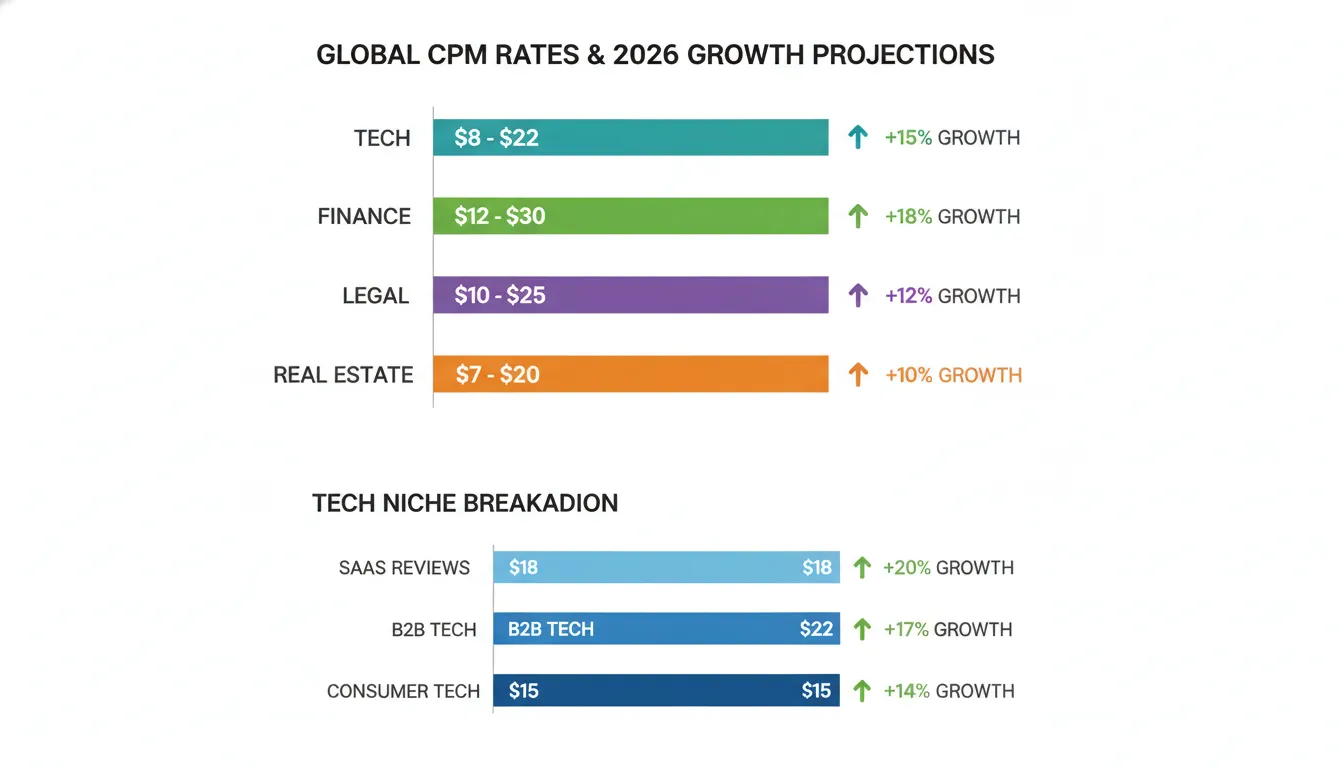
The technology YouTube niche has fundamentally transformed. In 2025-2026, the average tech channel creator earns between $8-$22 per 1,000 views—but these numbers hide a crucial reality. While general consumer tech reviewers hover at the lower end, SaaS specialists and B2B tech educators are consistently hitting $15-$22 RPM territory. This isn’t accident. It’s strategy. Advertisers pay premium rates for high-intent audiences. A CEO watching a project management software review is worth significantly more to advertisers than someone watching an unboxing video. The data is clear: B2B tech content outperforms consumer tech by multiple revenue percentages. In 2026, the winners aren’t the ones chasing view counts. They’re the ones building authority in specific SaaS verticals. Whether you’re a tech reviewer, software educator, or niche creator looking to scale earnings, this guide reveals exactly where the money is in the technology niche and how to capture it.
Understanding YouTube RPM vs CPM in the Tech Niche
Before diving into earning strategies, you need to understand the fundamental difference between RPM (Revenue Per Mille) and CPM (Cost Per Mille). Many creators conflate these terms, but they’re distinctly different—and understanding this difference is where most money gets left on the table.
CPM is what advertisers pay YouTube for 1,000 ad impressions. RPM is what *you* actually receive after YouTube takes its 45% cut. In the tech niche, CPM rates range from $12-$35 depending on audience quality, geography, and content type. Your RPM will be approximately 55% of that figure. So a $20 CPM translates to roughly $11 RPM.
The tech niche performs exceptionally well because it attracts high-value advertisers. Software companies, cloud platforms, development tools, and enterprise solutions spend aggressively on YouTube because the platform’s targeting capabilities reach decision-makers. A creator reviewing Slack, Notion, or HubSpot isn’t just reaching casual viewers—they’re reaching potential customers actively researching solutions.
Here’s where most creators miss the optimization window: CPM and RPM vary dramatically based on audience geography. U.S. and Western European audiences command premium rates ($18-$35 CPM). Asian markets, despite larger populations, typically generate $3-$8 CPM. For tech creators specifically, this matters immensely. A channel with 100,000 U.S. monthly views generates significantly more revenue than a channel with 500,000 Indian views, even though the Indian channel has 5x the traffic.
The tech niche also benefits from year-round advertiser demand. Unlike seasonal niches (holiday shopping, fitness resolutions), software and SaaS companies maintain consistent advertising budgets throughout 2026. Q4 historically sees slight increases, but tech channels don’t experience the dramatic drops other niches face in January or February.
Tech Niche Subcategories: Where the Real Money Lives
Not all tech content earns equally. The technology space divides into distinct subcategories, each with different CPM/RPM profiles. Understanding where you sit within this hierarchy determines your revenue ceiling.
SaaS and Business Software Reviews occupy the highest earnings tier. Creators focused on project management tools (Asana, Monday.com, Jira), CRM systems (Salesforce, HubSpot), or accounting software (Quickbooks, FreshBooks) regularly hit $18-$22 RPM. Why? Because these tools have high customer lifetime values. A software company spending $5,000/month in subscriptions cares deeply about influencing purchasing decisions. They’re willing to pay premium advertising rates. When your video genuinely educates potential customers about a SaaS platform, you’re providing measurable value to advertisers.
B2B Technology Education (cloud architecture, cybersecurity, API development, DevOps practices) commands $14-$20 RPM. These audiences are professionals seeking career advancement or solving specific technical problems. Advertisers targeting developers, IT professionals, and engineers understand that these viewers have purchasing power and decision-making authority. A single converted viewer might represent a $50,000+ contract for an enterprise software provider.
Consumer Tech Reviews and Unboxing sits at the lower end: $6-$12 RPM. While unboxing videos can generate huge view counts, advertisers don’t perceive viewers as high-intent. Someone watching a smartphone unboxing video might be casually browsing. The advertiser value is lower. These channels need enormous view counts to generate meaningful revenue.
Hardware and Gaming Tech splits the difference at $9-$15 RPM. Gaming peripheral manufacturers and component sellers advertise, but competition is fierce and viewers are often younger with lower purchasing power.
AI and Emerging Tech represents 2026’s fastest-growing segment, commanding $15-$25 RPM. As AI tools proliferate (ChatGPT, Midjourney, Claude, etc.), creators explaining these platforms attract sponsors from AI companies, educational platforms, and enterprise AI providers. This niche is actively expanding and represents the single best opportunity for new tech creators in 2026.
The strategic implication is straightforward: if you’re currently creating consumer tech content, repositioning toward SaaS reviews or B2B education can immediately increase your RPM by 50-150% without requiring massive subscriber growth.

Building an Audience for Maximum Tech Niche RPM
Creating content is only half the equation. Attracting the *right* audience determines your RPM potential. A tech channel with 10,000 U.S.-based software professionals watching consistently will outperform a channel with 100,000 casual viewers from mixed geographies.
Audience composition directly impacts your CPM/RPM rates. YouTube’s algorithm factors in viewer location, watch time, engagement rate, and estimated purchase intent. A viewer from Switzerland watching your 15-minute SaaS tutorial generates significantly more advertiser value than three viewers from Nigeria watching the same content. This isn’t discrimination—it’s economics. Advertisers’ budgets have geographic limitations and audience-targeting capabilities.
Start by defining your ideal viewer profile with precision. Are you targeting CTOs evaluating cloud solutions? Marketing managers comparing automation platforms? Individual developers learning new tools? The more specific your targeting, the higher your CPM rates will be. Create content directly addressing these specific pain points.
For example, instead of “10 Best Productivity Apps,” create “How to Migrate from Asana to Monday.com: Complete Data Transfer Guide.” The second video attracts people actively evaluating a specific tool—they’re in buying mode. Advertisers pay premiums for these high-intent viewers.
Leverage SEO intentionally. Tech creators often ignore keyword research because they assume YouTube’s algorithm handles discovery. Wrong. In 2026, comprehensive keyword strategy separates $3 RPM channels from $15+ RPM channels. Target long-tail keywords indicating purchase intent: “X vs Y comparison,” “How to set up X,” “X tutorial for beginners,” “X pricing review,” “X for [specific use case].”
Collaborate strategically with other creators in your segment. Rather than pursuing cross-promotions with general tech channels, partner with creators serving the same B2B audience. A project management software reviewer collaborating with a workflow automation creator reaches the same decision-maker profile. Your shared audience reinforces the niche positioning, which improves CPM rates over time.
Engagement metrics matter more in the tech niche than most categories. Creators in finance, legal, and insurance niches see similarly high CPM rates partly because audience engagement is measurable and predictable. Tech creators should encourage comments, questions, and discussion. Higher engagement signals to advertisers that your audience is actively consuming and considering content deeply—not just passively watching.
Key Takeaways
Monetization Strategies Beyond AdSense
While AdSense revenue determines your base earnings, the most successful tech creators in 2026 are diversifying aggressively. YouTube’s algorithm rewards consistent ad-friendly content, but your actual income needs multiple streams.
Affiliate marketing represents the fastest path to revenue multiplication for tech creators. When you review SaaS products, you’re already doing the promotional work. Joining affiliate programs (most SaaS platforms offer 20-40% recurring commission) transforms your content into direct revenue generators. A single affiliate signup from someone clicking your link might generate $50-$300/month in recurring commissions. Ten conversions monthly become $500-$3,000 in additional passive income.
The key is transparency and authenticity. Your audience knows you’re likely earning commission. What matters is honest assessment. If you’re reviewing five project management tools, recommend the best one for different use cases rather than pushing one option. This builds trust and increases conversion rates.
Sponsored content operates differently in the tech niche compared to other categories. Most SaaS companies avoid traditional sponsorships because they risk alienating viewers if the endorsement feels inauthentic. Instead, negotiate integration agreements. A software company might pay $3,000-$10,000 for a dedicated 5-minute segment within your video exploring their product. Frame it explicitly as sponsored. Your audience respects transparency more than seamless integration in technical niches.
Digital products leverage your authority directly. Tech creators can offer: templates for SaaS implementation, video courses on emerging technologies, consultation services, or comparison guides. A premium guide comparing 15 project management tools with detailed feature matrices might sell for $27-$97. With moderate audience size, you might sell 5-15 copies monthly—an additional $135-$1,455 in revenue.
Community membership (YouTube’s native feature) works exceptionally well for tech audiences. Tech viewers are often willing to pay $4.99-$9.99 monthly for exclusive content: early access to reviews, exclusive comparison spreadsheets, live Q&A with software experts, or members-only tutorials. Even with modest subscriber counts (50,000+), a 5% conversion rate generates $10,000+ monthly from memberships alone.
The most sophisticated tech creators are building complete product ecosystems. Their YouTube channel drives traffic to a SaaS comparison website (with affiliate links), which captures email subscribers, who receive affiliate recommendations and are pitched digital products or services. This integrated approach generates 3-5x the revenue of YouTube ad revenue alone.

Geographic Considerations for Tech Niche Earnings
One often-overlooked factor in RPM optimization is geographic audience composition. The tech niche’s unique challenge is that tech adoption varies globally, which affects both advertiser demand and audience size.
North America and Western Europe remain the highest-paying markets: $15-$25 CPM for tech content. These regions have mature SaaS markets, high software adoption rates, and enterprise spending. If your audience is primarily U.S.-based, your baseline CPM starts at a premium.
Scandinavia and Switzerland command similar rates ($14-$22 CPM) due to high tech adoption and strong purchasing power. If you’re building a tech channel targeting these regions, you’re optimizing for maximum RPM potential.
The United Kingdom, Australia, and Canada maintain solid rates ($12-$18 CPM) and represent natural expansion markets after North America.
Eastern Europe ($6-$12 CPM), despite growing tech scenes, sees lower advertiser spending due to regional budget constraints and smaller enterprise markets.
Asia presents complexity. While countries like Singapore and Japan maintain strong tech industries ($10-$18 CPM), India and Southeast Asia see significantly lower rates ($2-$6 CPM) despite enormous populations. A tech channel with 500,000 Indian viewers generates less revenue than a channel with 50,000 U.S. viewers.
For tech creators specifically, geographic targeting should inform content strategy. If you’re building from zero, create content appealing to North American/Western European audiences first. Their value justifies investment in quality production. As your channel grows, you can expand into other markets.
YouTube’s geographic data in your Studio Analytics shows viewer distribution by country. Reviewing this data quarterly helps identify where your growth is coming from and whether your content naturally attracts high-value audiences.
Tools and Resources for Tech Niche Monetization
Maximizing your tech niche RPM requires specific tools beyond YouTube Studio’s native analytics.
TubeBuddy and VidIQ provide keyword research and competitive analysis specifically calibrated for YouTube. For tech creators, using these tools to identify high-search-volume, low-competition keywords in SaaS categories can uncover hidden opportunities. Searching “HubSpot alternatives” or “Asana tutorial” reveals content gaps where you can position authority.
SocialBlade tracks your channel’s growth trajectory and compares CPM/RPM data against similar channels. This contextual data helps you understand whether your earnings are aligned with industry benchmarks or whether you’re underperforming.
Morningfame offers advanced analytics focusing on audience demographics. Since tech niche RPM depends heavily on audience composition, understanding whether your viewers are concentrated in high-value geographies matters. Morningfame shows this visually.
Google Trends identifies emerging interest in tech topics. In 2026, monitoring trends around AI, cybersecurity, and automation helps you position content before competition peaks. First-mover advantage in trending tech categories can generate enormous view counts with high CPM rates.
SEMrush and Ahrefs serve dual purposes: keyword research for your YouTube titles/descriptions (YouTube respects SEO fundamentals) and competitive analysis of what other tech creators are ranking for. Identifying content gaps where demand exists but supply is limited reveals high-value video opportunities.
Affiliate tracking platforms (Refersion, Impact, Refersion) help manage multiple SaaS affiliate programs simultaneously. Rather than manually logging into each platform, consolidated dashboards show which products convert best and which content pieces drive the most affiliate revenue. This data informs future content priorities.
For sponsored content management, Influee or AspireIQ connect you with relevant SaaS sponsors in your niche. These platforms vet partnerships and handle negotiation infrastructure, reducing the time spent on sponsorship logistics.
Cost breakdown reality: Most successful tech creators invest $200-$500 monthly in these tools. Premium YouTube analytics tools cost $50-$100/month individually, but the ROI is substantial. A $79/month SvidIQ subscription that helps you identify one high-performing content pillar worth $5,000 in additional revenue pays for itself immediately.
Pros and Cons of Focusing on Tech Niche for RPM Growth
Advantages:
– Premium CPM rates: $8-$22 CPM consistently outperforms most other niches except finance, legal, and insurance
– Recurring advertiser demand: SaaS companies maintain steady ad budgets year-round; no seasonal collapse
– Affiliate income multiplier: Nearly every SaaS tool offers affiliate programs; commission-based income compounds rapidly
– High audience intent: Viewers are actively researching solutions; low bounce rates improve engagement metrics
– Sponsorship opportunities: Software companies actively seek creator partnerships; negotiation leverage is strong
– Career advancement: Building expertise in SaaS categories positions you for consulting, advisory roles, or employment
– Diversification potential: Affiliate income, digital products, and services create multiple revenue streams beyond AdSense
– Scalability: You don’t need 1 million subscribers; 50,000 engaged tech viewers can generate $10,000+ monthly
Disadvantages:
– High production expectations: Tech audiences expect professional editing, clear audio, and organized presentation; low-budget channels struggle
– Rapid obsolescence: Software updates, new tools, and changing features require constant content refreshes; old videos underperform
– Algorithm inconsistency: While base CPM is strong, YouTube’s algorithm sometimes deprioritizes tutorial/educational content; viral potential is lower
– Subscriber acquisition difficulty: Building initial momentum requires patience; tech niches attract smaller but more selective audiences
– Competition from established creators: Channels like Linus Tech Tips, MKBHD, and Software-specific reviewers dominate; differentiation is essential
– Niche saturation in specific categories: Popular tools (Notion, Figma, ChatGPT) have hundreds of review videos; standing out requires unique angles
– Audience skepticism: Tech viewers are educated and critical; poor accuracy or outdated information gets called out immediately
– Sponsored content restrictions: Many SaaS companies demand
Advertisement
